
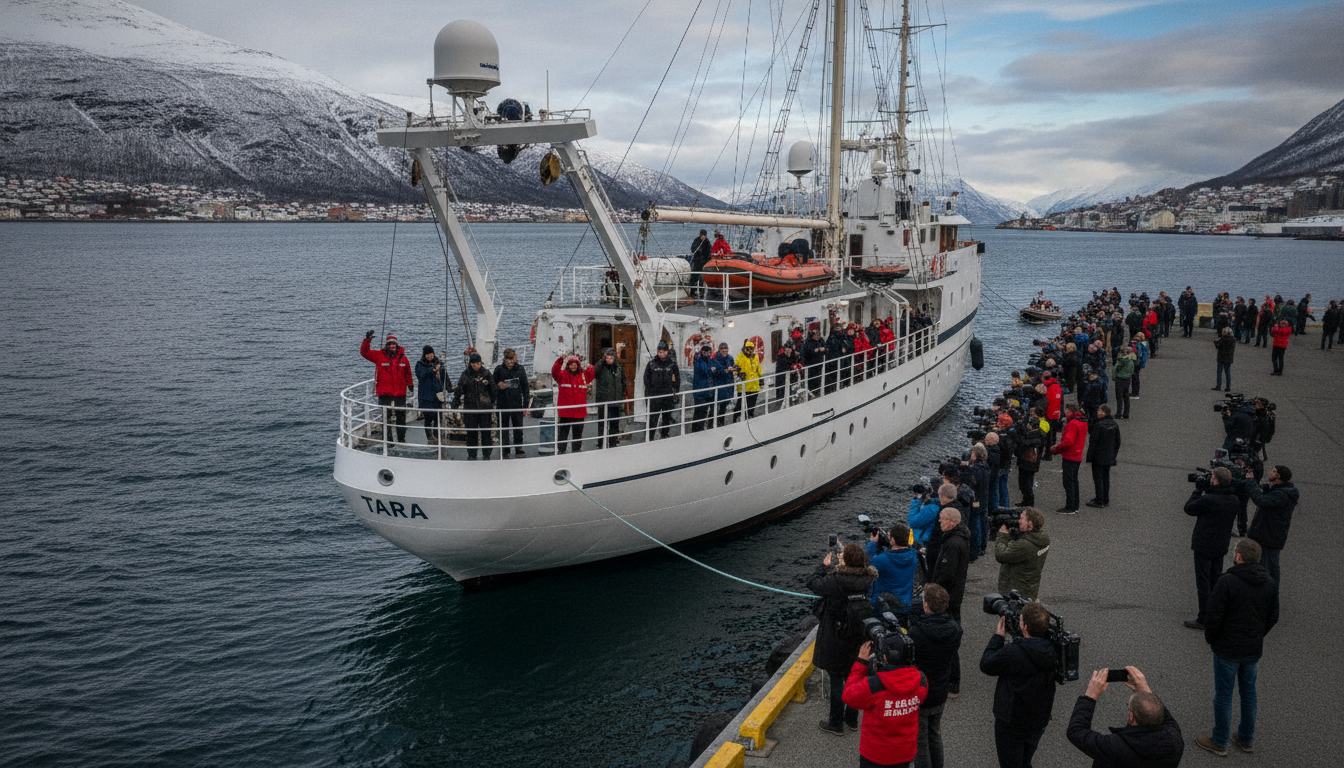
Tara Polaris Arctic expedition sets off from Tromsø for 20-year drift study
Tara Polaris Arctic expedition begins a multi-decade research program as a 27-metre French research vessel departs Tromsø to drift into central Arctic ice for long-term climate and biodiversity monitoring.
Opening voyage and mission timetable
The Tara Polaris Arctic expedition has left Tromsø, Norway, carrying a small, specialized team that will deliberately become locked in sea ice to study the central Arctic over the coming months. The 27-metre research vessel Tara Polar Station sailed from France on July 19, 2026, to Norway before beginning its planned drift into the Arctic pack ice.
This deployment is the first leg of a 20-year program that will return to the region every two years through 2046, creating a long-term observational record intended to capture seasonal and multi-year changes in a rapidly transforming polar environment.
Crew makeup and Canadian participation
A compact team of a dozen people will live and work aboard during the initial drift, combining seafaring crew with mission specialists and scientists. The on-board complement includes operational crew members, mission support staff and six scientists and engineers who will carry out fieldwork and laboratory protocols while the vessel is frozen into the ice.
Maxime Geoffroy, a researcher at Memorial University of Newfoundland’s maritime institute, is the lone Canadian participant on this first phase and will remain at sea for approximately eight months. He described the undertaking as both exhilarating and demanding, noting the logistical and human challenges of living in confined quarters for an extended polar winter.
Scientific aims and international coordination
The Tara Polaris Arctic expedition aims to fill major gaps in our understanding of the Arctic’s winter ecology by sampling when the region is typically inaccessible. Scientists behind the program say much of the existing research focuses on late summer conditions when sea ice is at its annual minimum; Tara Polaris intends to document the parts of the seasonal cycle that are currently under-sampled.
On board, a small science team will implement roughly 220 protocols developed by about 80 researchers on land, representing 13 countries and 30 international institutions. The coordinated effort is designed to integrate biological, chemical and physical measurements to build a more complete picture of how Arctic biodiversity and ecosystem processes are responding to accelerating climate change.
Operational plan: drifting and conducting work on the ice
Once the vessel reaches the central Arctic, mission planners expect to allow prevailing currents and ice movement to immobilize the ship in the floe, creating a drifting research camp. That drift approach enables scientists to collect time-series data across a range of ice and ocean conditions without repeated ship transits into an area that is difficult to access.
While frozen into the ice, the crew will establish workstations on the floe to deploy instruments, collect samples and maintain continuous observations. The approach mirrors historic polar drift campaigns but is notable for its scale and the breadth of protocols it will execute over consecutive years.
Hazards, training and safety protocols
The expedition team has trained extensively for extreme cold, isolation and emergency scenarios, including fire response on board and medical emergencies that may take days or longer to receive outside assistance. Temperatures in the central Arctic can plunge to minus 40°C or lower, and mission organizers have planned safety procedures to contend with those conditions.
Polar bears present a direct wildlife risk in the region, and the mission includes specific protocols to minimize encounters and respond if they occur. A Finnish Lapphund will accompany the team on the ice to provide early warning of approaching bears and to support morale during the long winter drift. A physician is part of the complement to manage health issues locally, reflecting the reality that external rescue could be delayed by weather and distance.
Long-term monitoring and scientific significance
By returning to the central Arctic every two years until 2046, the Tara Polaris Arctic expedition is intended to create a consistent, longitudinal dataset that can be compared across decades. Scientists say this long-term perspective is crucial to separate short-term variability from persistent trends driven by warming, sea-ice loss and ecosystem shifts.
Researchers involved hope the program will complement seasonal surveys and satellite observations by supplying in-situ measurements during under-sampled periods. Organizers argue that stitching together these “pieces of the puzzle” from multiple disciplines will improve models of Arctic change and inform global assessments of climate impacts.
The initial drift will test logistics and protocols for future campaigns, and mission leaders are measuring both scientific outputs and operational lessons that will shape subsequent deployments through the program’s 20-year horizon.
This first Tara Polaris Arctic expedition represents a rare commitment of time and resources to observe the central Arctic through the polar night, and its early findings are expected to inform understanding of rapid changes unfolding at Earth’s northern extremes.
