
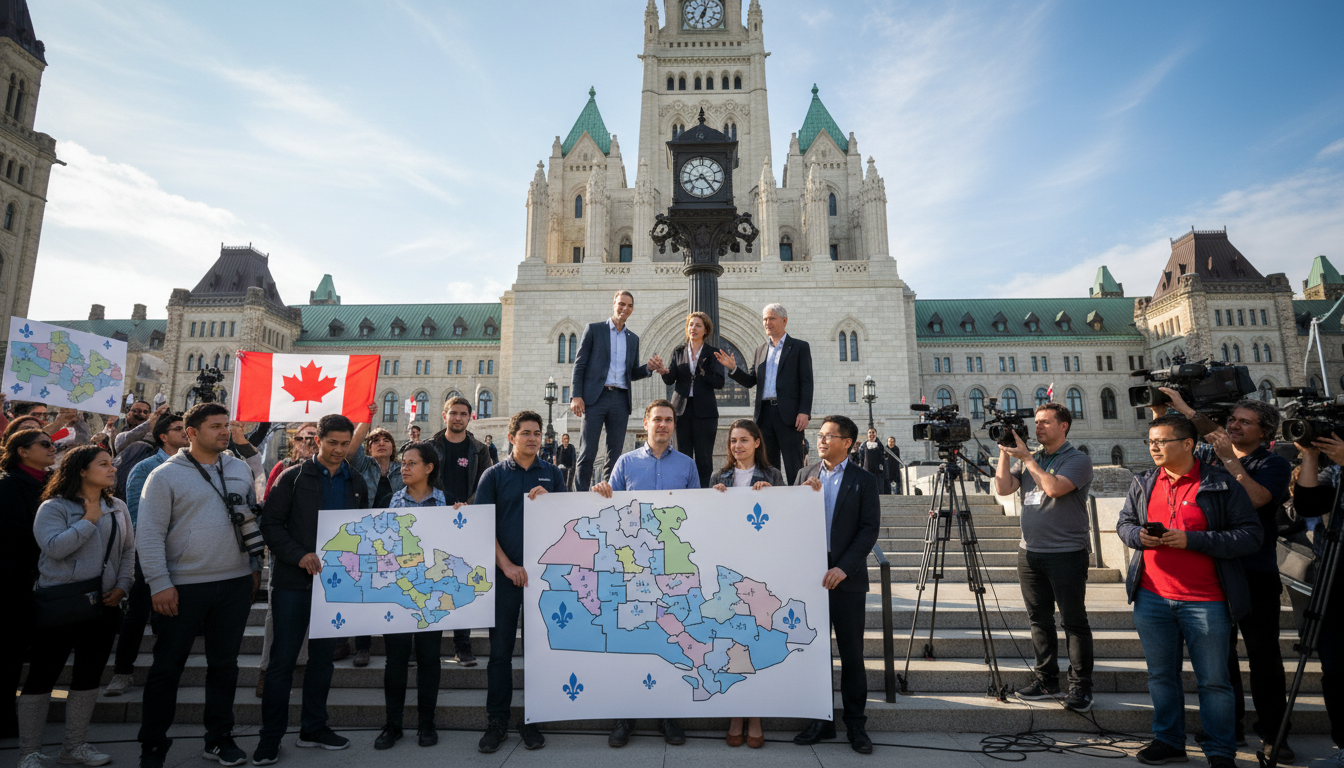
Supreme Court Upholds Quebec Electoral Map; New Boundaries to Take Effect July 14, 2026
Supreme Court rules the Quebec electoral map will come into force July 14, 2026, ending a months‑long legal dispute over redistricting and representation.
Supreme Court decision and immediate outcome
The Supreme Court of Canada on Wednesday, April 22, 2026, ruled that the Quebec electoral map drawn by the Directeur général des élections du Québec will take effect as scheduled on July 14, 2026. The bench delivered its ruling from the bench after closed‑door deliberations and announced that written reasons will follow at a later date. The decision resolves a constitutional and political dispute that had paused the implementation of the new boundaries.
The case was contested by the Attorney General of Quebec, backed by Ontario, Alberta and Saskatchewan, and the Conseil des préfets et des élus de la région des Laurentides. The Court’s ruling sides with the Laurentides council’s contention that the new configuration better addresses under‑representation in that region.
Background of the legal dispute
The challenge centered on the validity of “Law 59,” which briefly halted the redistricting process before Quebec’s Court of Appeal in December declared the law unconstitutional. That decision had left the status of the new map uncertain and prompted the Attorney General of Quebec to appeal to the Supreme Court. At issue were competing claims about parliamentary sovereignty, judicial review, and the proper role of courts in resolving electoral‑map disputes.
The Attorney General argued the matter fell within legislative prerogative and should not be decided by the judiciary, but the Laurentides council argued voters there were under‑represented under the current boundaries. The Supreme Court’s majority concluded the judicial review was appropriate and permitted the new map to proceed.
Key changes in the electoral map
The DGEQ’s redrawn map, unveiled in January, rebalances seats across regions by adding two constituencies in the Laurentides and two in the Centre‑du‑Québec. Those additions come at the expense of representation reductions in Gaspésie and parts of Montreal, while respecting the Electoral Act cap of 125 constituencies. The changes aim to reflect population shifts and to align seat distribution more closely with current demographic realities.
Electoral administrators must now prepare for the logistical steps required to implement the revised boundaries by mid‑July. That includes updating voter lists, notifying affected electors, and ensuring returning officers and parties have clear maps and materials ahead of the next scheduled election.
Political and regional implications
For residents of the Laurentides and Centre‑du‑Québec, the ruling is a tangible gain in representation that supporters say will improve access to elected officials. Conversely, communities in Gaspésie and Montreal will see their electoral weight reduced, a development likely to provoke political debate at both local and provincial levels. Parties and local officials will reassess campaign strategies in light of the changed electorate.
The decision also carries broader political weight because Quebec’s next provincial election must be held by October 5, 2026, under the Election Act. With the map confirmed, parties and independent candidates will have a compressed timetable to organize nominations and voter outreach under the new boundaries.
Reactions from government and regional actors
The Conseil des préfets et des élus de la région des Laurentides welcomed the ruling, asserting it vindicates claims of under‑representation and restores electoral parity for the region. The Attorney General of Quebec and the provincial government, having lost the appeal, indicated they will study the Court’s forthcoming written reasons to determine any further legal options or administrative adjustments. Federal‑provincial interveners that supported Quebec’s position — including Ontario, Alberta and Saskatchewan — framed the decision as a significant judicial determination on the limits of legislative autonomy.
Political parties in Quebec are expected to issue statements and prepare operational changes; candidates in affected districts will need to confirm nomination plans now that the legal uncertainty is resolved.
Timetable and steps before the next election
Election authorities have until July 14, 2026, to operationalize the new map, a schedule that requires targeted administrative work in the coming weeks. Voter registration notices, updated polling‑station assignments and candidate filings must reflect the revised boundaries to ensure a smooth transition. Elections Québec and the DGEQ will be responsible for public communications to explain boundary changes and their effects on where and how citizens vote.
The Supreme Court’s written reasons, when released, will be closely scrutinized for guidance on similar disputes and for any signals about the scope of judicial intervention in electoral matters. Stakeholders on both sides have indicated they will base planning and potential appeals on that forthcoming legal reasoning.
The Court’s ruling settles the immediate legal question and clears the way for the July 14 implementation, but it does not eliminate political debate over representation and how best to balance demographic change with regional fairness.
