
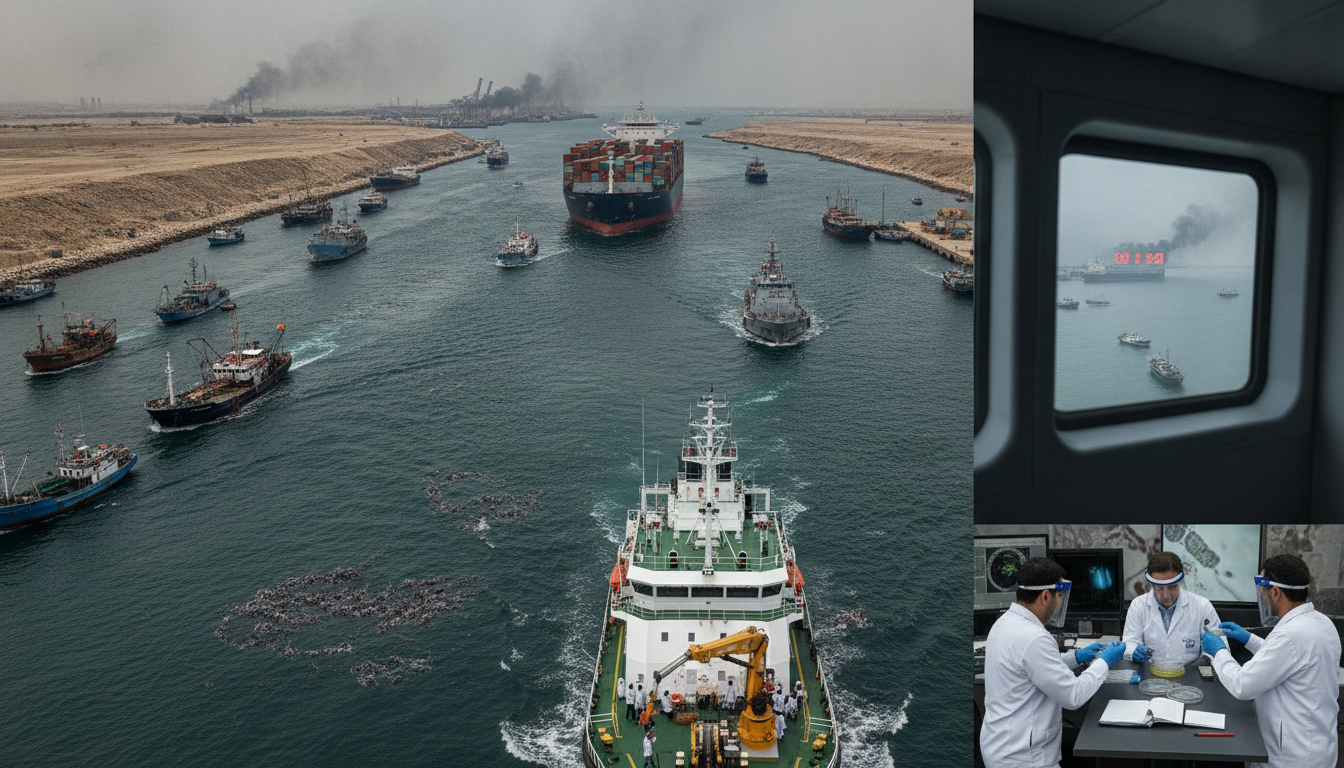
Strait of Hormuz closure sparks global biosecurity alarm over biofouling risk
Strait of Hormuz closure leaves thousands of vessels idle, raising biofouling and invasive species risks that could threaten global marine ecosystems and trade.
The prolonged Strait of Hormuz closure has left roughly 1,500 vessels trapped in the Persian Gulf with hundreds more stalled in the Gulf of Oman, prompting international scientists to warn of a mounting biosecurity threat. A study published in the journal Biological Invasions and interviews with marine experts link extended lay-ups to accelerated biofouling — the accumulation of marine organisms on ship hulls and external surfaces — which can ferry invasive species across oceans. Authorities and industry sources say the combination of vessel density, warm saline waters and extended idle periods compounds the risk of long-term ecological and economic damage.
Ships immobilized in Persian Gulf and Gulf of Oman
Maritime traffic through the region has been disrupted for weeks, and analysts estimate about 20 percent of global oil and gas shipments transit the Strait of Hormuz under normal conditions. The current stoppage has created crowded anchorages where ships remain stationary for weeks or months instead of the usual one to three days between port calls. That change in operational tempo increases the time organisms have to attach, grow and form reproductive populations on hulls and propellers.
Experts note that some vessels have been detained 20 to 40 times longer than typical port layovers, a factor that dramatically raises the likelihood of robust biofouling communities developing. Those fouling assemblages can include barnacles, tunicates and algae, many of which are known to survive transfer to new environments and outcompete local species. The sheer number of vessels and their close proximity create a concentrated source of potential invaders.
Recent study links lay-ups to invasive species spread
The peer-reviewed paper in Biological Invasions models how extended vessel immobilization in warm, saline waters can escalate the establishment probability of non-native species. Lead authors highlight that biofouling is an understudied vector compared with ballast-water discharge but can be equally consequential when conditions favour rapid organism growth. The study warns that unless cleaning procedures are implemented before ships depart, the current situation could seed ecosystems far beyond the Gulf region.
Researchers point to empirical data showing that organisms attached to hulls can survive long transits and detach or reproduce upon arrival in new ports. The study stresses that timely hull cleaning and targeted inspections would reduce transfer risk, but acknowledges logistical and safety constraints amid ongoing regional tensions. The authors call for coordinated international action to mitigate what they describe as a potential global biosecurity emergency.
Industry capacity and worker safety constraints
Clean-up firms say they lack the manpower and equipment to service thousands of vessels in a compressed timeframe, and operators are reluctant to delay commercial sailings for extensive hull maintenance. Dry-docking large numbers of ships is costly and time-consuming, while in-water cleaning can release concentrated biological material back into the surrounding waters if not properly contained. Companies that provide hull cleaning and de-fouling services warn that the scale of demand exceeds regional capacity.
Geopolitical instability also raises safety concerns for personnel tasked with cleaning operations. Experts warn that sending divers and technicians into contested or congested waters increases risk for crews and complicates logistics. As a result, many ships may depart with substantial fouling intact, effectively exporting the biological problem to distant ports and coastal habitats.
Historical precedents and species of concern
Marine invasions linked to shipping are not hypothetical: the zebra mussel’s arrival in North American waters through ballast releases in the 1980s transformed freshwater ecosystems and imposed large economic costs. In the marine context, tunicates and other sessile invertebrates have already caused problems for aquaculture and coastal infrastructure in regions like Atlantic Canada. Those species are resilient and, once established, exceptionally difficult to eradicate.
Scientists stress the particular vulnerability of temperate and cold-water regions to fouling species that thrive in warmer source waters when climate change shifts environmental thresholds. The combination of transported organisms and warming coastal waters increases the chance that invaders will gain a foothold and spread along shipping lanes and mariculture sites.
Regulatory gaps and international guidance
The International Maritime Organization updated guidance on biofouling in 2023, but there is no binding global regulation that mandates standardized hull-cleaning or inspection protocols comparable to rules for ballast-water management. Stakeholders say that patchwork national and port-level measures are inadequate for addressing large, sudden mobilizations of fouled vessels. Ongoing negotiation of new international measures seeks to close that regulatory gap, but experts caution that policy processes lag behind urgent operational needs.
Non-governmental organisations and industry groups are urging ports and flag states to adopt interim measures such as pre-departure hull inspections, containment protocols for in-water cleaning, and prioritization of high-risk vessels for dry-dock treatment. Implementing such measures will require rapid coordination, funding and clear liability frameworks to ensure compliance without further disrupting trade.
Implications for Canadian waters and aquaculture
Canadian scientists and coastal managers are watching the situation closely because invasive species carried on global shipping routes have previously affected Atlantic Canadian fisheries and shellfish farms. Species that tolerate warm and saline conditions in the Persian Gulf may not immediately thrive in colder waters, but changing ocean temperatures and shipping corridors increase the probability of establishment over time. Aquaculture operators are particularly alert to tunicates, which can smother farmed mussels and oysters and drive up maintenance costs.
Federal and provincial agencies may need to reassess surveillance and rapid-response plans if fouled vessels from the region arrive at Canadian ports. Enhanced monitoring at arrival points, targeted inspection regimes and contingency funding for containment could limit the local impacts of any introduced species.
The Strait of Hormuz closure has exposed a lesser-known pathway for biological invasions and highlighted the intersection of geopolitics, trade and environmental risk. Without swift, coordinated action to inspect and clean immobilized vessels, scientists warn that the global community could face long-term ecological and economic consequences as invasive marine species exploit disrupted shipping patterns.
