
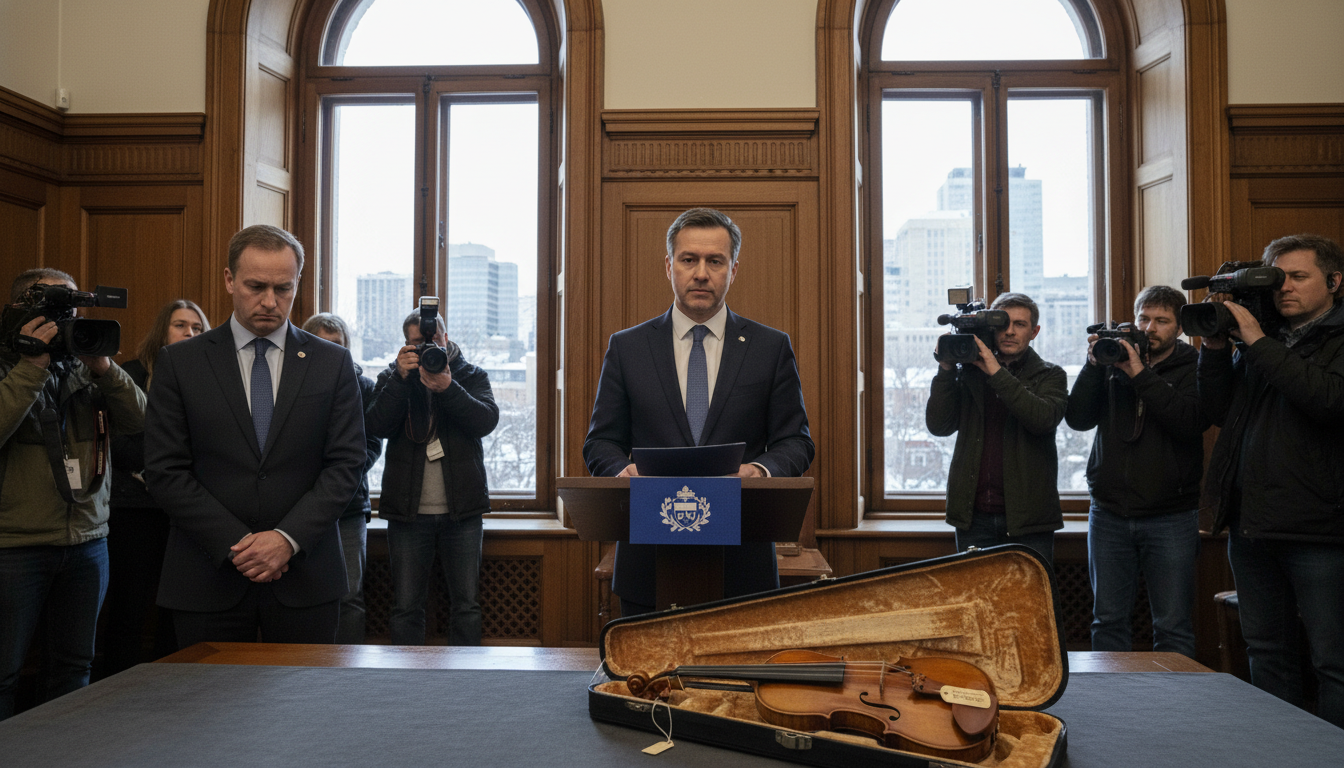
Quebec declassifies Stradivarius Des Rosiers despite heritage council objections
On April 17, 2026 Quebec declassified the Stradivarius Des Rosiers and its Tourte bow, overriding the heritage council’s warnings about cultural loss and export risk.
The decision to remove the Stradivarius Des Rosiers and the Tourte bow from Quebec’s inventory of protected heritage objects has raised immediate concern among preservationists and musicians. The Conseil du patrimoine culturel du Québec formally advised against the move, arguing the declassification would place an instrument of national significance at risk of sale abroad or conversion to a museum piece. The minister’s office says the step corrects a historical anomaly, but critics warn of a precedent that could affect other listed artifacts.
Council warned declassification would enable foreign sale or muséification
The heritage council delivered a written opinion to the minister during the declassification process launched on September 12, 2025. In that submission, the council said lifting protection would potentially allow the instrument to be transferred out of active musical use and into private collections overseas. The council argued the instrument’s public purpose — to be played by and support Quebec violinists — would be undermined if it became merely a collectible.
The advisory documents, obtained by media under access-to-information requests, framed the proposed declassification as a serious loss for Quebec’s living musical heritage. The council also noted it had received letters and requests for hearings from both the public and specialists, reflecting broad engagement from the cultural sector.
Historic purchase and original public mandate
The Stradivarius Des Rosiers and the Tourte bow entered the province’s cultural story through a public subscription in the 1940s and financial backing from businessman Ludger Simard. That campaign was explicitly intended to place a world-class instrument in the hands of leading Quebec violinists rather than allow it to disappear into private ownership. The council and several music historians say declassification would betray that philanthropic intent and the instrument’s public mission.
Over the decades the instrument was associated with prominent performers, including Arthur LeBlanc, and later Angèle Dubeau, who has been publicly identified with the violin for many years. Experts emphasize that rare instruments like this function as tools for career development for promising artists and as symbols of collective cultural investment.
Value and market pressures heighten risk
Appraisals attached to the council’s opinion place the Stradivarius Des Rosiers’ market value between CAD 15 million and CAD 30 million. That escalation in price, witnesses and experts told the council, has intensified competition from private collectors and international buyers. Ethnomusicologists and conservators warned that runaway prices make exceptional instruments less accessible to emerging professional musicians and more attractive to investors.
Those concerns underline a familiar tension between cultural stewardship and market dynamics, with critics saying declassification would open the door to a permanent shift in how the instrument is used and who benefits from it.
Legal and administrative history behind the instrument’s status
The instrument’s classification dates to 1977, when Gertrude Leblanc moved to protect it after actions that risked export or private sale. Administrative records show the classification became effective on September 2, 1977, and later transactions concerning ownership were permitted on condition that the restrictions tied to the historic designation be respected. A sale recorded in 1984 was carried out with retroactive effect to a 1978 agreement, adding complexity to the chain of title and the obligations attached to the violin.
The minister’s office has pointed out that the instrument ultimately came to be owned and maintained by Angèle Dubeau, who, according to officials, was declared sole owner by a court and paid for upkeep and insurance during her career. Heritage advocates say those legal outcomes do not erase the moral and public expectations embedded in the original fundraising and classification.
Minister’s office cites correction of an anomaly
Quebec’s Culture Ministry framed the April 17, 2026 decision as a reasoned response to a historical irregularity, noting the instrument’s eventual acquisition by a private musician and subsequent judicial recognition of that ownership. The cabinet statement also emphasized that Dubeau personally financed maintenance and insurance costs throughout her career, signaling a shift from the original collective ownership model.
Still, the Conseil du patrimoine culturel urged that any change be treated as exceptional and handled with extreme caution because it could create a precedent affecting the wider provincial heritage framework. The council recommended measures to preserve public access and to explore mechanisms that keep exceptional instruments in active musical use.
Calls for protections and a musical instrument bank
In its advice the council proposed concrete steps to limit future harm, including the creation of a provincial or national instrument bank modeled on existing programs that loan high-quality instruments to promising artists. Such a mechanism would aim to reconcile private ownership realities with the public interest in maintaining instruments in active performance circulation. The council also underlined the importance of recognizing the philanthropic origins of the acquisition and protecting that legacy.
Advocates say a formal lending program could secure access for young and mid-career musicians who require superior instruments to compete internationally, while reducing the incentive for rare instruments to be sold to private collectors overseas.
The minister’s declassification of the Stradivarius Des Rosiers and the Tourte bow on April 17, 2026 has set in motion a debate about cultural stewardship, market forces and the obligations tied to historically protected objects. The heritage council’s objection and its recommendations now form part of the public record and are likely to shape follow-up questions about whether safeguards will be introduced to keep exceptional instruments available to Quebec’s musical community.
Radio-Canada reported the council received multiple letters and hearing requests from academics, musicians and heritage groups, and the ministry says it considered the historical and legal context before acting. Angèle Dubeau was asked for comment about any possibility of sale or future plans for the instruments but had not provided a response at the time of reporting.
