
Belgrade student protests draw tens of thousands demanding early elections after Novi Sad rail disaster
Belgrade student protests on May 23, 2026 drew tens of thousands demanding early elections after the Novi Sad rail disaster, prompting EU concern and alarm.
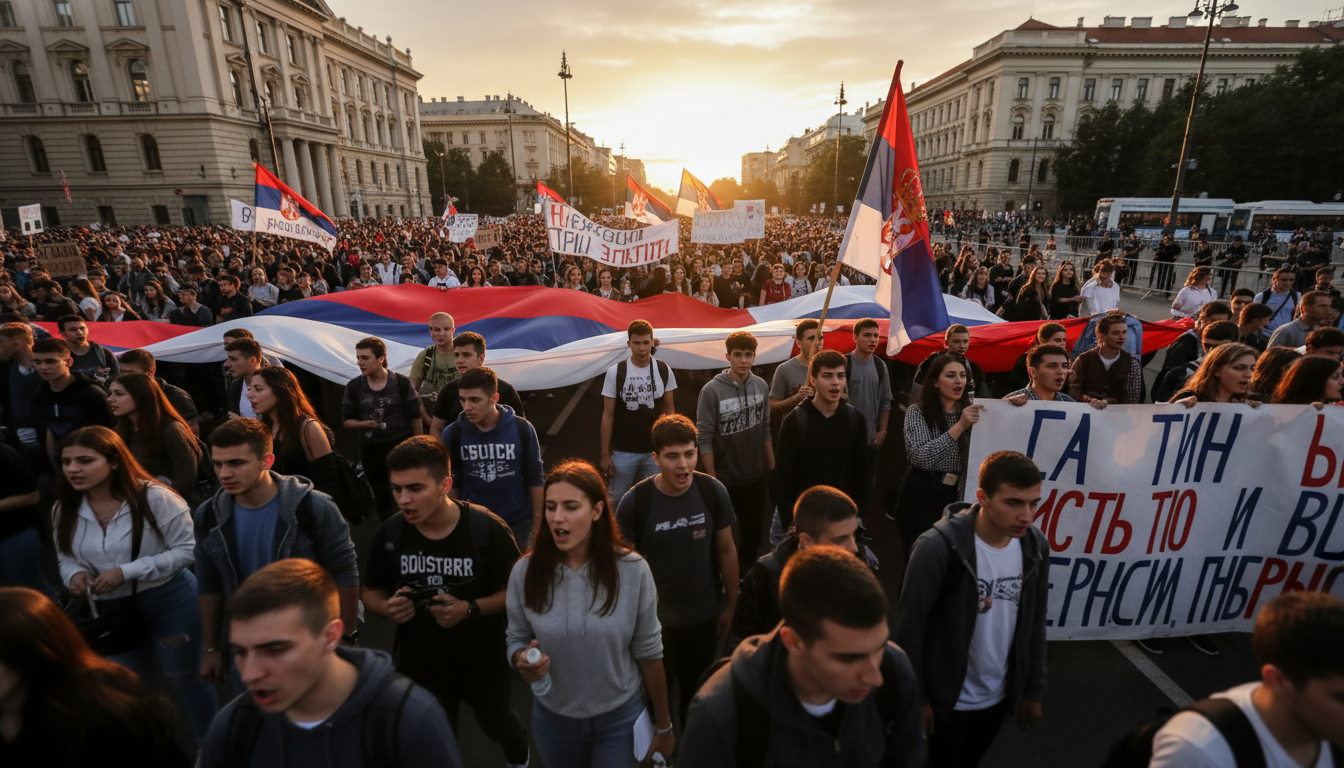
Tens of thousands of people, led by university students, filled central Belgrade on May 23, 2026 in a mass demonstration that sought to force early national elections and press for accountability after a fatal rail accident in 2024. The Belgrade student protests, anchored at Slavija Square, brought banners, chants and a visible youth presence that organisers say represents a broader anticorruption movement across Serbia. President Aleksandar Vučić has resisted calls for an immediate vote but acknowledged the possibility of a ballot between September and November 2026.
Students lead mass rally in Belgrade
The crowd converged on Slavija Square from multiple directions, with students wearing shirts and carrying placards stamped with the movement’s slogan, "Students win." Columns of cars and buses arrived from provincial towns, underscoring the turnout’s national reach and the protesters’ organisational reach beyond university campuses.
Organisers framed the day as peaceful and civic in tone, but authorities prepared for potential clashes after past confrontations. Protesters said their focus is political change through elections, while emphasising nonviolent tactics and the desire for transparent public institutions.
Movement traced to Novi Sad rail disaster
The student-led mobilisation traces its origins to the collapse of a station canopy in Novi Sad in November 2024 that killed 16 people and fuelled public outrage over safety and alleged official negligence. That tragedy sparked widespread anticorruption demands and prompted the resignation of then-Prime Minister Miloš Vučević, a moment that galvanised youth activism nationwide.
Students and civic groups say the protests are aimed at securing a full, transparent investigation of the disaster and at broader reforms to curb corruption and politicisation in state institutions. What began as targeted demands has broadened into a campaign pressuring the presidency and government for an early electoral reset.
President Vučić and government response
President Aleksandar Vučić has publicly denounced the protest movement and used forceful rhetoric against critics, framing some opponents as foreign-backed or intent on destabilising the country. In response to the rallies, pro-government supporters established a park camp near the presidency in a show of solidarity, creating a sharply polarised public scene.
Vučić has said publicly that elections could be held between September and November 2026, a window that protesters interpreted as insufficiently concrete given their push for an immediate timetable. Government and state-aligned media have frequently portrayed demonstrators as radicals, heightening political tensions ahead of any potential vote.
International and EU implications
The demonstrations have drawn attention from European institutions and human rights monitors, who have voiced concern about state conduct and the protection of civic freedoms. The Council of Europe’s human rights office signalled it would follow developments closely after criticism of how authorities have handled certain protest episodes.
Belgrade’s bid to join the European Union remains a key diplomatic priority, but the EU has warned that democratic backsliding could jeopardise substantial funding and accession prospects. Brussels officials have cautioned that erosion of rule-of-law standards may put roughly 1.5 billion euros in aid and pre-accession assistance at risk if reforms stall.
Security, logistics and turnout
State rail authorities cancelled all trains to and from Belgrade on the day of the rally, a move interpreted by organisers as an attempt to impede nationwide participation. Police presence around Slavija and along major access routes was heavy, with riot units deployed to deter potential violence between rival groups.
Pro-government supporters, some masked and organised, staged a separate camp and festivities near the presidency, creating a charged environment and raising fears of skirmishes. Protesters insisted on a peaceful demonstration, but memories of a disrupted mass rally in March 2025—when participants later alleged the use of an unknown sonic device—kept security concerns high.
Students and civil-society actors say they will keep pressure on authorities through street mobilisation and by seeking to convert public support into electoral leverage. Journalists and analysts in Belgrade note the movement’s broad appeal, but also point to its lack of a singular political platform or a clear, unified leadership capable of negotiating an immediate transition.
The coming months will test whether the student movement can translate protest energy into formal political pressure that changes election timing or outcomes. With the presidency signalling a possible autumn ballot and international observers watching closely, Serbia faces a period of heightened domestic contestation and diplomatic scrutiny.
