
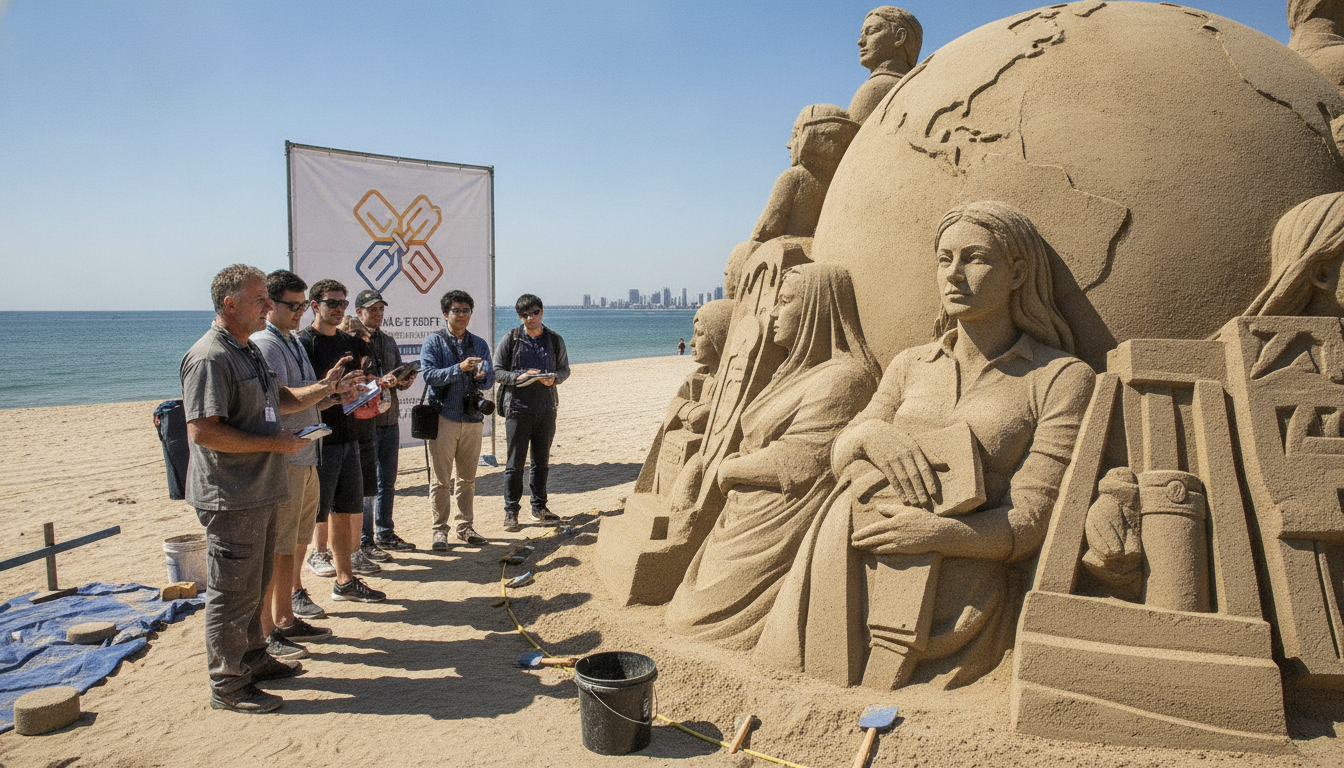
Sand art community narrows roles as festivals, tourism and regulation shape work
Sand art community of a few hundred specialists hires by skill for portraits, architecture and events, balancing creative demand with environmental limits.
Strong opening paragraph summarizing the news event.
The sand art community — often described by practitioners as tight-knit and small — is increasingly defined by specialization and short-term hiring tied to festivals, tourism and commissioned projects. Sand art remains a niche craft, and its practitioners say there are only a few hundred active professionals who regularly work at a commercial or competitive level. Artists are selected for particular jobs based on distinct skill sets, from portraiture and animal figures to lettering and large-scale architectural recreations. That selection process is shaping who gets work and how the craft evolves.
Small Community Shapes Global Sand Art Scene
Practitioners say the sand art field functions like a networked guild, where reputation and proven ability matter more than formal credentials. Croft, a long-time sand sculptor, noted that artisans know each other and collaborate or subcontract based on the demands of a project. Many artists travel between seasonal festivals and private commissions, creating a fluid labour market that relies on word-of-mouth and past performance. That close-knit environment both supports collaboration and concentrates opportunity among well-known names.
This small scale gives the community advantages and constraints at once. On one hand, tight networks enable rapid crew assembly for complex builds and ensure quality control. On the other hand, limited numbers mean competition for headline slots at major events remains fierce, and newcomers often must prove themselves through volunteer work or smaller contests.
Specialization Determines Who Gets Hired
Sand artists report that hiring decisions are job-specific and skill-driven rather than generalist. Event organizers and clients recruit specialists for portraits, realistic animals, typographic work, or structural illusion, depending on the visual brief and audience. Croft explained that not every sculptor can master every style, so teams are assembled with complementary talents to meet complex briefs. This matching of skills to tasks has become standard practice among established sand art crews.
The rise of social-media-driven briefs has increased demand for eye-catching, photographable pieces, elevating certain specialities. Sculptors who excel at close-up realism or dynamic figures tend to be first choices for promotional work, while those adept at scale and perspective attract architectural and installation commissions. Consequently, training and portfolio diversity can make the difference between steady seasonal work and sporadic gigs.
Events and Festivals Drive Work Opportunities
Seasonal festivals, coastal competitions and corporate events remain the primary revenue engines for many sand artists. Organizers hire teams for weeklong builds, public demonstrations, and judged contests that often carry prize money and media exposure. The festival calendar dictates much of the movement in the community, with artists shuttling between summer events and private commissions during shoulder seasons. Those events also serve as live auditions where lesser-known sculptors can gain recognition.
Tourism boards and municipal partners increasingly use sand art as a draw to boost beachfront visitation and cultural programming. That partnership opens new funding streams but also raises expectations for polished, durable displays that attract social media shares. In turn, artists must balance creative ambition with logistical demands such as timelines, public safety and site preparation.
Technical Skills Behind Portraits and Architecture
Creating credible portraits and architectural forms from sand requires a suite of tools and techniques that differ from casual beach carving. Sculptors rely on compaction methods, armatures in some large pieces, and the selective use of additives where permitted to achieve fine detail and structural integrity. Artists who specialize in portraiture emphasize surface texture, eye detail and proportional accuracy to capture likenesses in an ephemeral medium. Those who build architectural illusions focus on perspective, shadows and scale to create convincing three-dimensional scenes.
Because not all practitioners possess every technical skill, crews are commonly assembled with roles defined by expertise: detail sculptors, form builders, shapers and finishers. This division of labour speeds construction and improves finished quality, which is crucial for judged competitions and commissioned displays meant to last through an event.
Regulation, Environment and the Future of Sand Work
Environmental considerations and municipal regulations are increasingly shaping how and where sand art can be produced. Many jurisdictions restrict sand extraction and dune disturbance to protect coastal ecosystems, forcing artists and organizers to seek approved sources and work within tighter footprints. These rules add logistical and sometimes financial complexity, but proponents argue they are necessary to preserve beaches for public use and biodiversity. Artists are adapting by using imported sand mixtures, temporary barriers, or by staging installations on permitted grounds.
Long-term prospects for the craft hinge on a balance among creative ambition, environmental stewardship and economic viability. As festivals and tourism partners look for sustainable models, some artists are diversifying services to include workshops, corporate branding events and indoor sand installations. That diversification helps build year-round income streams while reducing pressure on fragile coastal sites.
Final paragraph without a title.
As sand art continues to attract audiences, the community’s reliance on specialization, festivals and careful site management will likely intensify. Practitioners say that maintaining high standards and working within environmental limits are essential to keeping the field viable for the next generation of sculptors. The craft’s future will depend on how well artists, event organisers and regulators coordinate to protect both the beaches and the livelihoods that depend on them.
