
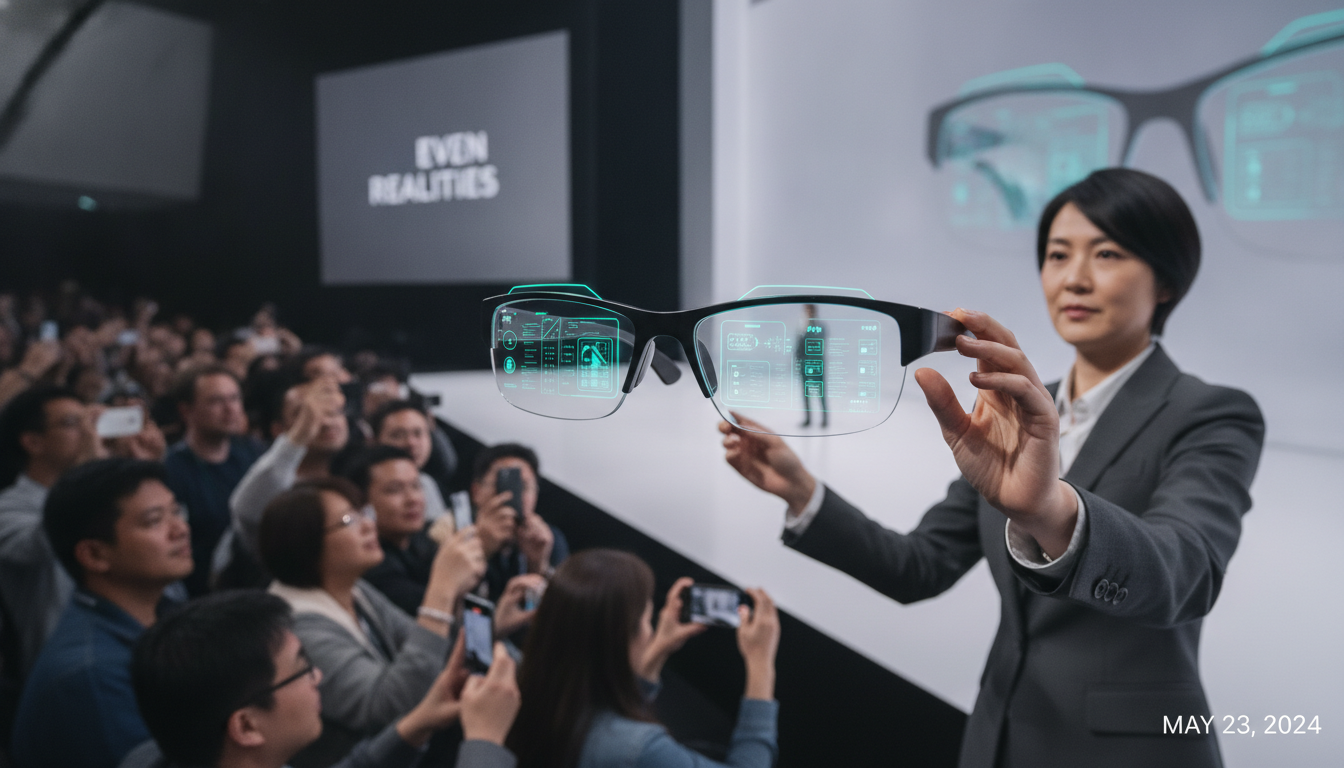
Even Realities G2 smart glasses blend bright neon HUD and privacy-first design but struggle with app dependability
Even Realities G2 smart glasses combine a neon-style heads-up display with productivity tools and a privacy-focused design, yet app reliability and voice-assistant hiccups temper the experience.
Summary of the G2 launch and positioning
Even Realities has positioned the G2 smart glasses as a productivity-first wearable aimed at professionals who need glanceable information without cameras or speakers. The G2 improves on the company’s first generation with a brighter display, more microphones and a substantially larger visible area. Company messaging emphasizes business and travel use cases — meetings, presentations and on-the-go translation — rather than social or camera-centric features.
Design, weight and build materials
The G2 frame is notably light, weighing about 35 grams, and is built from magnesium alloy with titanium-alloy temples for added strength and comfort. Two frame styles are offered to suit different wearer preferences, and integrated lenses include UV protection so the glasses function outdoors as well as indoors. The supplied protective case is robust and roomy, making it impractical for a pocket but effective for storage and recharging on the go.
Display upgrades and battery claims
Even Realities upgraded the optics for the G2: the monochrome neon-style HUD now pushes higher brightness and a smoother refresh rate than the original model. The company reports a 1,200-nit peak and a 60Hz refresh rate, plus a display area that’s substantially larger than the G1’s. Battery life is marketed at up to two days with typical use, and the charging case is rated to recharge the glasses multiple times before the case itself needs power. In real-world testing the battery proved serviceable for daily sessions, though individual results will vary with feature use.
Controls, assistant and real-time translation
Controls are primarily located on the temple stems, where single and double taps summon dashboards for schedules, news and notifications. Long-press options reveal a suite of features — Translate, Conversate, Teleprompt and Navigate — driven by the company’s Even AI assistant. Translation worked well enough in live demonstrations to let users follow Mandarin, French and Spanish exchanges, and a prep-notes capability can surface context-specific prompts during conversations. However, the voice assistant suffers from recognition errors outdoors and occasionally fails to activate, undermining reliability in noisy environments.
App dependency and navigation limitations
The G2 is intentionally lightweight on onboard compute and depends heavily on a companion phone app for many functions, a design choice that leaves core features vulnerable to connectivity and software issues. Early firmware and app releases produced frequent disconnects that improved after several updates, but notification pop-ups and mapping remain inconsistent. The built-in Navigate feature shows turn-by-turn cues on the HUD, yet it requires routes to be created within the Even Realities app rather than integrating with mainstream mapping services, which can cause address errors and reduce usefulness for unfamiliar routes.
R1 ring accessory and value proposition
Even Realities offers an R1 smart ring as an optional controller and health tracker, adding touch-based inputs plus metrics like heart rate and SpO2. The ring functions reliably as a remote, but its duplication of stem controls and its $249 price point raise questions about necessity for most buyers. Users already invested in dedicated health rings or wrist-worn trackers may find the R1 redundant, and the lack of an on-ring microphone limits its appeal as a full replacement for on-device controls.
Market fit and the road ahead
At $599, the G2 sits in a growing field of consumer smart glasses that range from camera-equipped lifestyle models to more productivity-oriented devices with head-mounted displays. By excluding cameras and speakers, Even Realities has narrowed potential privacy concerns and targeted professionals who prioritize discreet, glanceable information. The hardware improvements are tangible, but broader adoption will depend on tighter app integration, more robust voice processing in noisy settings, and a richer set of first-party apps that make the glasses indispensable rather than optional.
Early software updates indicate the company is responsive to connectivity problems, but several features still feel like works in progress rather than polished tools. For users whose workflows require live translation, teleprompting or persistent glanceable reminders, the G2 is compelling; for casual buyers seeking a daily wearable, the use-case is less certain until software and third-party support expand.
Even Realities appears to be betting that privacy-first, productivity-focused wearables will find a dedicated audience, but the G2’s ultimate success will hinge on the company’s ability to make the glasses reliable and useful enough that people reach for them every day.
