
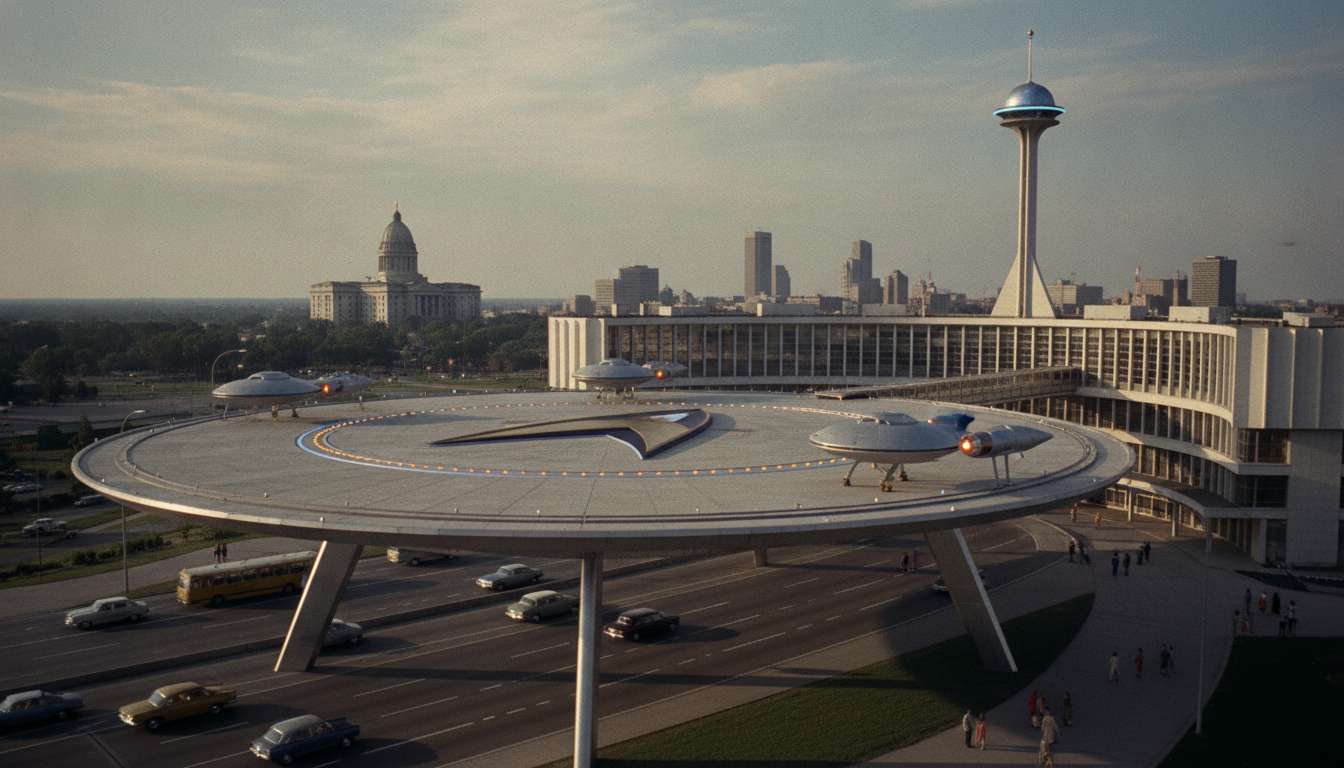
St. Paul landing pad: Alberta town’s 1967 space‑age structure recalls Star Trek era
St. Paul landing pad built in 1967 for Canada’s centennial remains a space-age Alberta landmark, a relic of Star Trek-era optimism and federal funding.
The St. Paul landing pad, erected in 1967 as part of Canada’s centennial projects, continues to draw attention for its retrofuturistic design and cultural resonance. Located about 185 kilometres northeast of Edmonton, the small northeastern Alberta town still points to the structure as a visible reminder of mid-20th-century aspirations. The landing pad’s association with space-age imagery has led residents and visitors to liken it to scenes from popular science fiction, including Gene Roddenberry’s Star Trek.
St. Paul’s 1967 landing pad marks a centennial initiative
The landing pad was one of several projects financed after St. Paul received federal centennial grant money in 1967. Municipal leaders at the time sought projects that would symbolize progress and civic pride as Canada marked its 100th anniversary. The finished structure embodied the optimistic architectural language of the era, aiming to look forward rather than back.
The site has remained part of the town’s landscape for decades and functions now as both a historical marker and a conversation starter. Locals report that the landing pad is often photographed and mentioned in regional guides that highlight unusual roadside attractions.
Federal funding shaped local visions of the future
Centennial grants from the federal government enabled towns like St. Paul to pursue civic improvements they otherwise could not afford. The financial support allowed municipalities to invest in public works, community centres and symbolic installations intended to commemorate the centennial. For St. Paul, the landing pad served as a tangible product of that era’s policy and cultural investment.
The federal role in financing these projects also meant that small towns could link local identity to national celebration. That connection has influenced how St. Paul frames its heritage and public storytelling about the 1960s.
Design and cultural context recall the Space Age
The landing pad’s form reflects popular design trends of the 1960s, when aerospace imagery and futuristic motifs permeated architecture and public art. Space-age aesthetics often used clean lines, circular shapes and metallic accents to evoke technological progress. Observers say the St. Paul structure channels that same visual vocabulary.
The timing coincided with the early years of televised science fiction; Gene Roddenberry’s Star Trek was in its second season in 1967 and helped shape public imaginations about technology and the future. While the landing pad was not created as a direct tie-in to any television show, many people today read the era’s cultural references into the build and its continuing local legend.
Local identity and public reaction over decades
Residents of St. Paul have treated the landing pad as part relic, part mascot, and part curiosity. Some embrace the structure as a charming example of mid-century optimism; others see it as an anachronism that signals the town’s enduring link to a specific historical moment. Tourism materials sometimes lean into the space-age angle to attract visitors traveling through northeastern Alberta.
Community groups occasionally use the pad as a backdrop for events, photographs and heritage promotions, highlighting its role beyond mere architecture. The structure is woven into local narratives about how St. Paul responded to centennial funding and how small towns interpreted national celebrations.
Condition, preservation questions and tourism potential
The landing pad’s physical condition varies by component, and its long-term maintenance has depended on municipal budgets and local priorities. Preservation advocates note that structures like this can be inexpensive to maintain yet valuable for cultural tourism when marketed thoughtfully. There is potential to integrate the pad into broader heritage trails that spotlight centennial-era projects across Alberta and Canada.
At the same time, any preservation or interpretation effort would require clear planning, modest investment and community consensus about the feature’s value. Town officials and volunteers would need to balance upkeep with other infrastructure demands while deciding how prominently to position the landing pad in St. Paul’s cultural portfolio.
Historical memory and mid-century optimism in small-town Canada
The landing pad stands as a material signifier of the 1960s belief in technology and national celebration. Projects funded through centennial grants across Canada sought to leave visible, lasting marks on communities of all sizes. In St. Paul, that legacy endures in a compact, somewhat whimsical structure that invites conversation about past expectations for the future.
For residents and visitors who view it as more than a curiosity, the site offers a lens on how federal policy, local ambition and popular culture intersected during a pivotal year in Canadian history. The landing pad is thus both an artefact and a prompt to consider how communities choose to remember moments of national importance.
As St. Paul continues to navigate economic and cultural priorities, the 1967 landing pad remains a durable piece of civic memory and a reminder of an era when looking forward meant imagining rockets, explorers and new horizons.
