
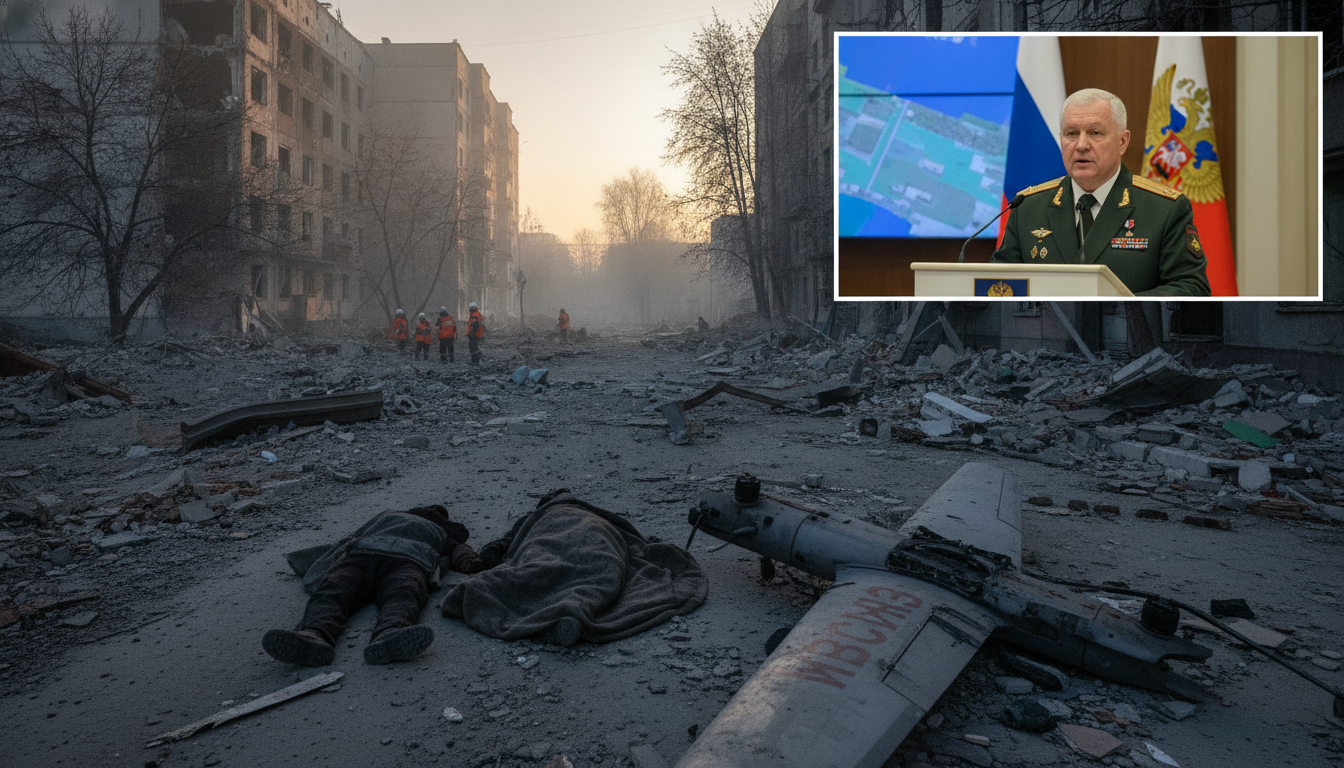
Russia says air defences shot down 635 Ukrainian drones overnight; two killed in Saratov
Russia claims its air defences downed 635 Ukrainian drones overnight, with two civilians killed in the Saratov region as Kyiv and Moscow trade long-range strikes. The surge in unmanned aerial activity and missile launches underscores a recent escalation in attacks on both sides.
Russian military statement on intercepted UAVs
The Russian Defence Ministry said its air-defence systems intercepted and destroyed 635 fixed-wing unmanned aerial vehicles over several regions and Crimea during the night. The claim was posted on state-controlled messaging channels, where Moscow characterized the operation as a broad defensive success.
Russian officials presented the figure as an indication of the scale of the threat they say came from Ukrainian forces. Independent verification was not available at the time of the statement, and the claim was couched as an official accounting rather than an independently confirmed tally.
Casualties reported in Saratov region
Saratov’s governor announced that two people were killed in the region after a drone strike, offering condolences and saying the families would receive assistance. Local authorities provided no further immediate details about the victims or the exact location of the strike.
Regional officials attributed the deaths to an “enemy drone attack” and said emergency services were responding to damage at the scene. The announcement followed Moscow’s broader account of intercepted Ukrainian drones across multiple regions.
Reciprocal strikes on Russian and occupied sites
Ukraine has increased strikes on targets inside Russia and on territory it says is occupied by Moscow, focusing recently on energy infrastructure, storage facilities and logistics hubs. Recent attacks reported by Kyiv and various international outlets have included strikes on refineries, fuel depots, and warehouse sites belonging to commercial entities.
Both sides have framed these operations as retaliation or pre-emptive measures, contributing to a pattern of tit-for-tat long-range attacks that have increasingly affected civilian infrastructure. Officials in Kyiv have said such strikes aim to degrade the logistics and supply lines Moscow relies on for its offensive operations.
Night of missiles and drones: official tallies differ
Ukraine’s air force reported that during the same period Russia launched 35 ballistic missiles and 185 attack drones against Ukrainian territory. Kyiv’s military said it intercepted two missiles and 154 drones, underscoring heavy defensive activity on both sides of the conflict.
The discrepancy between Russian claims of hundreds of Ukrainian drones destroyed and Kyiv’s count of incoming weapons highlights the challenge of independently confirming totals amid active combat. Both nations have relied on military briefings and regional governor statements to describe the scale of the strikes.
Fighting persists in the Donbass and beyond
Analysts say the exchange of long-range strikes has intensified even as ground fighting around the last contested towns in the Donbass grinds on. Moscow has continued to press for control of industrial areas in eastern Ukraine, while Kyiv resists and conducts operations aimed at disrupting Russian supply and command nodes.
The intensification of aerial and missile attacks has resulted in rising civilian casualties and infrastructure damage, according to regional reports from both Ukrainian and Russian-controlled areas. Observers note that as front lines remain contested, the strategic logic behind extended-range strikes has expanded beyond purely military targets.
Diplomatic efforts and requests for air-defence systems
Diplomatic mediation led by the United States has reportedly been stalled since late February, and Kyiv has repeatedly called for greater Western support, particularly additional air-defence systems. Ukrainian President Volodymyr Zelensky and other officials argue that more anti-aircraft capability is necessary to protect cities and critical infrastructure from missile and drone strikes.
Western governments have varied in the pace and scale of military aid, and discussions over the supply of advanced air-defence batteries remain politically sensitive. Kyiv’s appeals emphasize the civilian cost of the barrage and the need to reduce the ability of long-range strikes to inflict casualties and destruction.
The reported downing of 635 Ukrainian drones, if confirmed, would mark one of the largest single-night tallies of unmanned systems destroyed in the conflict, and it underscores how drones and missiles have become central to the campaign strategy on both sides. Continued exchanges of strikes are likely to keep pressure on emergency services, air-defence units and diplomatic channels in the days ahead.
