
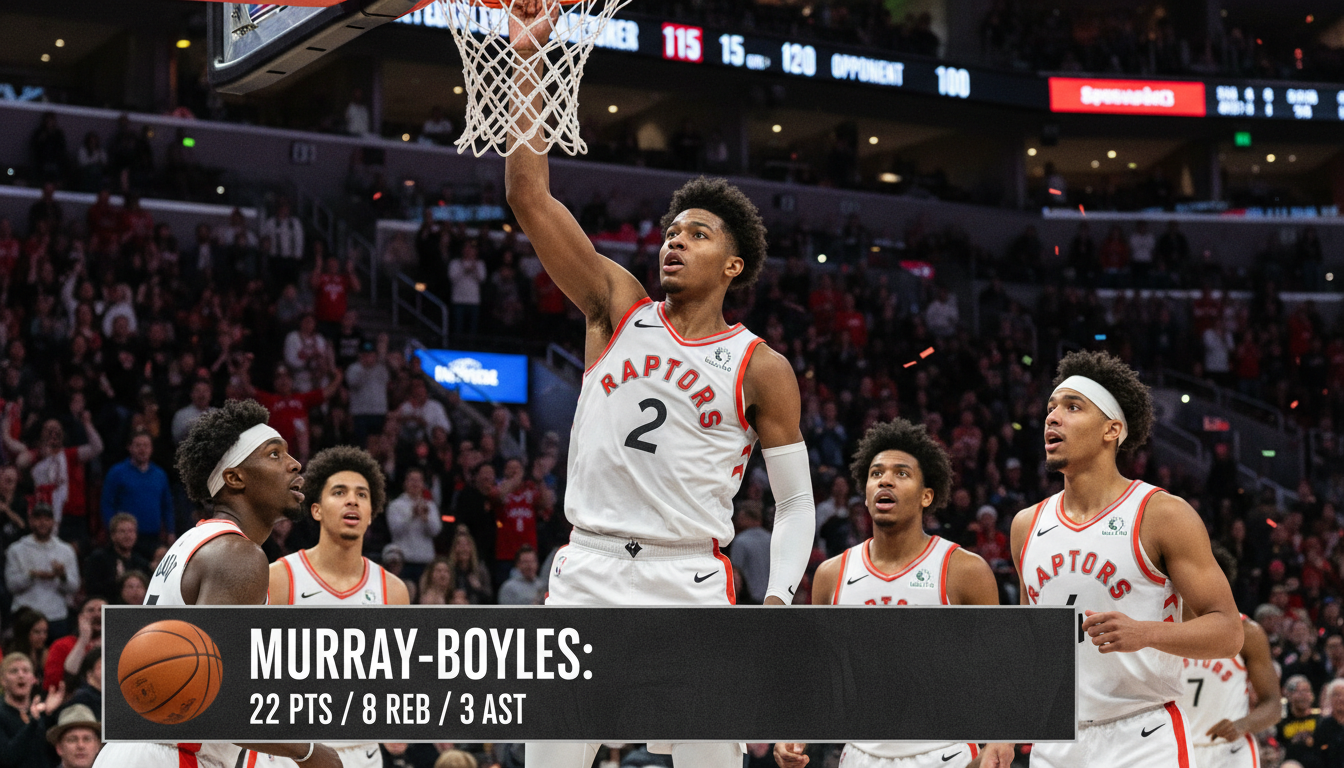
Collin Murray-Boyles Emerges as Raptors’ Playoff Catalyst with 22-Point Game 3 Performance
Raptors rookie Collin Murray-Boyles delivered a breakout 22-point performance in Game 3, staking his claim as a two-way force and shifting Toronto’s playoff dynamics. The 20-year-old’s aggressive rebounding and defensive activity gave the Raptors a decisive edge in a lopsided win over Cleveland. This game marked a defining moment for the young forward and a tangible example of how roster depth is reshaping Toronto’s postseason identity.
Rookie sets new Raptors playoff scoring benchmark
Murray-Boyles finished Game 3 with 22 points on efficient shooting, surpassing previous single-game playoff highs for a Raptors rookie. His scoring came with a 11-of-15 shooting night that combined finishing, putbacks and timely shots off the ball. That efficiency allowed Toronto to sustain pressure late in the contest and convert opportunities into a growing lead.
Beyond the point total, the rookie’s stat line included several momentum-shifting plays, which translated into a larger impact than the raw numbers suggest. Teammates and coaches repeatedly pointed to his physicality and willingness to dive for loose balls as decisive elements in the win.
Defensive impact altered Cleveland’s attack
Toronto’s defensive profile improved noticeably with Murray-Boyles on the floor, as Cleveland’s rim attempts and paint frequency declined. The rookie’s presence accelerated turnovers and disrupted passing lanes, forcing Cleveland into more contested and lower-percentage possessions. Those changes helped tilt tempo control back to the Raptors and allowed them to capitalize in transition.
Coach Darko Rajakovic highlighted Murray-Boyles’ energy and defensive discipline as key to the team’s adjustments. The young forward’s rotation awareness and ability to contest without fouling kept the Cavaliers off-balance and opened space for Toronto’s secondary scorers.
Scottie Barnes’ mentorship and in-game chemistry
Scottie Barnes played a visible role in encouraging the rookie, physically and vocally, during critical moments of the matchup. Barnes’ decision to push Murray-Boyles into the game signaled trust and established an on-court rapport that translated into immediate production. Their pairing produced complementary efforts: Barnes’ playmaking and Murray-Boyles’ finishing and defensive hustle.
The tandem combined for multiple plays that stifled Cleveland’s comeback attempts, with Barnes finding Murray-Boyles on clean rebounds and scoring opportunities. That synergy suggests a growing internal hierarchy where a high-paid star and an ascending rookie can coexist as primary contributors.
Coaching adjustments and rotation evolution
Rajakovic’s willingness to increase Murray-Boyles’ minutes midway through the series proved decisive, changing rotation patterns and clarifying roles. The coach emphasized habit installation during the regular season, and the rookie’s minutes spike was the first visible return on that investment. Toronto’s rotation began to resemble the structure Rajakovic described, with Murray-Boyles filling the physical, defensive slot the team needed.
The shift also allowed other rotation players to operate within clearer responsibilities, improving rebounding rates and reducing opponent rim access. Executing those adjustments in a playoff environment reinforced the staff’s confidence in leaning on younger pieces when matchups demand it.
Wider implications for the series and franchise construction
Murray-Boyles’ breakout carries implications beyond a single victory, forcing the Cavaliers and potential opponents to recalibrate scouting and defensive plans. Having a second two-way forward capable of matching Barnes’ energy makes Toronto less predictable and harder to game-plan against. It also provides a blueprint for constructing depth through defensive-first pieces who can swing moments without heavy offensive volume.
For the franchise, the emergence of a rookie ready to perform under playoff pressure validates recent draft and developmental decisions. It suggests Toronto may be moving toward a model that prizes athletic, versatile defenders to pair with their primary scorer, a combination that could alter personnel strategies for the offseason.
Opponents took note after Game 3, with Cleveland players publicly acknowledging the need to account for Murray-Boyles differently. Whether that attention produces counter-adjustments in the coming games will influence how sustainable his role can be across a longer series.
Murray-Boyles’ performance in Game 3 was a clear turning point: a young player translating practice habits to playoff-level effect, and a coach rewarded for trusting developmental progress. If he continues to combine rebounding, defense and efficient finishing, Toronto’s postseason trajectory may hinge as much on this rookie’s growth as on its established stars.
