
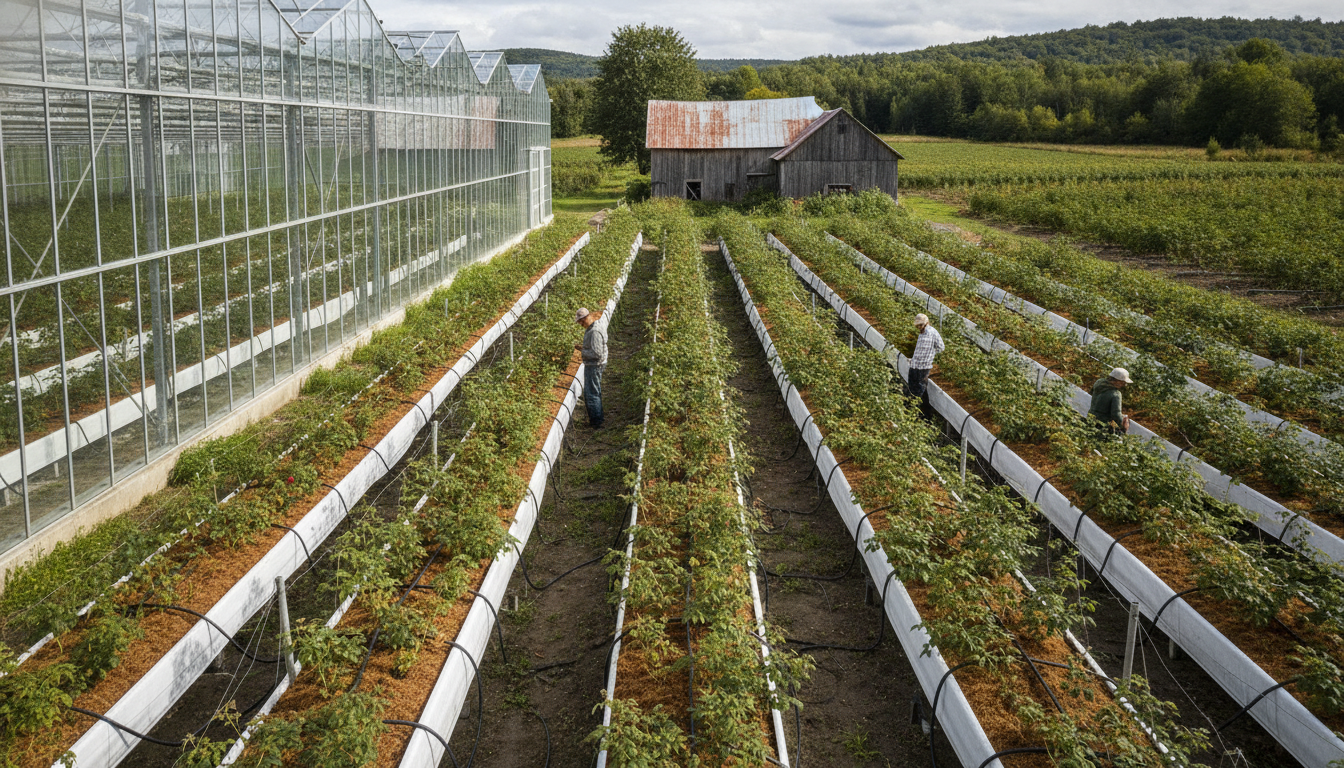
Quebec raspberry farming shifts to soilless systems as climate risks and costs reshape the sector
Quebec raspberry farming is increasingly moving to soilless systems and protective tunnels as producers adapt to extreme weather, but high setup costs leave many small growers behind.
Rising costs and mounting climate risk are accelerating changes in Quebec raspberry farming, with larger producers adopting soilless growing media and tunnel systems to stabilize yields and meet supermarket standards. Growers who invest in coco coir substrates and covered production report greater control over nutrition and harvesting windows, while smaller operations say the capital required and past storm losses make conversion risky. Industry representatives warn that without targeted public support, the transition will favour larger, vertically integrated businesses and squeeze family-scale pick-your-own farms.
Soilless systems adopted in Lévis operation
Vincent Méthot, owner of Ferme François et Lise Méthot in Lévis, has converted his raspberry fields to containerized production.
Plants now grow in pots filled with coconut coir rather than native soil, allowing precise delivery of nutrient solutions that producers say act like an intravenous feed for berries.
He also uses large tunnel structures—open at the ends—to protect fruit from heavy showers and extend the harvest window, a shift he began experimenting with in 2007.
Industrial yields and supermarket-ready varieties
Producers using these systems report the ability to cultivate a wider range of commercial cultivars and to reach volumes and consistency demanded by grocery chains.
Soilless culture can reduce disease pressure, enable mechanized harvesting and tighten quality control, which improves shelf life and marketability.
For farmers targeting packing houses and large distributors, those advantages can translate into higher returns that justify the initial investment.
Smaller farms face storm losses and subsidy gaps
Not all growers have been able to make the switch. Richard Méthot of La Ferme à Frédérique, who operates a smaller, pick-your-own business, tested soilless technology in 2008 but retreated after severe storm damage.
He says Hurricane Irene’s remnants struck in 2011, destroying key installations and eroding the financial cushion that had been supported by earlier research subsidies.
When public aid for those projects waned, the risk-reward calculation for his scale of operation no longer supported further conversion.
Industry data shows rapid uptake across the province
The Association des producteurs de fraises et de framboises du Québec (APFFQ) estimates that more than half of the province’s raspberry production now relies on protected or soilless techniques.
Association officials say the past decade produced a concentrated body of local expertise, driven by a mix of university research, grower collaboration and visits to international operations.
That knowledge transfer has helped larger growers refine nutrient management and tunnel design to suit Quebec’s climate.
Scale, distribution and competitiveness determine access
Several producers caution that the economics of conversion favour those with broad distribution networks and larger volumes.
Installing tunnels, irrigation systems and substrate-based growing beds requires capital and logistical capacity that small family farms often lack.
Industry leaders stress that without economies of scale, even well-run small operations struggle to justify the multi-year payback periods associated with these technologies.
Calls for government support to widen access
Josiane Cormier, president of the APFFQ, says extreme weather events in recent years have been financially and psychologically damaging for producers and that the sector must become more resilient.
She is urging provincial and federal authorities to make targeted funding available so more growers can test and adopt technologies in a Quebec context.
Cormier also notes the need to balance environmental and social standards with competitiveness, arguing that public investment could help smaller farms stay viable while meeting market demands.
As raspberry season approaches, farmers across Quebec are weighing the trade-offs between higher upfront costs and steadier production in the face of more frequent weather extremes.
For some, the move to soilless culture and protective tunnels represents an investment in stability and market access; for others, it remains an unaffordable option that could reshape the province’s agricultural landscape if left unsupported.
