
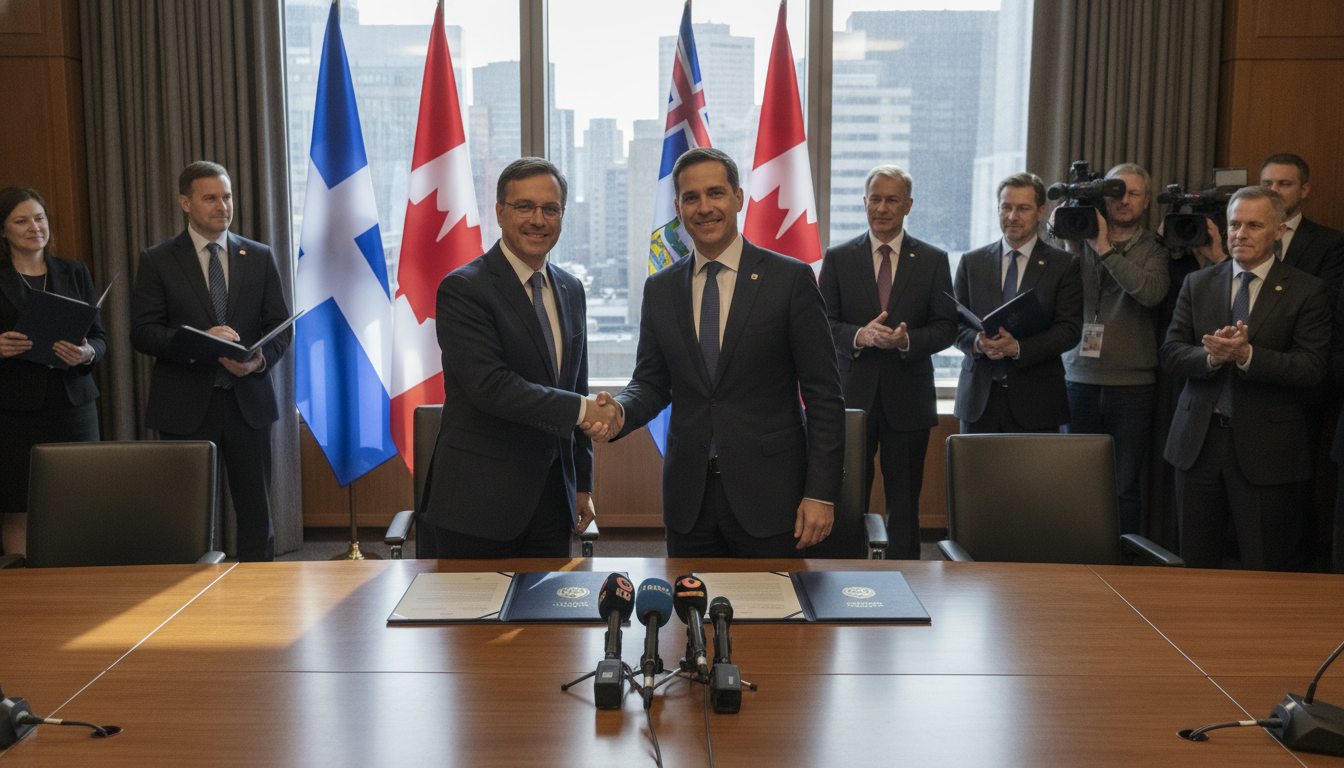
Quebec to announce Churchill Falls agreement in St. John’s, officials say
Quebec premier to announce Churchill Falls agreement in St. John’s Monday, a move officials say will bolster Quebec’s energy security and economic growth.
Strong announcement planned in St. John’s
Quebec premier Christine Fréchette is scheduled to make a public announcement in St. John’s on Monday at 1:45 p.m. local time concerning an agreement tied to the Churchill Falls hydroelectric project. The premier will be accompanied by Economy Minister Bernard Drainville and Hydro-Québec CEO Claudine Bouchard for the event, provincial schedules show.
Officials say the announcement will focus on "energy security and economic development" for Quebec, though the full terms were not released ahead of the briefing. Sources close to the negotiations indicate that a formal agreement between Quebec and Newfoundland and Labrador is expected to be finalized at the start of next week.
Fréchette, Drainville and Hydro-Québec leadership to present
The presence of both the premier and the economy minister signals the provincial government’s emphasis on the deal’s economic implications. Hydro-Québec’s CEO joining the delegation highlights the utility’s central role in any arrangement affecting the Churchill Falls facility. Organizers have framed the gathering as a cabinet-level announcement rather than a routine corporate update.
Government officials have declined to provide detailed text of the agreement before the announcement, saying only that the measures will address provincial priorities tied to power supply and industrial development. Media and industry observers will be watching closely for specifics on governance, financing and operational responsibilities.
Agreement expected to concern Churchill Falls hydroelectric works
Sources indicate the deal relates to the vast Churchill Falls hydroelectric complex, a major energy asset in Labrador with cross-provincial significance. While the precise provisions have not been disclosed, the announcement is widely understood to concern access, revenue-sharing or operational arrangements connected to the facility. The stakes are substantial given Churchill Falls’ role in regional power systems.
The hydroelectric project has long featured in interprovincial energy discussions, and any alteration to existing arrangements could have implications for electricity flows and commercial contracts. Observers caution that finalizing a durable agreement typically requires alignment on technical, legal and financial fronts.
Potential implications for Quebec energy security
Quebec officials describe the move as strengthening the province’s energy security, an increasingly prominent policy goal amid changing demand patterns and broader shifts in regional electricity markets. An agreement tied to Churchill Falls could affect Quebec’s capacity to manage peak loads, supply industries and plan longer-term infrastructure investments. Energy planners will be assessing how any new terms interact with existing Hydro-Québec commitments and grid operations.
Analysts say that changes to access or transfer arrangements could influence pricing, reserve margins and the province’s ability to support new industrial projects. At the same time, operational coordination with Newfoundland and Labrador will be essential to avoid unintended disruptions in supply or transmission constraints.
Economic development and regional stakes
Beyond power system impacts, the announcement is being framed as an economic development initiative for Quebec. Officials have linked the discussions to opportunities for job creation, industrial investment and regional supply chains. The involvement of the economy minister suggests Quebec intends to highlight potential downstream benefits tied to the arrangement.
For Newfoundland and Labrador, the terms of any agreement will also carry economic weight, affecting provincial revenues, employment in the energy sector and the administration of local infrastructure. Municipal and Indigenous stakeholders in Labrador are likely to seek clarity on how fiscal benefits and environmental responsibilities will be shared under any new framework.
Outstanding questions and next steps after the briefing
Key details expected to emerge at the Monday event include whether the agreement is a framework for future negotiations or a binding contract with immediate operational changes. Observers will look for specifics on timelines, financing mechanisms and whether federal approvals or regulatory reviews are required. The role of Indigenous communities and consultation processes is another area likely to draw attention following the announcement.
Following the public statement, officials indicated they will release more documentation and may schedule follow-up meetings with provincial regulators and industry partners. Implementation of any complex energy accord typically unfolds over weeks or months, with staged steps to align technical systems, legal instruments and fiscal arrangements.
Quebecers and stakeholders across Atlantic Canada will be watching for the full text of the agreement, expected to clarify the nature and duration of commitments by both provinces. The Monday announcement at 1:45 p.m. in St. John’s will mark the first public moment in what parties describe as a significant phase of collaboration on Churchill Falls.
The coming days should reveal whether the agreement represents a narrow operational change or a broader reshaping of how the Churchill Falls resource is managed between Quebec and Newfoundland and Labrador.
