
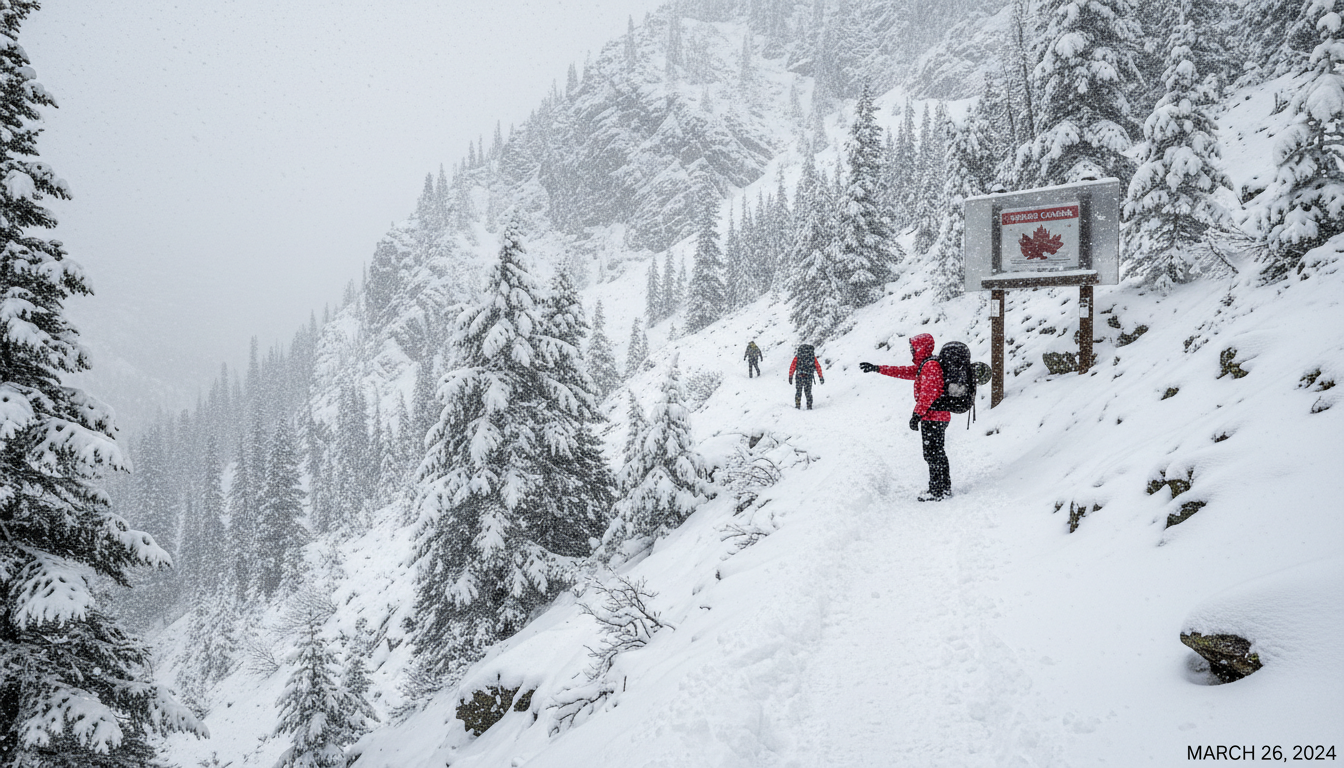
Banff hiking warning: Parks Canada urges caution as heavy spring snow makes several trails treacherous
Parks Canada warns hikers that spring snow and avalanche risk have left popular Banff trails hazardous, prompting urgent rescues and helicopter extractions.
Parks Canada has issued a Banff hiking warning after a string of springtime rescues highlighted hazardous conditions on several popular routes. Heavy snowpack at higher elevations and lingering avalanche-prone terrain have caught early-season hikers off guard, officials said. The advisory urges people to delay trips or to travel only with avalanche training and appropriate equipment.
Trails identified as high risk
Several well-known routes in Banff National Park remain unsafe for early spring travel, Parks Canada officials said. The list includes Cory Loop Pass, the ascent of Rundle from Banff, and multiple Lake Louise-area hikes such as Lake Agnes, Little Beehive and Plain of Six Glaciers. Park staff also warned about the south lakeshore approach and unofficial routes on Sulphur Mountain, which are exposed to avalanche terrain and unstable snowpack.
Details of recent rescue operations
Parks Canada confirmed multiple incidents in recent weeks that required emergency response teams to intervene. Two rescues involved helicopter sling extractions after hikers became stranded on cliffs or ledges when they wandered off-route. In one northern park incident, ski-borne rescuers retrieved a stranded person from deep snow after a nighttime call for help, an operation made more complex by an overnight storm.
Conditions behind the delayed spring melt
Snow levels at higher elevations are among the largest on record in some parts of the park, pushing the seasonal window for safe travel later than usual. Staff described a daily pattern where ridgelines and approaches are frozen overnight but soften and enter an avalanche cycle by afternoon. Those fluctuations, combined with lingering winter weather, mean trails that normally open in late spring may not be reliably passable until mid-June or later.
Visitor safety advice and recommended gear
Parks Canada is reminding visitors that a spring outing in the mountains still requires winter skills and equipment. Officials recommend avalanche training, carrying a transceiver, probe and shovel, and using traction devices such as ice cleats for steep, icy sections. Hikers are also urged to plan trips with shorter daylight and to turn back early if conditions deteriorate, rather than attempting risky terrain later in the day.
Navigation and information sources
Officials cautioned that crowd-sourced hiking apps and informal trail reports can be incomplete or out of date during transition seasons. Parks Canada recommends that visitors consult official trail condition updates posted online and check in at visitor centres before heading out. Park staff said up-to-date condition reports and direct advice from visitor safety specialists remain the most reliable sources for planning safe travel in Banff.
Consequences and public response
The recent incidents have strained search and rescue resources and highlighted how quickly winter conditions can persist at elevation. Visitor safety specialists noted that many incidents begin when people underestimate the depth of remaining snow or overestimate their ability to navigate avalanche-exposed terrain. Officials emphasized that rescuers often face increased risk when responding to preventable emergencies and urged the public to err on the side of caution.
Early-season hikers planning excursions in Banff National Park should treat this as a clear, immediate advisory: many popular routes remain in winter conditions and require appropriate preparation or postponement. Park authorities continue to monitor snowpacks and will update trail condition notices as weather and melt rates change.
