
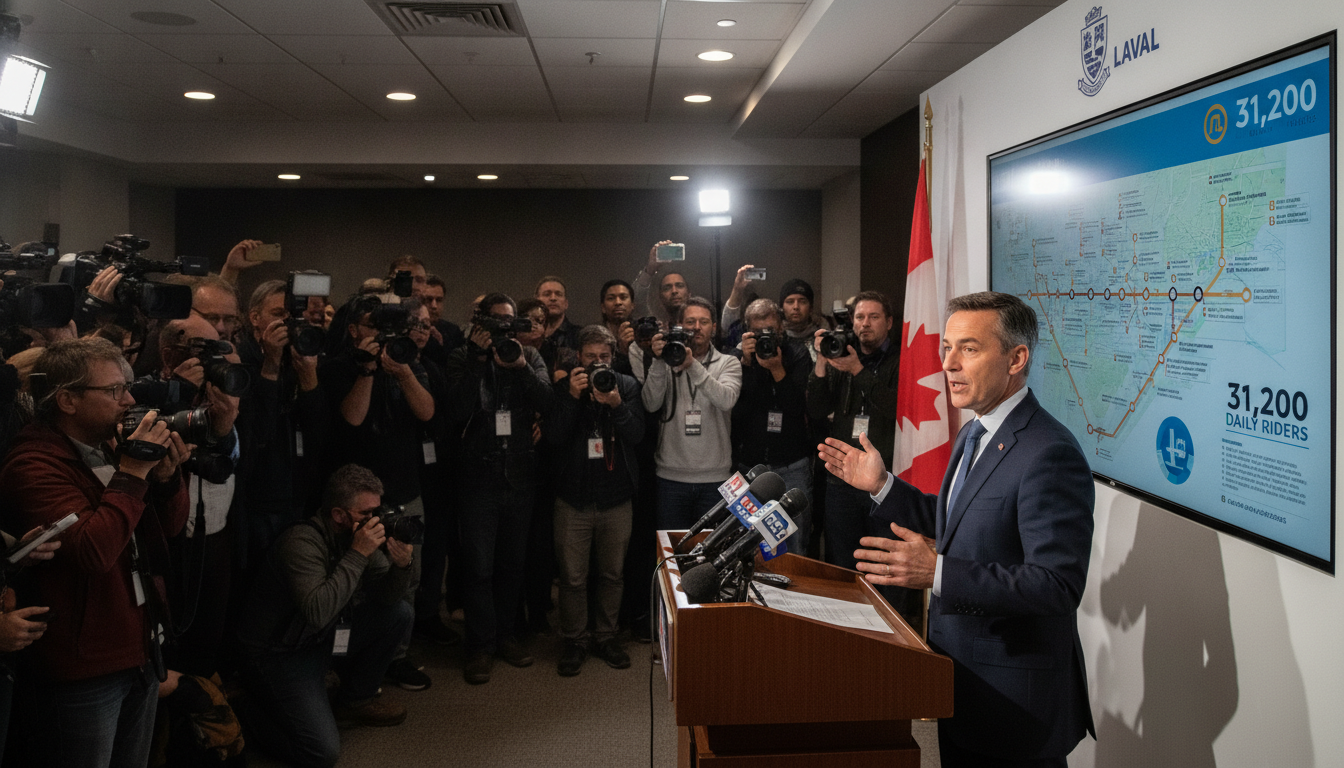
Orange Line extension pitched as Laval mayor cites ARTM figures showing big ridership gains
Mayor Stéphane Boyer used preliminary ARTM study figures to argue the Orange Line extension would carry tens of thousands of riders and sharply cut driving.
Laval Mayor Stéphane Boyer presented preliminary numbers from an Autorité régionale de transport métropolitain (ARTM) study to promote an Orange Line extension, saying it would attract roughly 31,200 morning peak users and convert about 11,000 daily car trips to transit. He told listeners the proposal — which would add six to eight stations to link the east and west branches of the line — could reduce travel time between Laval’s centre and downtown Montréal by about 40 per cent. The mayor made the comments on a regional radio program as the ARTM continues detailed planning work for future transit infrastructure.
Mayor releases study figures before full public report
The ARTM study is not yet publicly available in full, but the agency’s preliminary estimates cited by the mayor form the backbone of his argument for the Orange Line extension. Radio-Canada reported that the study projects large morning peak ridership at new stations, although the complete methodology and full set of results have not been released for independent review.
Boyer framed the figures as evidence that the extension would move far more people than other projects under consideration in Québec, and urged provincial decision-makers to prioritise investment in Laval. He said he raised the issue directly with Premier Christine Fréchette during a meeting in early July 2026 and was told the government intends to address perceived imbalances in regional infrastructure funding.
Route proposal would link branches and Carrefour Laval, connect to REM
The proposal put forward by Laval’s mayor calls for adding six to eight new stations to the Orange Line to join its east and west branches, creating a continuous rapid transit link across the city. Key objectives include providing direct service to major destinations such as the Carrefour Laval shopping complex and improving access for residents across Laval’s boroughs.
Planners have also highlighted a potential interchange with the Réseau express métropolitain (REM) at Bois‑Franc, offering a direct connection between the extended Orange Line and the region’s growing light‑rail network. Proponents say such intermodal links would expand travel options and reduce the need for car trips into Montréal.
ARTM weighed tram and BRT options and found lower ridership
The ARTM reviewed multiple scenarios to connect Laval’s separated Orange Line branches, including a tramway and a bus rapid transit (BRT) or service rapide par bus (SRB) option. According to the agency’s early analyses, those alternatives produced significantly lower projected ridership than an underground metro extension and were therefore judged less advantageous on a capacity and mode‑shift basis.
The authority has identified eight priority areas across the Greater Montréal region for more detailed study as part of a planning programme that will produce results progressively through 2029. Those studies are intended to provide comparable assessments of demand, costs and potential benefits for a range of infrastructure choices in the coming years.
Cost estimate remains unclear; Boyer proposes cost‑saving measures
No recent, publicly released cost estimate for an Orange Line extension is available, and the absence of firm numbers has become a central point of debate. Citing the per‑kilometre costs used for the blue line extension, Boyer suggested a headline figure exceeding $10 billion, but he argued that the actual price tag for a Laval project could be substantially lower with targeted measures.
To reduce costs, the mayor proposed building stations on municipal land where possible, negotiating agreements with major property owners to integrate stations into private developments at little or no land acquisition cost, and designing simpler, more utilitarian station structures than those that characterise some existing Montréal stations. He also suggested coordinating the project with the blue line extension schedule to reuse the tunnel boring machine already commissioned for that work.
Boyer compares projected ridership to Québec ‘third link’ estimates
Boyer contrasted the ARTM’s projected morning ridership for an Orange Line extension with published estimates for the proposed road link near Québec City, known colloquially as the “third link.” He cited a 2024 analysis by CDPQ Infra that projected up to 1,100 vehicles per hour in the morning peak toward Québec City — roughly 3,300 vehicles in total during peak periods by 2041 — and argued that the metro extension would move an order of magnitude more people.
The mayor said such comparisons underscore his contention that provincial funds earmarked for large road projects might produce far smaller mobility gains than comparable investments in high‑capacity public transit. He accused decision‑makers of favouring politically expedient projects over those that deliver higher ridership per dollar, and called for a clearer provincial prioritization exercise.
ARTM’s ongoing work and municipal lobbying have set the stage for an extended public and political debate over priorities, costs and timelines. The agency’s phased release of studies through 2029 will provide further data for planners and elected officials to weigh, while Laval officials continue to press for a fast, affordable connection that they say would reshape commuting patterns across the region.
