
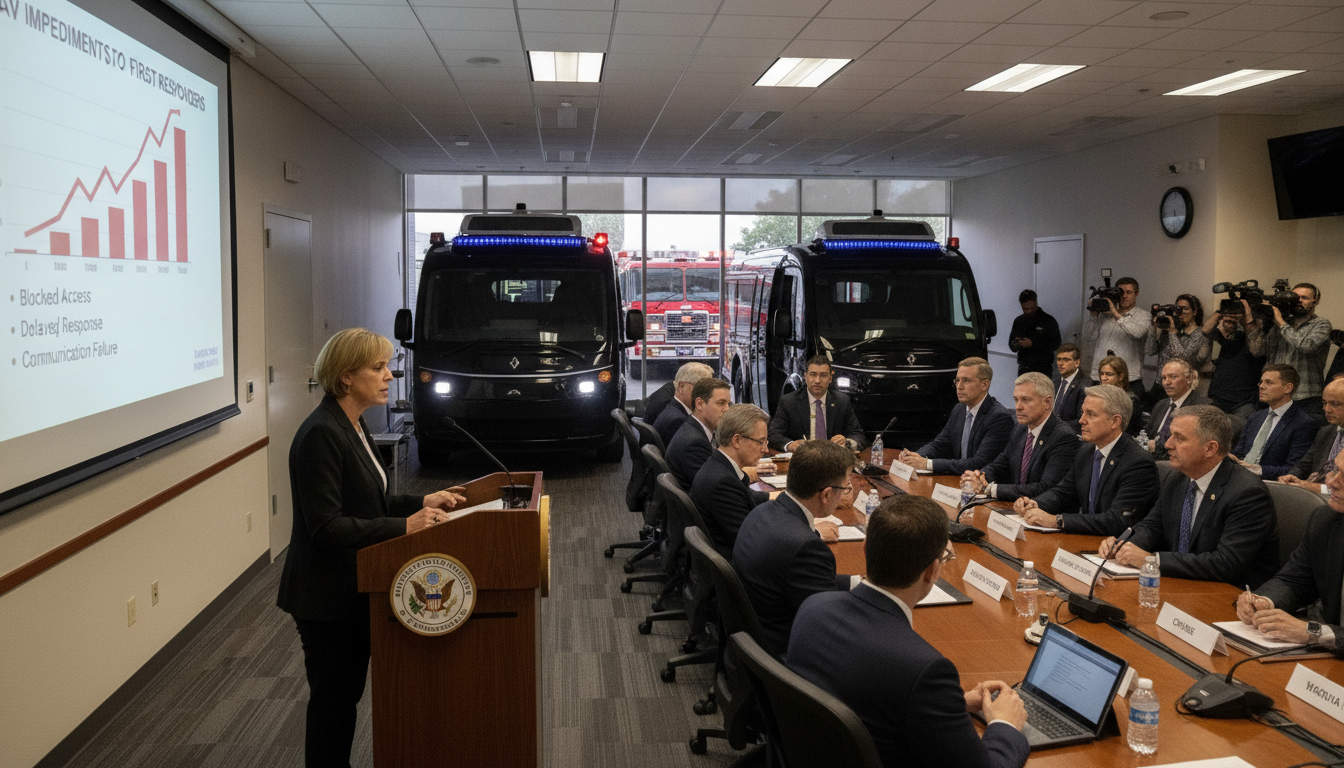
NHTSA orders autonomous vehicles to stop blocking first responders, gives developers until July 31, 2026
NHTSA demands fixes from autonomous vehicle makers after multiple incidents where driverless cars impeded emergency operations; developers must propose solutions by July 31, 2026.
The National Highway Traffic Safety Administration on July 8, 2026 directed autonomous vehicle developers to address a “clear pattern” of driverless cars interfering with law enforcement and first responders.
The agency said such behavior—vehicles entering active emergency scenes, obstructing ambulances and fire apparatus, or failing to react to flares, smoke, flashing lights and traffic cones—cannot be treated as rare anomalies.
NHTSA has set a deadline of July 31, 2026 for companies to present concrete fixes to prevent these incidents, framing the issue as an operational safety shortcoming rather than an experimental edge case.
NHTSA’s directive and rationale
NHTSA’s administrator told developers the inability of autonomous systems to detect and respond to emergency scenes constitutes a functional insufficiency that must be remedied.
The letter stresses that emergency responses involve life-or-death timelines and that delays caused by automated systems can have real-world consequences.
By setting a tightly framed deadline, the agency is signaling a shift from passive oversight toward active demand for demonstrated corrective measures from AV operators and manufacturers.
Documented behaviors at emergency scenes
Investigators working with the agency collected accounts in which autonomous vehicles drove into active scenes, stopped in travel lanes, or failed to recognize traffic-control devices placed by responders.
Reported failures include ignoring illuminated warning lights, not reacting to smoke or fire conditions, and misinterpreting cones and flares that mark hazardous zones.
NHTSA emphasized these are recurring patterns rather than isolated testbed glitches, urging developers to prioritize robust emergency-scene recognition and response capabilities.
Implications for robotaxi fleets
While the agency did not single out specific firms, details in the directive point to robotaxi operators that deploy driverless passenger services in multiple cities.
Industry investigations earlier in 2026 identified several incidents in which remote or on-site operators had to manually intervene to move vehicles out of the way during critical responses.
Those accounts, spanning through March and including a June 2026 episode where a vehicle was moved to unblock a roadway after an explosion, have heightened scrutiny on fleets operating without a human safety driver.
Accountability and enforcement questions
NHTSA’s letter does not lay out explicit penalties if developers fail to meet the July 31, 2026 deadline, but it draws a parallel with how the law treats human drivers who impede emergency operations.
The agency’s language suggests it will consider holding companies to standards of accountability that could include enforcement actions if responses are not satisfactory.
For now, the immediate ask is for developers to present credible strategies and timelines for technical fixes and operational changes that prevent interference with first responders.
Regulatory work on vehicle design and safety standards
Separately, NHTSA said it is progressing with updates to Federal Motor Vehicle Safety Standards that govern vehicle design and equipment.
Proposed rule changes discussed by the agency would enable new vehicle architectures that lack conventional human-driver features, such as steering wheels and pedals, and would eliminate requirements for equipment like windshield wipers and sun visors in certain designs.
NHTSA published its 2026 Regulatory Plan and Unified Agenda in early July 2026, outlining the rulemaking work that could reshape how autonomous platforms are certified and regulated.
Industry next steps and technical priorities
Developers are now expected to demonstrate improved detection and classification of emergency scenes, more conservative operational behaviors near active responses, and reliable remote-operator or software-based intervention protocols.
Possible technical measures include enhanced sensor fusion tuned to emergency lighting and flares, updated behavior models that yield or avoid ingress to cordoned areas, and clearer integration with dispatch or blue-light signaling systems.
Companies must also show how new measures will be validated in real-world conditions and how they will be deployed across fleets to avoid piecemeal fixes.
The NHTSA directive marks an escalation in federal scrutiny of autonomous vehicle operations, placing rapid technical remediation and clearer accountability at the center of industry priorities.
As developers prepare responses ahead of the July 31, 2026 deadline, regulators, local emergency services and fleet operators will be watching for solutions that demonstrably prevent automated vehicles from impeding lifesaving work.
