
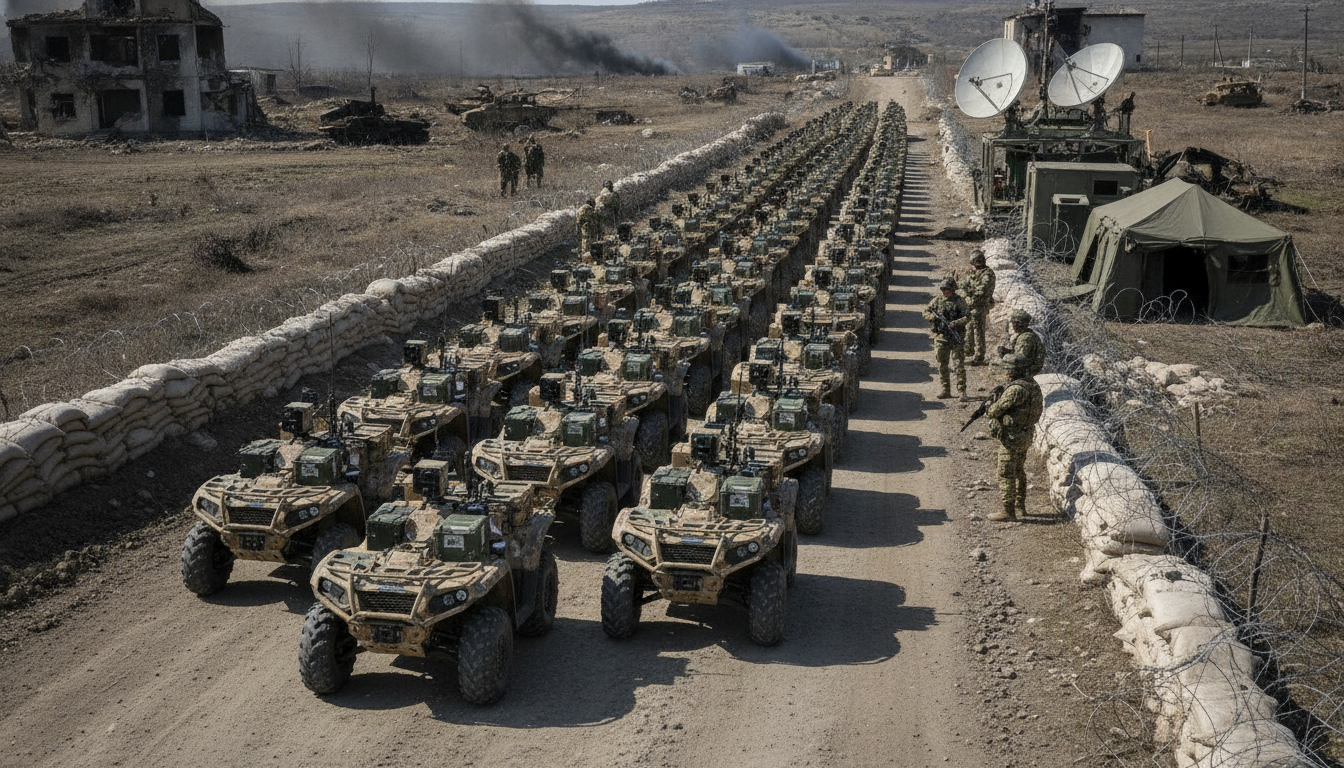
Forterra Lancer ATVs: Company Says 100+ Self-Driving Vehicles Deployed in Ukraine Over Nine Months
Forterra says 100+ Lancer self-driving ATVs served in Ukraine for nine months, hauling supplies, evacuating casualties and informing U.S. defense contract bids.
Deployment Scale and Mission Summary
Forterra announced that more than 100 of its Lancer autonomous ATVs have been operating in Ukraine for the past nine months, a deployment the company says is the largest of its kind by a U.S. defense tech firm. The Lancer vehicles, built on Polaris ATV platforms and fitted with bespoke sensors and compute systems, have completed over 1,100 missions and driven roughly 2,500 miles. Company officials framed the deployment as both an operational test and a logistics lifeline that has carried hundreds of thousands of pounds of materiel. The presence of these vehicles reflects a broader U.S.-backed effort to modernize battlefield logistics in support of Ukrainian forces.
Operational Performance and Field Results
Forterra reports the Lancer fleet moved approximately 777,440 pounds of cargo and completed 52 casualty evacuations during the deployment period. Operators in Ukraine said the vehicles have been particularly valuable for resupply and casualty movement where aerial options face persistent risk. Some Lancers have been lost to combat conditions, often after becoming immobilized in mud or difficult terrain and then targeted. Despite losses, soldiers working with the vehicles described the platform as transformative for frontline logistics.
Technical Modifications and Capabilities
The Lancer is gas-powered and can carry up to 750 kilograms, a marked increase over many Ukrainian-built battery UGVs that typically carry smaller loads. Forterra added field-oriented modifications—most notably satellite communications hardware—to adapt the vehicles to the contested environment and to enable reliable remote control and data exchange. The company has also iterated on software updates delivered remotely to address electronic warfare effects and to refine navigation in rugged conditions. These adaptations helped bridge the gap between a commercial ATV baseline and the operational demands of a high-intensity battlefield.
Limits of Autonomy and Combat Challenges
Ukrainian operators and Forterra officials emphasized that most Lancers have been teleoperated in combat zones rather than left to full autonomy. The vehicles can navigate varied terrain autonomously, but commanders said they still cannot reliably identify and respond to unexpected enemy threats in real time. Electronic warfare, the difficulty of sensing in obscured conditions, and the tactical need to limit attrition have all constrained fully autonomous use. Company leaders described autonomy development as ongoing, combining classical robotics work with newer AI techniques to improve situational responses.
Lessons Learned in the Field
Forterra said lessons from the deployment included hard data on software update processes, electronic interference, vehicle durability and maintenance needs under combat stress. Field visits by company engineers and leaders revealed operational "seams" where manual workarounds remained necessary, and those observations have driven product changes. Soldiers also pressed for lower-cost iterations to permit wider, more expendable use in front-line operations. The balance between capability and cost emerged as a recurring theme: more vehicles at lower unit price could improve operational flexibility and reduce the impact of attrition.
Strategic and Contract Implications
Backers of Forterra note that the deployment could strengthen the company’s position for future national security contracts, after more than $500 million in venture funding positioned it to pursue larger defense work. U.S. Army personnel involved in ground autonomy programs cited the operational experience as confirmation that ground robotic systems are achievable and worthy of investment. Competing startups and programs are racing similar trajectories, investing in models and training data to push UGVs toward more autonomous, adaptable behavior. For the U.S. defense establishment, real-world testing in Ukraine has provided data that are informing acquisition priorities and doctrine.
The Forterra Lancer deployment in Ukraine underscores both the potential and the current limitations of autonomous ground systems in contested environments. Field performance highlighted clear logistics advantages but also reinforced that autonomous decision-making in live combat remains a work in progress. As Forterra and others refine hardware, communications and AI-driven perception, defense planners will weigh cost, attrition and the operational need for both teleoperated and autonomous modes in future procurements.
