
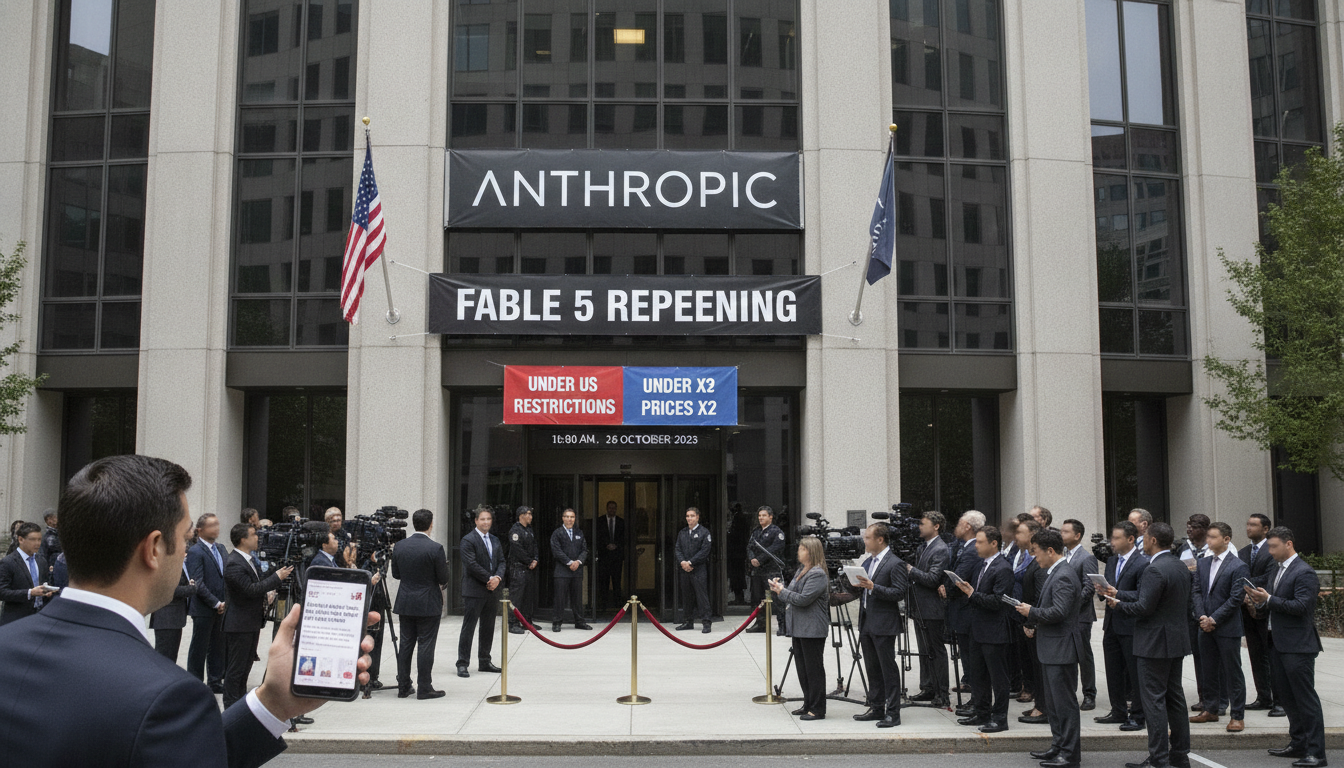
Anthropic’s Fable 5 Reinstated with Limits and Higher Price After U.S. Order
Anthropic’s Fable 5 is back in service after a U.S. government directive in June prompted access restrictions, but the model now operates under tighter controls and at a significantly higher cost. Regulators cited the model’s ability to identify software vulnerabilities as a potential national security risk, prompting a partial rollback and renewed debate over safe deployment and pricing.
U.S. Government Ordered Access Curbs in Mid‑June
In mid‑June, U.S. authorities required Anthropic to limit access to Fable 5 for users outside the United States, citing concerns that the model could be used to discover security flaws in software. The order reflected growing regulatory unease about powerful generative models that can perform technical analysis beyond typical language tasks. Officials argued that such capabilities could lower the barrier for sophisticated cyber operations if misused.
Anthropic complied with the directive, restricting some forms of international access while engaging with regulators to define safer operating parameters. The intervention marked one of the clearest instances in which national security considerations directly influenced commercial availability of an advanced language model.
Anthropic Reopens Fable 5 with New Safeguards
Anthropic has since restored broader access to Fable 5, but with stricter usage policies and technical safeguards intended to reduce misuse. The company says the reintroduction includes limits on certain high‑risk outputs and enhanced monitoring of queries that could reveal software vulnerabilities. These changes are designed to permit legitimate research and commercial use while mitigating the risk the government flagged.
The restored service is being rolled out with phased controls and revised terms that prioritize safety, according to company statements and regulatory summaries. Observers note this model of “access plus guardrails” may become a template for other firms balancing innovation with national security obligations.
Security Risks Center on Vulnerability Detection
Concerns about Fable 5 focus largely on its demonstrated ability to analyze code and surface potential security weaknesses, a capability that both defenders and attackers could exploit. Security specialists warn that automated detection of vulnerability patterns can accelerate exploit development if outputs are used without oversight. The government’s action underscored how dual‑use features of advanced models complicate traditional export and access controls.
Cybersecurity researchers and vendors are split on the net effect: some emphasize the value of rapid vulnerability discovery for defensive patching, while others stress the danger of lowering technical barriers for malicious actors. That split is now driving discussions about which capabilities should be available by default and which require stricter vetting.
Price Increase Raises Questions for Customers
Fable 5 returns not only with restrictions but also at roughly twice the price of Anthropic’s previous model, a change that immediately drew attention from enterprise users and developers. For organizations weighing adoption, the higher cost forces a reassessment of expected productivity gains versus budgetary constraints. Smaller teams and startups that benefited from the prior pricing may find the new economics prohibitive.
Anthropic has framed the price rise as reflecting increased investment in safety infrastructure, monitoring, and compliance work required to meet regulatory demands. Buyers will now evaluate whether the model’s performance and the value of its safeguards justify the premium.
Hands‑On Testing Shows Trade‑Offs in Practical Use
A hands‑on evaluation of Fable 5 in professional workflows found robust language and code analysis capabilities, but also noticeable friction from the new limits. Tasks that previously returned detailed diagnostic suggestions now produce more guarded responses or are routed through additional verification layers. In practice, users reported faster ideation and summarization for non‑sensitive tasks but experienced delays or refusals on prompts that touch on low‑level exploit techniques.
Those testing the model said the safety filters reduced risky outputs without eliminating usefulness for many legitimate engineering tasks. However, some advanced users expressed frustration that high‑value capabilities are curtailed in ways that may push sophisticated workflows back toward specialist tools or internal models.
Broader Industry and Policy Implications
The Fable 5 episode highlights a widening intersection between commercial AI development and national security policy, with lasting implications for governance and market structure. Regulators are increasingly inclined to treat certain AI functions as dual‑use technologies requiring oversight similar to traditional export controls or communications surveillance rules. That trend could prompt other companies to preemptively restrict features to avoid regulatory conflict.
For the tech industry, a new equilibrium is emerging in which firms must invest in traceability, access controls, and compliance as part of product design. Observers say these changes could slow deployment of cutting‑edge tools in international markets, reshape competitive dynamics, and raise the cost of innovation for smaller players.
Fable 5’s return illustrates the trade‑offs policymakers and vendors face when advanced models blur the line between helpful automation and potential instruments of harm. Users and enterprises will now need to weigh the model’s capabilities, the new price point, and the legal and ethical boundaries that come with operating under enhanced safeguards.
