
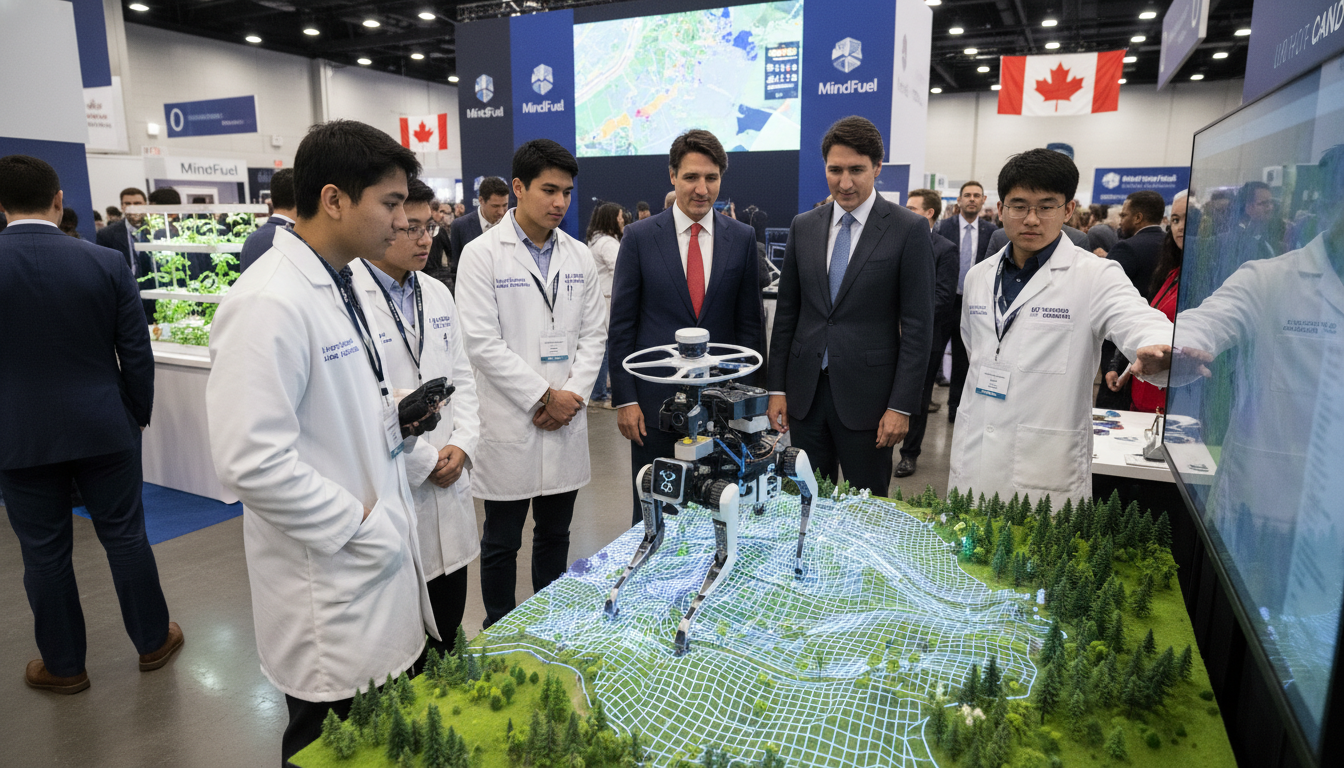
MindFuel Tech Futures Challenge Showcases Student Innovations from Coast to Coast
Students from across Canada presented projects and heard guidance from industry leaders at MindFuel’s Tech Futures Challenge Innovation Showcase on May 30, 2026. The MindFuel Tech Futures Challenge brought more than two dozen student teams to the University of Calgary’s Hunter Hub to demonstrate prototypes, research and community-focused solutions.
More than two dozen student teams presented their work
The Saturday showcase featured teams from British Columbia to the Maritimes, each pitching projects that ranged from community infrastructure to environmental monitoring. Organizers said the event prioritized practical demonstrations and clearly defined problem statements that judges and advisors could assess.
Presentations included group projects, individual research initiatives and early-stage prototypes reflecting interests in sustainability, health, robotics and civic engineering. Students displayed models, data visualizations and working prototypes to explain their approaches and potential impact.
Robotics, ice rinks and bioethics drew attention
Several projects attracted particular interest from attendees and panelists. A University of British Columbia team unveiled a quadruped robot designed to traverse forest floors and generate 3D maps to support forestry management and tree-growth monitoring. The device, described by its creators as a field-ready mapping tool, aims to simplify data collection in uneven terrain.
A 22-student team from Calgary’s Renert School presented a proposal to lower energy use in community ice rinks by optimizing temperature regimes and refrigeration practices. The students argued that moderate-temperature strategies could cut costs and emissions while maintaining ice quality for public use.
Another highlight came from a Queen’s University student who co-founded NeuroEthica, a project exploring the intersection of neuroscience and bioethics. The presentation examined ethical frameworks for emerging neurotechnologies and proposed education and policy pathways for responsible research.
Industry leaders delivered practical advice to students
A panel of business and innovation experts spoke to the students about resilience, experimentation and problem selection. John Froh, president and CEO of STARS, urged participants to view setbacks as learning opportunities that build resilience and refine ideas.
Melissa Power, a project geologist with Canadian Natural, encouraged students to embrace unfamiliar roles and fields, noting that experimenting with different disciplines often reveals new passions. Grant Sanden, founder and CEO of GeologicAI, recommended focusing on problems that personally frustrate you as fertile ground for innovation.
Guy Levesque, executive director of the Hunter Hub for Entrepreneurial Thinking, stressed curiosity and exploration as drivers of entrepreneurial thinking. Local community leader Jim Gray challenged students to translate concern into action, asking them directly what they planned to do about the challenges they identified.
MindFuel’s role in developing Canada’s innovation pipeline
Organizers said the Tech Futures Challenge is part of MindFuel’s broader strategy to boost the country’s innovation capacity by equipping students with practical skills. Through mentorship, workshops and showcase opportunities, the organization connects classroom learning with industry expectations and real-world problem solving.
MindFuel’s programs focus on building technical literacy, design thinking and entrepreneurial skills that can accelerate ideas from concept to prototype. The showcase also served as a networking platform where students could meet potential mentors, investors and academic collaborators.
Pathways to commercialization and further research
Several student teams expressed interest in continuing work beyond the showcase, pursuing partnerships with industry or university labs. Presenters described next steps that included refining prototypes, scaling pilot studies and seeking funding for field tests.
Panelists advised teams to sharpen value propositions and identify measurable outcomes that demonstrate feasibility to stakeholders. They also suggested leveraging local innovation hubs and university incubators to access expertise, lab space and seed funding.
Students left with concrete feedback on technical design, go-to-market strategies and pitching technique. Organizers noted that the event’s mix of critique and encouragement aimed to leave projects more robust and students better prepared for subsequent competitions or entrepreneurial ventures.
MindFuel said it will monitor promising projects emerging from the showcase and explore ways to connect teams with resources to advance development. The organization highlighted collaboration with academic partners and private-sector sponsors as key to sustaining momentum for student-led innovation.
The Tech Futures Challenge on May 30, 2026, at the University of Calgary brought together youth, educators and industry in a single-day forum designed to accelerate problem-solving and mentorship across sectors. The showcase underlined a growing emphasis on student-driven solutions to local and national challenges, and many teams signaled plans to keep developing their ideas in the months ahead.
