
Meta data centre to bring $13B AI campus and new power infrastructure to Sturgeon County
Meta data centre to bring $13B investment and 1GW AI-optimized campus to Sturgeon County, creating thousands of jobs and new power infrastructure near Edmonton.
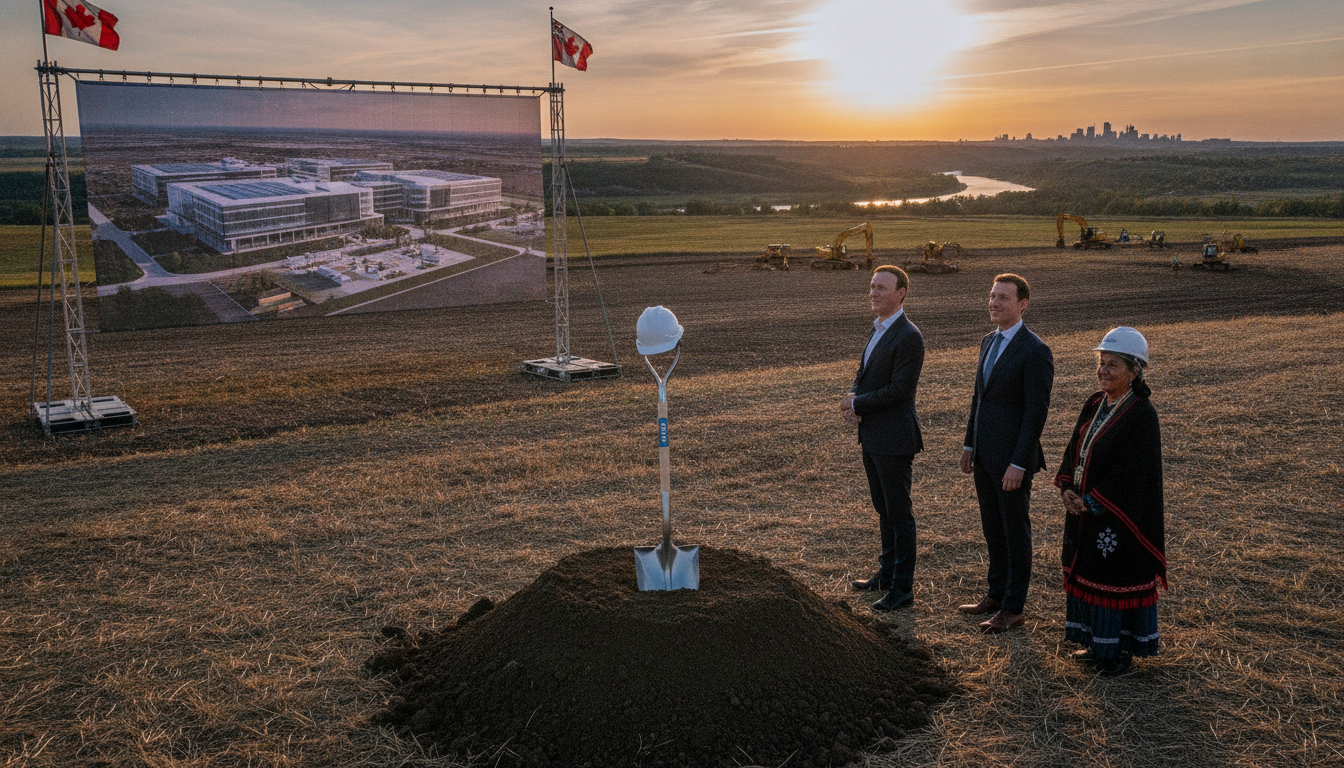
Sturgeon County will host a $13-billion Meta data centre after the company selected a heavily zoned industrial tract near Highways 643 and 825, the company and local officials confirmed on July 9, 2026. The one-gigawatt, AI-optimized Meta data centre — the technology giant’s first in Canada and its 33rd worldwide — will be built on roughly 1,900 acres inside Alberta’s Industrial Heartland and includes an upfront $60-million investment in roads and water infrastructure. Officials say the project is expected to generate thousands of construction jobs and introduce long-term operational capacity that will alter the economic profile of the region.
Meta chooses heavy industrial land in the Heartland
Sturgeon County officials stressed the site sits within a long-established heavy industrial zone that has been reserved for large projects for decades. Mayor Alanna Hnatiw said the land has been owned and managed with industrial use in mind, even while some parcels were farmed in recent years, and that planning deliberately maintains buffer zones to separate heavy operations from residential areas. The location lies within a major petrochemical cluster on the North Saskatchewan River, where existing road, water and utility frameworks have supported billions of prior investments.
Scale and scope of the $13-billion project
Meta’s announcement outlines a one-gigawatt campus designed for advanced artificial intelligence workloads, making it the largest data centre planned in Canada by capacity. The company will ready about three square miles of land and build an AI-optimized facility across multiple phases, calling for significant civil works and site servicing. The initial capital commitment includes a $60-million public-facing build-out for access roads and water systems to ensure the property is construction-ready.
Construction jobs, permanent employment and local revenue
County leaders estimate the project will create about 3,000 jobs at peak construction and roughly 300 long-term positions once the campus is operational, figures that officials say will translate to large local economic multipliers. Beyond direct employment, the county expects increased business for contractors, service providers and small enterprises that support major construction and ongoing operations. Tax assessments on the improved property are projected to deliver annual revenue well above the agricultural returns the land previously produced.
Power strategy and the Greenlight Electricity turbine
Power provision for the data centre will combine grid allocations and a new natural gas combined-cycle turbine developed by Greenlight Electricity, with the company slated to be the primary off-taker. Meta has already secured 970 megawatts of Alberta Electric System Operator (AESO) allocations to access the grid while the turbine is constructed, and the initial phase of the Greenlight facility will add roughly 932 megawatts of generation. According to industry representatives, the turbine is expected to consume on the order of 150 million cubic feet of gas per day at full data-centre load, a fraction of the region’s current daily production levels.
Grid interactions, excess capacity and environmental controls
Officials say the arrangement leaves room for flexibility in Alberta’s electricity market; when Meta’s needs fall below the turbine’s output, surplus generation can be directed back to the provincial grid. Local industry leaders point to existing energy infrastructure in the Heartland as a practical fit for a large computing campus, noting prior investments in transmission and process water capacity. Meta and regional authorities also emphasized measures to limit resource impacts: the company described the data centre’s cooling architecture as a closed-loop system and said expected water consumption will be lower than that of a typical golf course.
Timeline for buildout and regulatory steps
Earth-moving work is scheduled to begin later in 2026, with Meta and partners projecting the first bank of servers to be operational in early 2029 and additional phases completed through 2031. Sturgeon County officials said Meta did not request local tax incentives for the project, citing the region’s competitiveness and pre-existing industrial services as key selling points. Permitting and infrastructure expansion for water and process systems will proceed alongside construction, with regional associations coordinating to align workforce and supply chain needs.
As the Heartland prepares for its newest major investment, county leaders and industry representatives say the project will reinforce the area’s role as a heavy-industry and advanced-technology hub while generating new layers of employment and municipal revenue. The Meta data centre marks a significant shift in local land use from long-running agricultural leases to high-density computing infrastructure, and officials expect its phased arrival to unfold over the remainder of this decade.
