
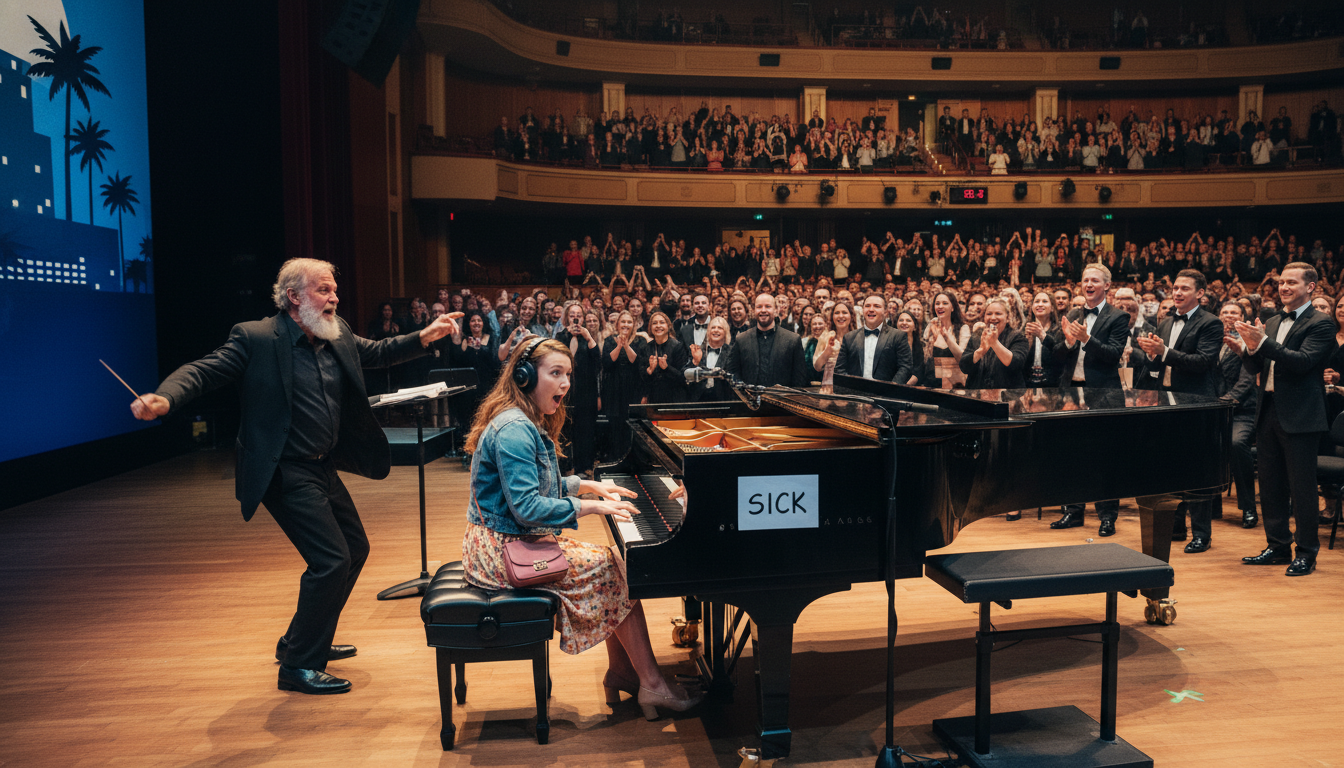
Audience Member Fills In at ‘La La Land’ Concert in Australia
Sterling Nasa, 21, stepped into the spotlight after a keyboardist fell ill, as an audience member fills in to keep the orchestral performance moving. The impromptu substitution occurred during a live presentation of music from the film "La La Land" in Australia, where organizers and musicians adapted swiftly. The unexpected turn drew attention to on-the-spot musical skill and the unpredictability of live concert work. The moment highlighted how a single volunteer in the auditorium can become a performance lifeline.
Unexpected Replacement on Stage
A scheduled keyboard player was forced to leave the stage because of sudden illness, prompting an urgent search for someone who could cover crucial piano parts. An audience member fills in when standard contingency measures are exhausted or unavailable, and that is what happened in this case. Concert staff and orchestra members moved quickly to identify a volunteer who could meet the demands of the score. The substitute’s presence allowed the program to continue without a prolonged interruption.
Student Steps Onto the Keyboard
The volunteer was identified as Sterling Nasa, a 21-year-old university student who was attending the performance. Nasa was called forward from the audience and agreed to play, taking on the keyboard responsibilities normally handled by a professional member of the ensemble. His readiness to join the musicians on stage underscored both personal preparedness and confidence in the repertoire. The orchestral leaders adjusted cues and accompaniment to integrate him into the ongoing set.
Musical Challenge and Repertoire
Music from "La La Land" includes piano-forward cues that require precise timing and sensitivity to orchestral dynamics, and the keyboard part is integral to the film’s signature sound. An audience member fills in must be able to follow a conductor and synchronize with other musicians in real time, which demands familiarity with the material and strong sight-reading or memory skills. While specific pieces played were part of the film’s score, the broader challenge was maintaining tempo and balance with a full ensemble. Musicians and organizers reported that the transition, though improvised, stayed faithful to the program’s musical intentions.
Reaction From Musicians and Audience
Colleagues on stage and listeners in the hall adjusted quickly as the replacement took his place at the instrument, with applause and supportive responses marking the exchange. The orchestra’s ability to resume the program with minimal disruption reflects rehearsed contingency practices and a cooperative performance culture. Audience members later described the sequence as a dramatic and human moment within an otherwise formal concert setting. The practical grace of the musicians and the volunteer’s composure were widely noted by those present.
How the Moment Was Coordinated
Stage managers and front-of-house staff coordinated entry to the stage and ensured the substitute had the appropriate position and access to the keyboard. A conductor or lead musician typically simplifies cues in such scenarios to make the volunteer’s integration manageable, and the ensemble shortens or adapts orchestral textures when necessary to support a non-regular player. Safety and acoustics were also considered, as quick changes can affect microphone placement and onstage spacing. Those logistical choices helped the performance continue smoothly.
Context Within Live Performance Protocols
Live orchestral productions routinely plan for unexpected absences through understudies, cover players, or standby musicians, yet not every venue has such redundancies immediately available. In some circumstances an audience member fills in because they are the most practical option at the moment, particularly when the score includes parts a competent pianist can play without extended rehearsal. The incident draws attention to the value of preparedness and the informal networks that can emerge in live events. It also prompts venues to review backup plans for essential instrumental roles.
Aftermath and Community Response
Footage and accounts of the substitution circulated after the performance, prompting comments about spontaneity, musical skill and the spirit of live concerts. Observers praised the volunteer for stepping forward and helping sustain the evening’s program, while colleagues emphasized the collaborative nature of orchestral work. For the student involved, the episode may be remembered as an unusual but formative experience in public performance. For organizers, it is a real-world example to inform future planning and risk management.
The incident in Australia served as a reminder of the unpredictable elements of live music and the resourcefulness that audiences and performers can show when a program is imperiled. An audience member fills in rarely becomes headline material, but on this occasion it preserved a concert evening and showcased how community and artistry can intersect under pressure.
