
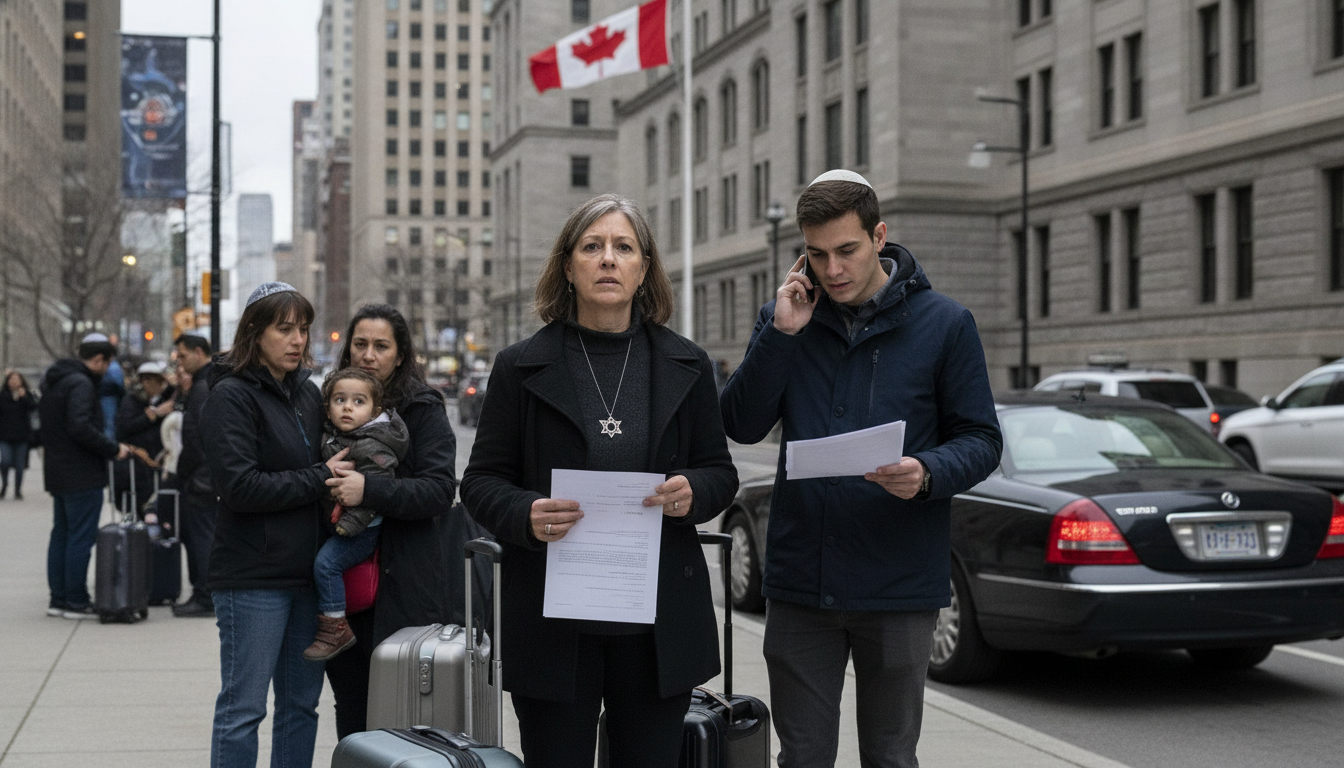
Jewish Canadians leaving Canada spur calls for U.S. asylum routes and heighten community “plan B” discussions
Antisemitism and safety fears are driving Jewish Canadians leaving Canada to consider U.S. relocation, asylum options and ‘plan B’ moves and community debate.
A growing number of Jewish Canadians leaving Canada are contacting U.S.-based resettlement groups and immigration attorneys as concerns about antisemitism and community safety push families to weigh relocation. Organizations such as Tulsa Tomorrow and Jewish Tulsa report hundreds of inquiries, and some advocates have asked U.S. officials to consider special asylum or refugee pathways. The trend has prompted debate in Ottawa and Washington about legal thresholds, political sensitivity and the long-term implications for Canadian Jewish life.
Rising inquiries to U.S. resettlement programs
Tulsa Tomorrow, an Oklahoma-based organization that helps Jewish families settle and integrate in the United States, says it has been contacted by roughly 900 Canadian families — nearly 2,000 people — seeking information about relocation programs. Jewish Tulsa’s director emphasized that such contacts are not casual, but reflect serious consideration by families contemplating uprooting their lives.
Immigration lawyers in the United States report increased demand for consultations from Canadian Jewish clients. Several practitioners say requests have accelerated since October 7, 2023, and that prospective migrants cite a mix of safety concerns, access to Jewish institutions and family considerations as motivating factors.
Calls for U.S. asylum routes and mixed political response
Jewish Tulsa and the American Enterprise Institute urged the U.S. administration to evaluate asylum or refugee pathways for Jews citing a hostile climate in Canada. Those calls reached Washington amid rising media attention and were framed as emergency responses for vulnerable community members seeking immediate protection.
The U.S. response so far has been cautious. Administration spokespeople have not announced a formal refugee stream specific to Canadian Jews, and U.S. officials have instead encouraged Canada to strengthen protective measures domestically. The political calculus in Washington appears sensitive to the idea of creating faith- or nationality-based exceptions in immigration policy.
Legal obstacles and uncertainty over eligibility
Immigration specialists warn that establishing eligibility for asylum requires proof of individualized persecution or well-founded fear tied to protected grounds; generalized unease or community-level threats may not meet that standard. Lawyers working with clients have counseled that fear, discomfort or a perception of insecurity alone are rarely sufficient to secure refugee status under U.S. law.
Beyond legal hurdles, experts highlight political risks. Creating a carve-out for Jewish Canadians could provoke diplomatic friction with Ottawa and incentivize similar requests from other groups. Observers also note the ephemeral nature of political advantage: an administratively favorable posture in Washington could change with future elections, leaving relocated families exposed to shifting policies.
Personal stories behind the statistics
Some families have already chosen life outside Canada. Ben Feferman and his wife moved their four children from Toronto to Boca Raton, Florida, in July 2021, citing a combination of safety concerns, access to Jewish schools and synagogues, and cost-of-living pressures. He says his family now feels well protected and does not intend to return.
Other individuals express more ambivalence: many consider a "plan B" as insurance rather than an imminent departure. For some, the decision to investigate relocation stems from a perceived decline in the availability of communal institutions outside major Canadian centres, while for others it reflects a cumulative reaction to recent global and domestic events.
Statistics, polls and community responses
Statistics Canada recorded 788 hate crimes targeting Jewish people in 2025, up from 492 in 2021, and reported that incidents aimed at Jewish victims accounted for roughly 71 percent of religion-motivated offences last year. Those numbers have fed perceptions of heightened vulnerability among some community members.
The Canadian Jewish Barometer 2026, conducted online from January 15 to February 11 with more than 3,000 adult respondents including 626 Jewish respondents, found that about one-quarter of Jewish respondents had seriously considered moving abroad or had made plans to do so. Robert Brym, a co-author of the survey and a sociology professor at the University of Toronto, cautioned that expressed intent or consideration does not necessarily translate into actual departures and that migration flows are affected by many factors beyond antisemitism alone.
B’nai Brith and other communal organizations acknowledge the anxiety reflected in the data but stress that most Jewish leaders view Canada as home. Regional leaders say they are working to bolster local protections and communal supports while listening to members who are contemplating alternatives.
An immigration lawyer summed up the legal debate, saying the rise in incidents is part of a wider trend across Western countries and that proving comparative safety in another jurisdiction would be difficult on legal grounds alone.
A range of voices in the Jewish community — from migration advocates to organizations urging staying and fighting antisemitism in place — now shape public debate. Some insist on enhanced domestic protection measures and improved policing and hate-crime responses, while others press for practical relocation assistance for families who decide to leave.
The choices facing Jewish Canadians leaving Canada are complex and personal, shaped by evolving assessments of safety, access to institutions and long-term stability. As inquiries to U.S. programs continue and public debate intensifies, both governments and communal organizations are under pressure to offer clearer options and better protections for vulnerable populations.
