
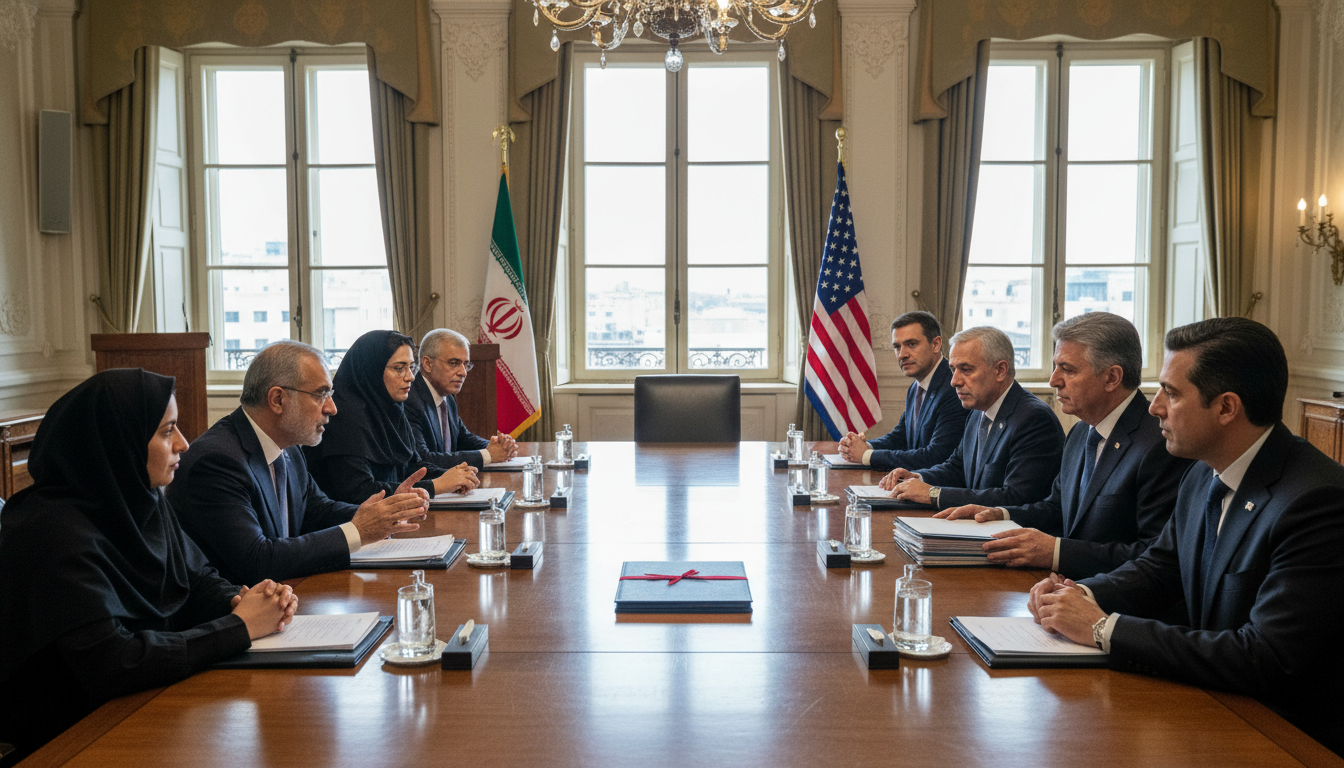
Iran Sets Guarantees as Condition in Iran-US Negotiations
Iran insists on firm guarantees for its rights as talks with the United States proceed, complicating Iran-US negotiations over ceasefire, sanctions and nuclear assurances.
Iran Conditions Deal on Guarantees
Iran’s chief negotiator, parliamentary speaker Mohammad Bagher Ghalibaf, said Sunday that Tehran will not approve any agreement unless it has concrete guarantees that “the rights of the Iranian people” are fully protected.
The statement, broadcast on state television, reflected Tehran’s insistence that verbal commitments are insufficient and that any protocol must include verifiable measures on sanctions relief and access to frozen assets.
Iran’s stance closes a major gap with Washington, which has signalled that a key priority of the talks is preventing Tehran from acquiring a nuclear weapon while restoring freedom of navigation through the Strait of Hormuz.
U.S. Revises Offer as Trump Highlights Nuclear Pledge
U.S. officials signalled a firmer negotiating position this week after reports that President Joe Biden’s administration had sent a revised draft protocol to Tehran.
President Biden, in media remarks, emphasised that Washington’s central guarantee is that Iran will not acquire nuclear weapons, and he framed recent exchanges as evidence of Tehran’s renewed commitment to that pledge.
U.S. outlets have reported that the American proposal hardens language on enforcement and sequencing, a move designed to secure Western concerns while creating political cover for concessions on sanctions.
Sanctions, Frozen Assets and Control of the Strait
Tehran says lifting U.S. sanctions and unfreezing Iranian assets are non-negotiable rights and must be part of any final settlement.
Iran also insists on maintaining some leverage over the Strait of Hormuz, a strategic chokepoint through which a significant share of global oil shipments transit, after having effectively curtailed traffic early in the war.
Washington has opposed any permanent Iranian control of the strait and responded with a partial port blockade in mid-April, underscoring how economic and maritime issues remain at the core of the impasse.
Escalation Risks and U.S. Military Signals
Senior U.S. defence officials warned this week that military options remain on the table if diplomacy fails, with the Pentagon describing American forces as prepared to resume strikes against Iranian targets if necessary.
CENTCOM reported an operation in which a missile strike disabled the engine room of a Gambian-flagged cargo vessel attempting to reach an Iranian port, a move Washington said was aimed at enforcing maritime restrictions.
Iran’s Islamic Revolutionary Guard Corps meanwhile claimed it shot down a U.S. MQ-1 drone accused of preparing hostile operations near Iranian waters; the U.S. military did not immediately confirm the incident, highlighting the persistent danger of miscalculation.
Fighting in Lebanon and Israeli Ground Advances
The conflict’s spillover into Lebanon is a central Iranian demand for cessation, as Tehran seeks a halt to Israeli operations against Hezbollah before addressing nuclear issues.
Israel has expanded operations in southern Lebanon, crossing the Litani River and seizing strategic positions including the medieval Beaufort fortress, which Prime Minister Benjamin Netanyahu described as a pivotal gain.
The intensification has prompted calls for emergency United Nations Security Council action and an evacuation directive for areas south of the Zahrani River, reflecting the growing humanitarian and diplomatic pressure.
Diplomatic Roadblocks and Possible Scenarios
Negotiators face a sequence problem: Tehran wants a protocol that ends hostilities and unlocks economic relief before detailed nuclear discussions, while the U.S. and allies demand enforceable nuclear constraints before lifting major sanctions.
Analysts say a phased approach with independent verification mechanisms could bridge the gap, but political timelines and domestic constituencies on both sides complicate compromise.
Oil markets and regional partners are closely watching the talks, since an agreement could ease global energy prices and maritime risk, while a breakdown could prompt renewed military responses and broader economic ripple effects.
The talks underscore a precarious balance between diplomacy and deterrence, with both sides trading public assurances and private demands as they test whether guarantees can be written into a durable protocol.
