
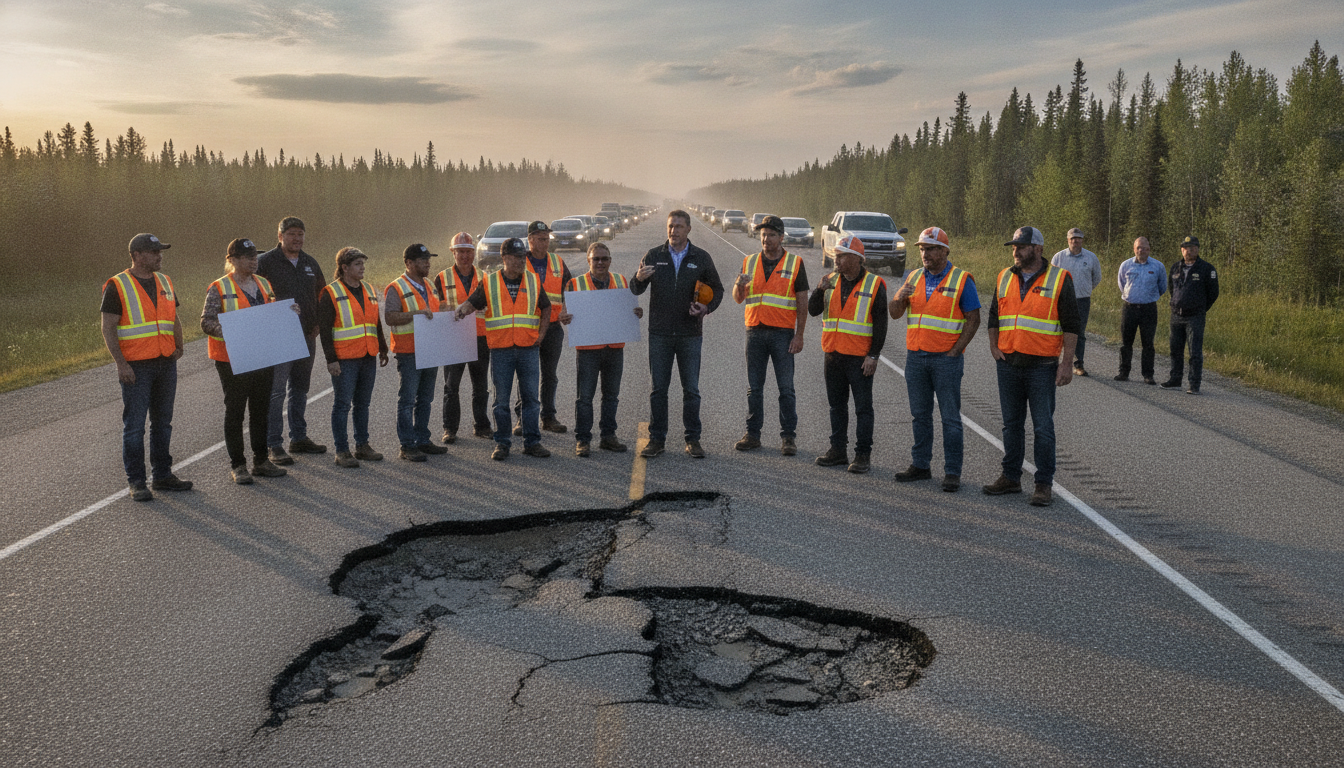
Highway 63 potholes prompt residents and contractors to fill damaged road in Fort McMurray
Residents and contractors filled Highway 63 potholes on June 12, 2026, after drivers reported thousands in vehicle damage and officials signalled a provincial response.
Spring thaw drives volunteers to repair downtown stretch as drivers report costly vehicle damage, prompting mayor to seek municipal control of road.
For nearly a year residents and businesses in Fort McMurray have been reporting an unusually high number of potholes along Highway 63, and on June 12, 2026 dozens of volunteers and local contractors took matters into their own hands and began filling holes that they say are damaging vehicles and disrupting traffic. The phrase Highway 63 potholes became a common complaint in conversations across the city this spring as drivers shared photographs and repair bills. The community action drew attention from municipal and provincial leaders, who acknowledged the severity of the problem and discussed accelerated timelines for road oversight and repairs.
Volunteers and contractors respond on June 12, 2026
On June 12, 2026 volunteers arrived with pylons, shovels and a truckload of asphalt to repair a stretch of Highway 63 passing through downtown Fort McMurray. Local contractors supplied heavy machinery and compactors, and volunteers directed traffic as they tamped down fresh material, describing the effort as a stopgap measure until formal repairs could be completed. The work was concentrated on an 18-kilometre section of the highway that residents say bears the greatest wear from heavy industrial traffic and winter freeze-thaw cycles.
Organizers said the initiative was driven by frustration after repeated vehicle damage over the winter and spring, and by a desire to make the road safer for commuters and commercial drivers. One volunteer described posting photos and documenting repairs to ensure provincial officials would follow up, while others said they wanted to protect neighbours from blowouts and rim damage. Municipal staff and councillors were observed speaking with contractors on site to coordinate any necessary traffic control and to ensure public safety during the volunteer-led repairs.
Drivers report thousands in repair costs and sudden tire failures
Homeowners and commuters have reported significant out-of-pocket costs attributed to the Highway 63 potholes, with several drivers saying repairs and replacements have cost them thousands of dollars. Residents provided specific examples of tire blowouts, bent rims and suspension work after striking large potholes that they said appeared without warning. One Fort McMurray driver told municipal officials that he spent more than $5,500 to repair damage after hitting a pothole, while another household reported $2,500 in combined vehicle repairs.
Those accounts reflect a broader pattern of complaints filed with local elected officials and social media groups in recent months, where photos of crater-like potholes and damaged wheels circulated widely. Businesses that rely on the highway for deliveries and employee commutes also reported disruptions and safety concerns. Insurance claim data tied directly to pothole damage can lag, but the volume of individual reports and the high cost of repairs has amplified pressure on the province and contracted maintenance providers to act more quickly.
Mayor seeks municipal control of an 18-kilometre stretch through the city
Sandy Bowman, mayor of the Regional Municipality of Wood Buffalo, told provincial officials he wants the municipality to oversee routine maintenance tasks — including pothole patching, line painting and ditch mowing — along the downtown segment of Highway 63. Bowman argued that local control would allow faster response times and closer quality oversight, but he emphasized the municipality should not assume the financial burden of provincial infrastructure. Discussions with the province, he said, have been constructive, and the recent deterioration of the road has accelerated talks about transferring responsibility.
The mayor proposed contracting arrangements that would let the municipality control maintenance contracts without billing local taxpayers for repairs that serve a provincial freight corridor. He told provincial representatives he was prepared to manage work crews and scheduling to ensure repairs align with local needs and commercial traffic patterns. The idea reflects a growing municipal desire to secure more direct management of the roadways that pass through urban areas, particularly when seasonal damage creates acute hazards for residents.
Provincial response and contractor role as asphalt plants restart
Provincial officials acknowledged the spike in potholes this spring and said seasonal conditions contributed to the problem, noting that asphalt plants in the region were starting production as temperatures rose. Alberta’s transportation minister indicated the province had heard concerns from Fort McMurray and that staff were addressing the issue as asphalt became available for more durable repairs. The minister also said the frequency of potholes increased after a prolonged winter and repeated freeze-thaw cycles.
The province contracts a private firm to maintain Highway 63, and officials confirmed the company had been tasked with patching and other seasonal maintenance. That contractor did not provide a statement in response to repeated inquiries. Officials said emergency and interim repairs would continue while engineering assessments determine which sections require larger-scale rehabilitation. The provincial timeline for transferring management of any section of the highway to the municipality remains under discussion, but ministers indicated the events of spring 2026 had accelerated internal reviews.
Engineering explanation: how spring thaw creates potholes
Potholes form when water penetrates pavement through small cracks, freezes and expands beneath the surface, then thaws and weakens the underlying materials. Repeated cycles of freezing and thawing and the weight of heavy vehicles cause the pavement to break and collapse, forming cavities that grow quickly under traffic. Regions that experience long winters and abrupt spring warming, like northeastern Alberta, are particularly vulnerable to this process because moisture-laden soils and sustained freeze conditions combine to undermine pavements.
Transportation engineers also note that modern heavy-haul traffic and increased axle loads magnify the effects of compromised subgrades. When maintenance budgets and response timelines are strained, small cracks can propagate into larger failures; timely sealing and drainage repairs are essential to prevent the progression. In Fort McMurray, residents and officials pointed to the volume of industrial transport as a factor that places added stress on the highway, especially on sections that were designed decades earlier for lower traffic intensities.
Political pressure and accountability from local MP and council
The federal Conservative MP for the region publicly described the highway as being in its worst condition in recent memory and outlined a series of constituent complaints that extended beyond potholes to lighting, snow clearing and localized flooding. Municipal councillors and the mayor said they had personally experienced vehicle damage in recent months and were coordinating documentation of complaints to press the province for faster action. The accumulation of local testimony, photographs and on-the-ground repairs has created political momentum for a clearer plan of accountability.
Elected officials emphasized that the road supports substantial economic activity in the Fort McMurray region and that its condition affects industry, municipal services and resident safety. They also noted that a transparent schedule for repairs and an agreed chain of responsibility would reduce the need for ad hoc volunteer responses. Officials asked the province to clarify maintenance standards, expected timelines for permanent repairs and any interim measures that would reduce further vehicle damage this season.
Community frustration leads to grassroots mobilization
The decision by residents to organize a volunteer repair effort reflected mounting frustration after months of negotiating with maintenance contractors and provincial agencies. Volunteers described spending an entire morning placing traffic cones, filling holes with asphalt and compacting patches so that vehicles could safely pass downtown. Organizers recorded work and circulated images to provincial officials and local media, hoping to spur follow-up and document the scale of the problem.
Those who volunteered said the effort was not intended to supplant formal maintenance but to provide immediate relief where larger crews had not arrived. Several participants said the repairs would likely be temporary, given seasonal stresses and the known limitations of small-scale patching on major highways. Still, the visible action underscored community concern and the willingness of residents to take collective steps to address pressing safety hazards.
Repair options and longer-term rehabilitation plans
Short-term pothole patching is a standard emergency response that fills cavities and restores a passable surface for drivers, but transportation engineers warn that these measures can be short-lived if the underlying pavement structure is compromised. The province is evaluating which sections of Highway 63 require full-depth reclamation, resurfacing or structural reinforcement, and those projects typically demand more time, specialized materials and larger budgets. Provincial officials indicated they will prioritize sections with the highest traffic volumes and the most significant safety risks.
Municipal leaders suggested that transferring control of the downtown stretch would allow more consistent maintenance such as line painting and cleaning, which can extend pavement life and improve safety. Any transfer, however, must be accompanied by clearly defined funding commitments and performance standards, municipal officials said. Experts recommend comprehensive assessments of drainage, subgrade composition and traffic loads before choosing a rehabilitation strategy to ensure that repairs last for multiple seasons.
What residents and motorists should expect in the coming weeks
Residents should expect interim patching to continue as asphalt plants ramp up production and crews move to the most damaged stretches, while longer-term rehabilitation proposals undergo planning and tendering. Motorists are advised to slow down in areas where repairs are in progress, obey temporary traffic control measures and report newly formed potholes to the municipal or provincial maintenance hotlines. Drivers should also document vehicle damage with photographs and repair invoices if they seek compensation through insurance or claims processes, recognizing that timelines for formal responses can vary.
Municipal and provincial officials said they will update the public on any agreed timelines for transfers of responsibility and on planned capital repairs. In the meantime, community groups and industry partners may coordinate further volunteer efforts to address immediate hazards, though officials stressed such actions are emergency measures rather than substitutes for scheduled maintenance.
This winter and spring’s damage on Highway 63 has exposed tensions between local expectations and the logistical realities of maintaining a high-volume provincial corridor. The recent volunteer repairs on June 12, 2026 have highlighted the willingness of Fort McMurray residents to mobilize, and they have increased pressure on provincial authorities and contractors to deliver durable fixes and clearer lines of accountability.
Local leaders have indicated that the conversation about municipal control of the road will continue in the weeks ahead, with an emphasis on ensuring taxpayers do not bear the full cost of maintaining a highway that serves regional industry and provincial revenue streams. As officials refine their plans, drivers are left to navigate repaired sections and newly formed potholes while awaiting more permanent rehabilitation. The coming months will test whether accelerated production at asphalt plants and renewed coordination between the province and the municipality can translate into safer, more reliable conditions on Highway 63.
