
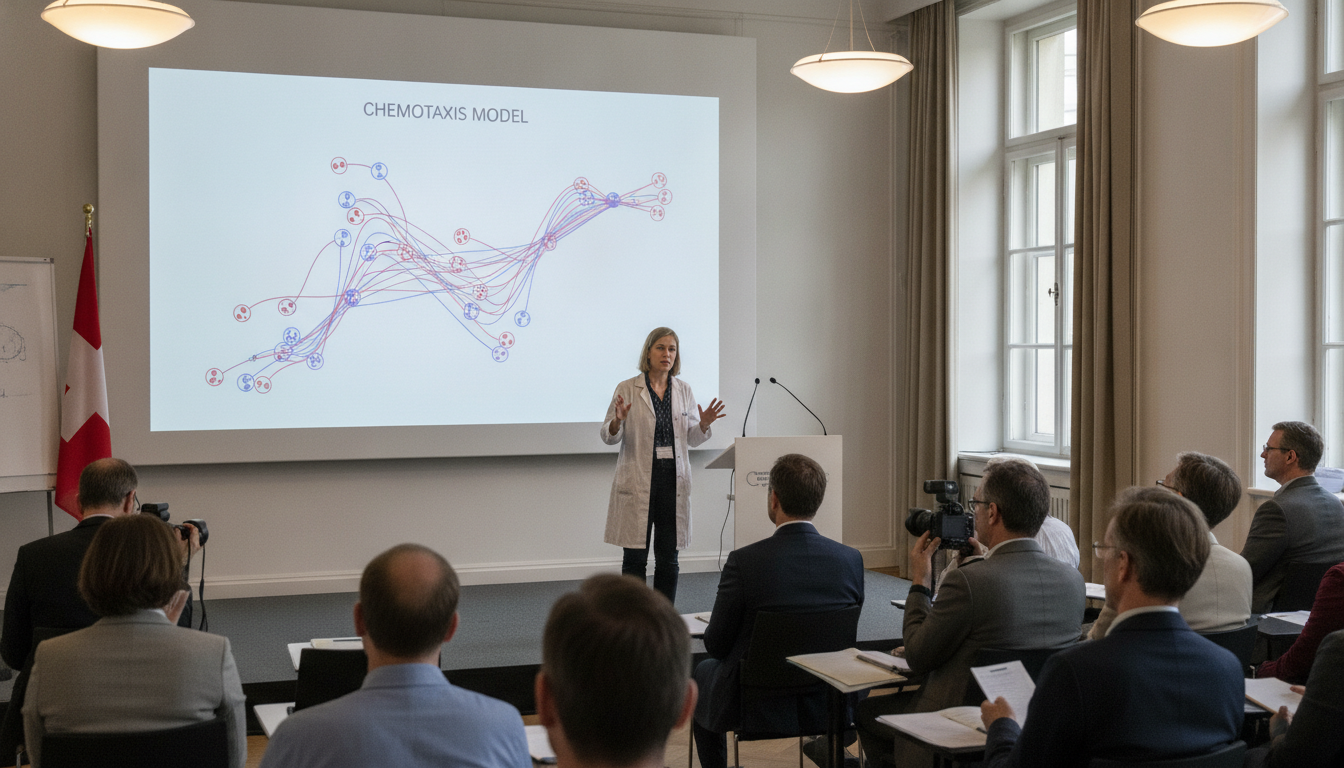
Hair follicle patterning explained by chemotaxis in Swiss study
UNIGE researchers reveal chemotaxis-based hair follicle patterning; mathematical simulations reproduce diverse follicle arrangements across two rodent species.
Swiss team maps mechanism behind hair follicle patterning
A team at the University of Geneva (UNIGE) has identified a simple biological mechanism that can explain how hair follicle patterning emerges during mammalian embryonic skin development.
Using a mathematical model grounded in cell movement in response to chemical signals, the researchers showed that hair follicle patterning can self-organize without a complex, global positioning signal.
The study focused on how placodes—embryonic skin structures that give rise to hair follicles—arrange themselves into regular geometric patterns.
Lead investigators Athanasia Tzika and Michel Milinkovitch and their colleagues combined experimental observations with simulations to test competing explanations for follicle placement.
Placodes and existing theories of follicle placement
Placodes are local clusters of epithelial cells in the embryo that mark the sites where hair follicles will form.
Until now, the dominant explanation for their spacing in laboratory mice was an expansion–induction model in which an already-formed placode emits an inhibitory signal to prevent nearby placodes from forming.
Under that expansion–induction framework, patterns arise because inhibitory molecules cast a “no-go” zone around early placodes, leaving gaps where new placodes can emerge as skin grows.
While this model accounted for ordinary lab mouse fur, it struggled to explain more oriented or anisotropic arrangements observed in some species.
Chemotaxis-based self-organization reproduces patterns
The UNIGE team proposed an alternative: chemotaxis-driven self-organization, in which cells migrate in response to gradients of a chemical signal produced by the epidermis.
They built a mathematical model coupling dermal cell movement with a diffusible epidermal signal and ran simulations of embryonic skin development.
The chemotaxis model reproduced the sequential appearance of placodes and the filling-in of gaps that characterizes follicle patterning.
According to the researchers’ simulations, local interactions between cells and chemical cues are sufficient to generate ordered distributions without a hierarchical, organism-wide positioning system.
Cross-species test with Acomys validates model
To test whether the mechanism was broadly applicable, the researchers applied the same chemotaxis model to a different rodent, Acomys dimidiatus, known for an unusually oriented fur pattern.
Where the classical expansion–induction model failed to capture the directional arrangement of Acomys follicles, the chemotaxis-based simulations matched the species’ distinctive architecture when species-specific biochemical and growth parameters were included.
The results indicate that modest changes in the strength, range or dynamics of cell–signal interactions can produce a wide variety of tissue architectures.
The team argues that evolutionary diversity in skin patterns may therefore arise from the same underlying self-organizing process acting under different biochemical contexts.
Methods, publication and scientific implications
The work combined imaging of embryonic skin, quantitative analysis of placode emergence and computational modelling calibrated to experimental data.
The detailed findings are reported by the authors in the Proceedings of the National Academy of Sciences, where they outline model assumptions, parameter choices and comparisons with observed patterns.
By demonstrating that chemotaxis-driven local interactions can recreate both common and unusual follicle arrangements, the study reframes questions about how patterned tissues form during development.
The approach highlights the explanatory power of relatively simple physical and chemical rules when coupled to biological growth processes.
Understanding the mechanisms that lay out hair follicles has relevance beyond basic developmental biology.
Insights into self-organization and signal-guided cell migration could inform work on skin regeneration, wound healing and engineered tissues, though practical applications will require further investigation.
The UNIGE findings suggest that hair follicle patterning in mammals can emerge from the same self-organizing mechanism across species, with differences in final architecture explained by variations in cellular and chemical parameters.
