
Alberta referendum campaign launched as “Unity Bus” tours province to keep Alberta in Canada
Forever Canadian campaign launches Unity Bus tour to encourage Albertans to vote to remain in Canada in an Alberta referendum set for Oct. 19, with volunteers mobilizing across the province.
Strong launch in Edmonton draws hundreds
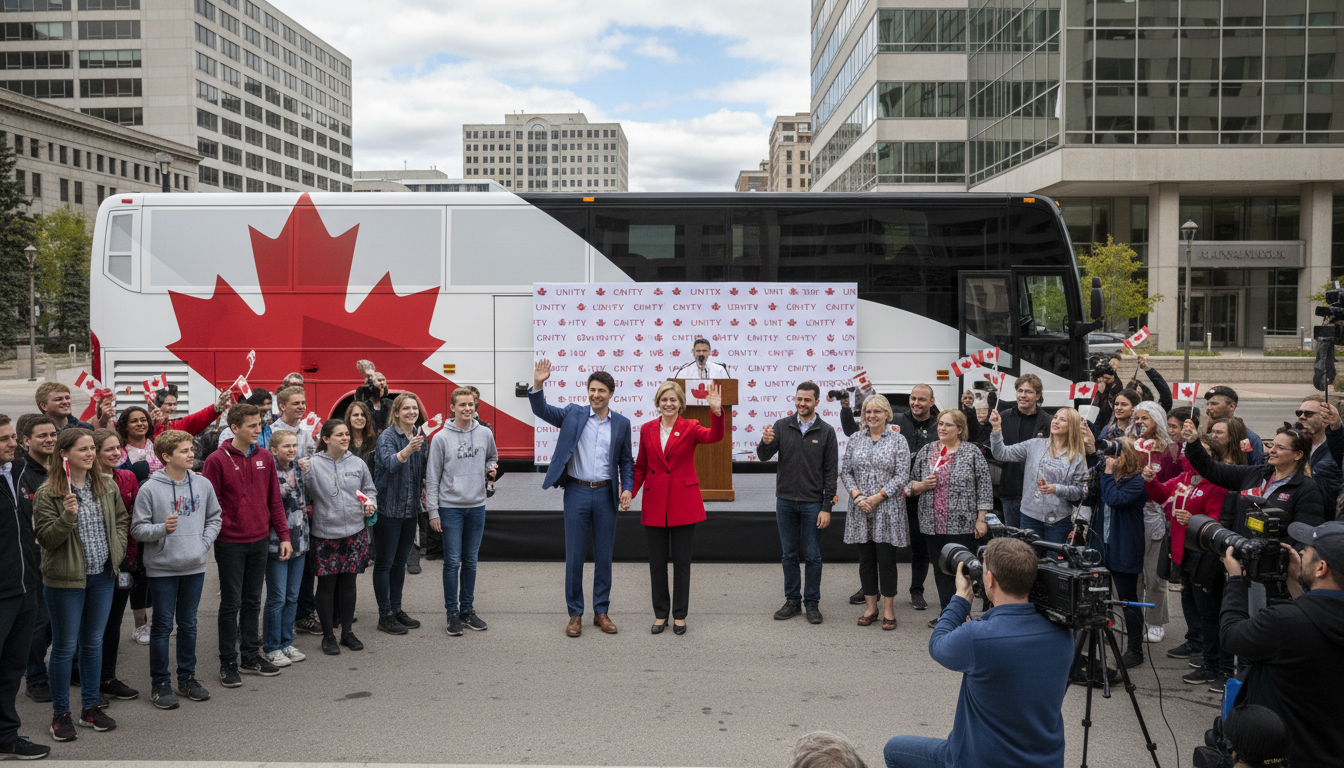
Hundreds of supporters in red-and-white gathered outside a newly opened campaign office in northwest Edmonton to mark the formal launch of the Forever Canadian effort.
Attendees waved Canadian flags, cheered as passing cars honked and joined together to sing "O Canada" in a show of federalist solidarity.
The crowd assembled as campaign founder Thomas Lukaszuk unveiled a blue-and-white "Unity Bus" that he said will crisscross Alberta over the summer and into the months ahead.
Lukaszuk told supporters the campaign’s immediate goal is to educate voters and maximize turnout in an Alberta referendum scheduled for Oct. 19.
Unity Bus to conduct door-knocking, lawn-sign drives and outreach
Lukaszuk said the Unity Bus will be the visible centrepiece of a provincewide effort that includes volunteers canvassing neighbourhoods, placing lawn signs and distributing information on voting procedures.
Campaign organizers described a multi-pronged approach combining in-person events at campgrounds and town halls with targeted voter registration drives and fact-checked materials aimed at clarifying what will be on the ballot.
Organizers emphasized the importance of turnout, saying they expect the campaign’s effectiveness will hinge on mobilizing a clear majority rather than narrowly winning a close vote.
The strategy aims to counter separatist messaging by offering practical information about referendum rules, voter registration deadlines and the stakes of an Oct. 19 question about Alberta’s place in Confederation.
Premier’s referendum announcement and what the question will ask
Premier Danielle Smith announced in a televised address that Albertans will be asked on Oct. 19 whether they want to remain in Canada or begin the process that could lead to separation.
Her government framed the ballot question as a mechanism to let voters decide Alberta’s future after months of political agitation over the province’s relationship with the federal government.
Smith has argued she could not directly place a separation question on a ballot after a judge quashed a separatist petition earlier this month, a ruling that the premier said her government will challenge in the courts.
The judge’s decision cited a failure to consult Indigenous governments when approving the petition, a legal requirement that has shaped the dispute over whether a separation question could be validated through petition.
Legal challenge and First Nations consultation at centre of dispute
The court ruling that halted a separatist petition found the provincial government did not meet its duty to consult First Nations before green-lighting the petition process.
That finding has been central to the legal debate over whether organizers of Stay Free Alberta — the separatist group behind the petition — followed the procedural rules required for a valid provincewide petition.
The separatist petition’s legal status remains unresolved and Elections Alberta has not verified the signatures collected by Stay Free Alberta.
By contrast, supporters of the Forever Canadian petition said their submission was verified in December, a detail the campaign has used to underscore its legitimacy in public arguments.
Signatures, verification and competing claims of public support
Premier Smith has pointed to two petitions — one federalist and one separatist — as evidence of strong public interest in putting the province’s future in Confederation on a ballot this fall.
The premier cited the combined total of the two campaigns’ signature counts as indicative of widespread desire among Albertans to decide the province’s status, though officials and observers note verification and legal hurdles remain distinct for each petition.
Forever Canadian organizers reported gathering more than 400,000 signatures, while the separatist petition has been reported to have roughly 300,000 signatures, though that figure has not been formally verified by election authorities.
Campaign officials emphasized that signature totals are politically persuasive but do not substitute for the legal requirements that govern ballot questions and referendum mechanics.
Political alignment and potential cooperation with federal Conservatives
At the launch, Lukaszuk signalled openness to working with federal Conservative figures who have publicly urged Albertans to vote to remain in Canada.
Lukaszuk said the campaign will include many smaller efforts and welcomed cooperation from politicians and organizations that share the objective of keeping Alberta within Confederation.
Conservative Leader Pierre Poilievre has said Conservative MPs will press for Albertans to vote to stay in Canada, and Lukaszuk indicated that such support would be folded into the broader Forever Canadian mobilization.
Campaign organizers portrayed the effort as a coalition of federalists and provincial supporters rather than a partisan operation, stressing a common aim over specific party alignments.
Federal presence and local voices at the launch
The campaign launch was attended by federal officials who framed the referendum as a pivotal moment for national unity and for Albertans who identify strongly as both province residents and Canadians.
Eleanor Olszewski, identified by organisers as the federal minister responsible for Prairies economic development and as the local MP, addressed the crowd and spoke about her personal ties to Alberta and Canada.
Speakers underscored that many Albertans see their provincial and national identities as intertwined and that the referendum forces a difficult choice about the relationship between the two.
Organizers and elected officials urged calm, facts-based debate and stressed that any decision should be made through lawful, well-understood processes that honor Indigenous rights and legal obligations.
Separatist response and questions about a rival campaign
Representatives of Stay Free Alberta, the separatist organization that has sought to put separation before voters, did not immediately indicate whether they will launch a separate provincewide campaign in response.
Mitch Sylvestre, identified as the head of Stay Free Alberta, had not responded to requests for comment on whether the group plans an organized ground campaign matching the federalists’ outreach.
Analysts and campaign strategists expect that an active separatist campaign, if mounted, would use similar tactics of canvassing, signage and regional events but with a focus on arguments for greater provincial autonomy or independence.
That potential competition for voter attention raises questions about the tenor of the public discussion in the months leading up to the October vote and the resources each side will bring to shore up support.
Turnout, voter registration and what to watch before Oct. 19
Campaign officials said they will place particular emphasis on explaining how to register for the referendum and on boosting turnout, which could prove decisive if the vote is close.
Organizers warned that low turnout could allow a motivated minority to shape the outcome, reinforcing the campaign’s focus on door-to-door outreach and visible signs of support in communities across Alberta.
Election authorities and legal experts caution that the mechanics of any referendum — including eligibility, thresholds for a binding result and post-referendum procedures — will determine practical consequences and require public clarity.
The campaign’s pledge to distribute fact-checked material on voting procedures is designed to reduce confusion and to ensure Albertans understand both the questions before them and the legal implications of their votes.
Wider implications for Canadian unity and Indigenous consultation
The dispute over petition approvals and the required consultation with First Nations has highlighted broader constitutional and reconciliation-related questions that will be part of the public debate.
Legal scholars note that obligations to consult Indigenous governments arise from constitutional principles and previous case law, and that failure to observe these duties can invalidate public processes with major political consequences.
Federal and provincial leaders have signalled the stakes extend beyond Alberta, with national unity, economic uncertainty and intergovernmental relations all potentially affected by the referendum outcome.
Observers say the coming months will test mechanisms for dispute resolution in Canadian federalism and will likely prompt renewed scrutiny of how governments engage Indigenous partners in decisions that affect lands, resources and governance.
Campaigners say they intend to keep the public conversation focused on practical concerns about the consequences of separation for pensions, trade, healthcare and federal transfer payments.
Forever Canadian representatives describe their messaging as grounded in facts about governance and the economic realities that would follow any move toward secession.
What voters can expect from campaign events and materials
The Unity Bus tour is scheduled to stop in towns across northern and southern Alberta, with planned events at community centres, campgrounds and public squares.
Organizers say volunteers will hand out printed material explaining registration deadlines, polling locations and the difference between a non-binding consultation and a legally binding referendum.
Campaign literature will, according to organizers, include checklists for voters, frequently asked questions about referendum procedures and summaries of what a vote for remaining in Canada would mean in practical terms.
Officials cautioned that the campaign will not be the sole source of information and urged voters to consult Elections Alberta and other official sources for final rules and instructions.
The campaign’s presence on social media and at public events aims to combine grassroots mobilization with targeted outreach in areas where support for separation has been reported to be strongest.
Organizers said they would monitor turnout patterns and adapt their strategy to focus efforts in regions where voter engagement may determine the final result.
As the Oct. 19 date approaches, both sides are expected to intensify efforts to sway undecided voters and to clarify their respective visions for Alberta’s future.
Observers anticipate a heated but ultimately civic-oriented contest, with both grassroots activists and political leaders seeking to shape public opinion through forums, debates and direct engagement.
Voters and community leaders are being reminded that legal rulings and appeals are likely to continue to affect the campaign’s landscape, and that official guidance from Elections Alberta will govern the actual referendum process.
Campaign officials on both sides have emphasized adherence to election rules and to respectful debate as they prepare for a campaign period that will stretch across the summer and into the fall.
Public reaction outside Edmonton reflected a mix of relief among federalist supporters and continued determination among separatist advocates to press their case.
Community groups and municipal officials have called for calm and for accessible information to ensure all eligible voters can participate knowledgeably on Oct. 19.
The coming months will test the ability of campaigners to translate signature counts and rallies into turnout, and to do so while navigating legal reviews and public scrutiny.
For now, the Unity Bus represents a visible, mobile symbol of the Forever Canadian campaign’s effort to keep Alberta firmly within Confederation as the province moves toward the October vote.
The campaign’s stated goal is clear: secure a decisive vote in favour of staying in Canada by combining grassroots outreach, partnerships with federal figures and a steady schedule of public events across Alberta.
