
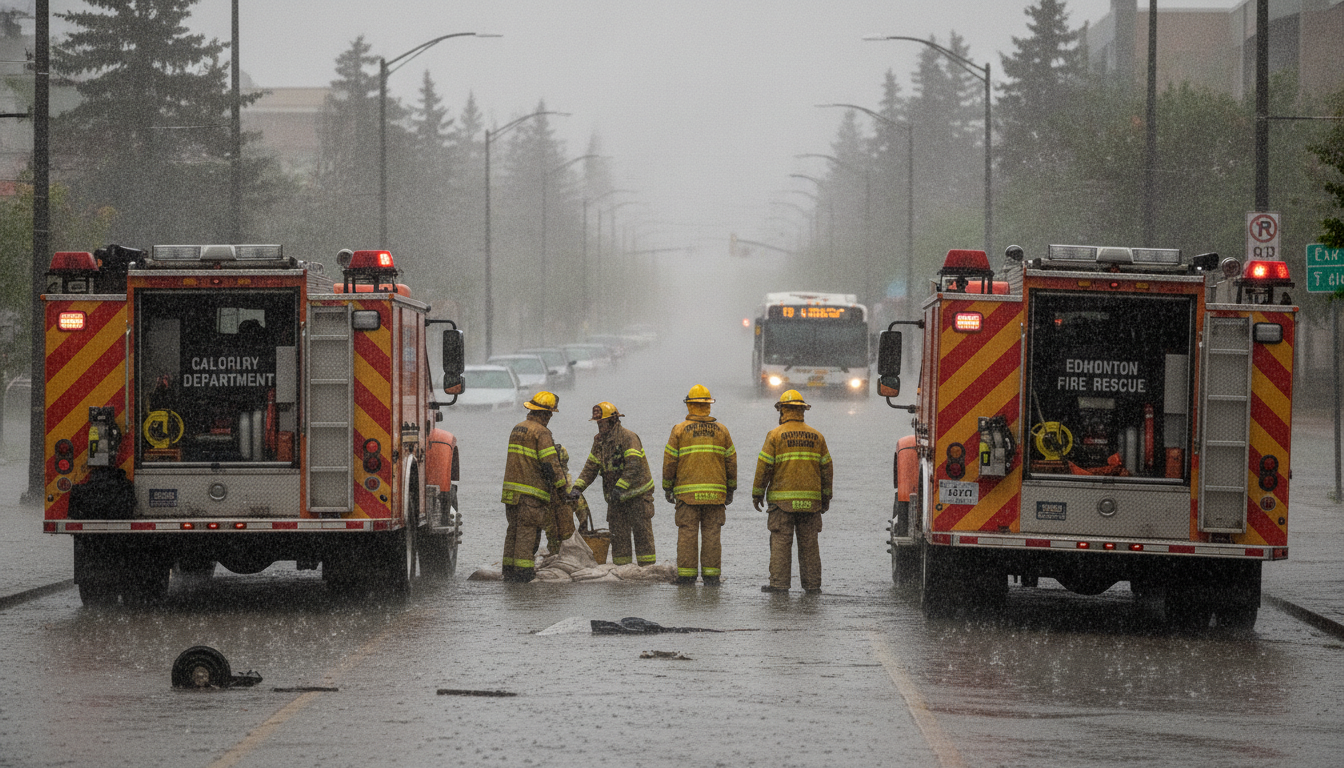
Edmonton flooding surges after June record; city braces as July inches toward historic total
Edmonton flooding has surged after an unprecedented June deluge and heavy July rains, leaving saturated soils, closed roads and damaged canopy across the city as crews scramble to respond.
Edmonton recorded an extraordinary 271 mm of rain in June, surpassing the previous June benchmark from 1914, and as of July 29, 2026 the city has received about 264.7 mm more this month, putting the region within reach of the all-time July total of 282.7 mm set in 1901. The rapid sequence of intense storms has left low-lying streets and trails temporarily converted into ponds and rushing waterways, hindering drainage where the ground can no longer absorb additional precipitation. City officials and utility crews say the combination of saturated soil and blocked drains has been the main driver of localized flooding and infrastructure disruption.
Extreme rainfall totals recorded in June and July
Edmonton’s June rainfall of 271 mm is one of the highest monthly totals in the modern record, officials confirmed, and July’s cumulative rainfall through July 29 stands at roughly 264.7 mm. Those totals mean the city has already eclipsed the old June milestone and is tracking toward a July record that has stood for more than a century. Meteorologists warn that the sequence of storms, amplified by broader climate patterns this season, is producing short-duration, high-intensity downpours that overwhelm traditional stormwater systems.
Saturated soil and overflowing ravines driving urban flooding
With soils across the region at or near saturation, much of the new rainfall runs off rapidly into streets, parks and ravines rather than soaking in. Low-lying areas — including sections of Mill Creek Ravine — have experienced fast-moving water and temporary channels where there are normally trails. The lack of infiltration also increases the risk of erosion and stresses storm-management infrastructure that was not designed for these sustained volumes.
Mutual aid from Calgary to tackle canopy and waste management
Facing a heavy workload from uprooted and fallen trees, Edmonton has activated a temporary mutual-aid agreement with Calgary to import additional forestry and waste management crews. Calgary teams began arriving to help clear downed branches, remove hazard trees and support the city’s parks service in preventing the spread of tree pests such as the elm bark beetle. City communications staff described the deployment as a swift example of Alberta municipalities coordinating resources during a weather emergency.
Epcor response and storm-drain clearing priorities
Epcor says its target is to clear reported catch basins within 24 hours, but unprecedented call volumes have stretched crews thin this week. The utility has asked residents to safely remove visible debris from storm drains when possible, and to contact Epcor at 780-412-4500 if a blockage cannot be cleared or if water continues to pool. Officials warn that blocked drains combined with saturated ground are a leading cause of flooded roadways and basements during these events.
Closures and transit detours across the city
Several roads and municipal facilities remain closed or operating on detours after the recent storms, with southbound Connors Road and a lane on Groat Road at 107 Avenue among the affected links. Edmonton Transit Service has rerouted multiple bus lines, including the 500X, 511 and 701, and motorists are being asked to avoid gravel roads where soft spots can develop under heavy loads. The city has also closed all sports fields and asked the public to stay off oversaturated turf to avoid long-term damage.
Indoor facilities and recreation centres impacted by flooding
A number of indoor venues were forced to close after weekend flooding, including the Reuse Centre at 6835 83 Street — which was expected to reopen on July 30, 2026 — Indigenous Peoples Experience at Fort Edmonton Park, Telus World of Science and several aquatic facilities. Pools, saunas and community leisure centres have been affected by water intrusion or safety inspections, and the city is triaging repairs while monitoring river valley water levels. Officials cautioned that reopening timelines will depend on inspections and cleanup progress.
The city’s urban forest has also suffered significant impacts; municipal inventories note Edmonton contains roughly 12.8 million trees overall, with about 380,000 located along boulevards and in parks where removal and restoration work will be concentrated. Fallen branches and canopy damage elevate the risk of pest outbreaks and require careful handling to prevent further loss.
Residents are being urged to take straightforward precautions: avoid floodwaters, report blocked drains and downed trees, obey posted closures and steer clear of submerged roadways. The city continues to update road closure maps and facility statuses as crews prioritize public safety and infrastructure repairs.
Emergency services and municipal staff say recovery will be measured and collaborative, with neighboring municipalities providing assistance and utilities ramping up call-handling and field operations. For now, the priority is restoring safe travel routes, reopening critical community services and reducing the short-term risk of pest and tree disease spread after the intense rainfall this season.
