
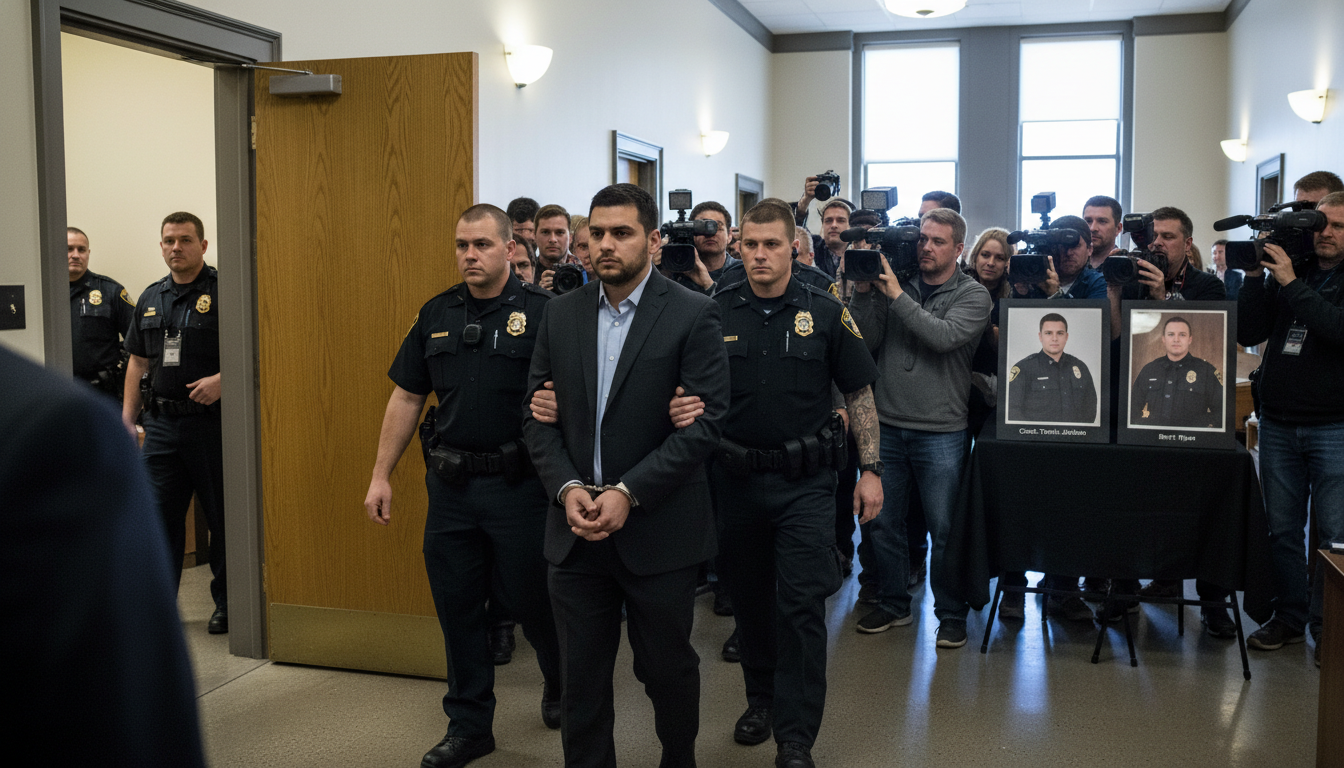
Dennis Okeymow guilty of manslaughter for supplying rifle used in 2023 Edmonton shootings
Dennis Okeymow guilty: Edmonton man convicted of manslaughter for selling a rifle used in 2023 shootings that killed two police officers and injured others.
An Edmonton court on Tuesday found Dennis Okeymow guilty of manslaughter and multiple related offences after a judge concluded he supplied the semi‑automatic rifle used in the March 2023 shootings that killed two Edmonton police officers and gravely injured others.
The verdict includes three counts of manslaughter, criminal‑negligence charges related to a firearm and several counts of causing bodily harm, reflecting the judge’s finding that Okeymow’s actions made the deaths foreseeable.
Sentencing will be scheduled at a later date, and the conviction marks a significant development in the years‑long criminal investigation into the twin incidents that shocked the city.
Court convicts Dennis Okeymow of manslaughter
Justice John Little told the courtroom that although Okeymow did not fire the weapon himself, by selling a high‑capacity semi‑automatic rifle to a teenager he knew or ought to have known the sale could lead to serious harm.
The Crown proceeded on evidence that Okeymow sold the firearm and ammunition to then‑16‑year‑old Roman Shewchuk in early 2023, and the judge accepted that the supplier bore criminal responsibility for the fatal consequences.
Beyond three counts of manslaughter, the verdict includes three counts of criminal negligence causing death and two counts of criminal negligence causing bodily harm, together with multiple lesser drug and trafficking offences to which Okeymow previously pleaded guilty.
Details of the March 12 Pizza Hut shooting
The first attack occurred in the early morning hours of March 12, 2023, at a Pizza Hut To Go near 133 Street and 114 Avenue in west Edmonton.
Rich Albert, then 55, was working as a delivery driver when a masked gunman entered, shot him in the head from close range and left the restaurant within seconds.
Albert survived but sustained catastrophic injuries, including loss of sight in one eye, retained bullet fragments in his brain, prolonged hospitalizations and long‑term cognitive and psychological effects that have left him unable to work.
Ambush at Baywood Park apartment that killed two officers
Four days later, on March 16, officers Const. Travis Jordan and Const. Brett Ryan responded to a domestic‑violence call at an apartment in the Baywood Park complex near 114 Avenue and 132 Street.
When the officers entered the hallway with the caller, they were immediately shot; both officers died at the scene after being struck by multiple rounds.
The attack also left the caller, Katerina Shewchuk, critically injured; she later escaped and sought help, and paramedics transported her to hospital for emergency surgery.
Forensic evidence connecting the two shootings
Investigators later tied the two incidents together through ballistic and DNA evidence recovered at both scenes.
A cartridge casing from the Pizza Hut shooting was matched to the rifle recovered at the apartment, and DNA found on a knife outside the restaurant was linked to the apartment’s occupant.
Police also found additional ammunition and other material in the apartment that connected the firearm to both attacks, forming a central pillar of the Crown’s case against Okeymow as the supplier.
How the rifle changed hands and the criminal sale
Court documents show the semi‑automatic rifle had originally been purchased legally in 2016 but passed through multiple hands before Okeymow sold it to Roman Shewchuk in early 2023.
Prosecutors say Okeymow sold the rifle along with 80 rounds of ammunition for $2,500 — a sum they noted was well above the combined retail value of the items.
The Crown further pointed out that Okeymow did not provide safety or storage equipment such as a trigger or cable lock, a case or any protective gear when he transferred the weapon to the teenager.
Undercover Operation Miguel and the investigation that followed
Police launched a targeted investigation after identifying Okeymow as the person who furnished the rifle; that probe included an undercover operation that used the alias Miguel.
Authorities arrested Okeymow in July 2023 on an unrelated matter to create an opportunity for an undercover officer to develop contact, then monitored conversations and interactions as part of a broader trafficking investigation.
Investigators later executed a search at Okeymow’s home, seized his phone and obtained forensic evidence that the Crown said linked him to firearms trafficking and ultimately to the transfer of the rifle used in the killings.
Shooter’s history of mental‑health crises and treatment
Court records introduced during the trial documented a history of serious mental‑health problems for Roman Shewchuk, including a diagnosis of schizophrenia and repeated psychiatric hospitalizations in 2022.
Family members and clinical staff described episodes of psychosis, auditory hallucinations and delusional beliefs that led to multiple emergency department visits and police interventions through the year before the shootings.
Records indicate that Shewchuk improved while hospitalized and on antipsychotic medication but that symptoms returned when he stopped treatment and resumed substance use after discharge.
Immediate aftermath for families and Edmonton police
The deaths of Consts. Travis Jordan and Brett Ryan prompted mourning across the Edmonton Police Service and the wider community, with both officers remembered by colleagues and family for their service.
Jordan had served eight and a half years with EPS and Ryan five and a half years; both were married and left behind grieving spouses, and Ryan’s wife was pregnant at the time of his death.
The shootings prompted renewed discussion within the city about officer safety, mental‑health crisis response and the flow of illegal firearms on to the streets of Edmonton.
Victim impact evidence and the long road to recovery
At trial, victim impact evidence detailed the long‑term consequences for survivors, notably Rich Albert’s persistent neurological impairments and psychological distress.
Albert has reported memory loss, anxiety, depression and permanent blindness in one eye, alongside ongoing medical needs and the loss of his ability to work.
Katerina Shewchuk suffered serious injuries in the apartment shooting and has been left to manage trauma while the family copes with the deaths and the loss of their son.
Legal theory behind charging a supplier for another’s killings
The Crown framed Okeymow’s liability on the principle that supplying a dangerous weapon with ammunition can amount to criminal responsibility when the supplier knew or ought to have known the risks.
Justice Little’s judgment emphasized the foreseeable danger of giving a semi‑automatic rifle and a large quantity of ammunition to a minor, particularly given the context of prior drug‑based relationships and the absence of safeguards.
The conviction illustrates prosecutors’ ability to pursue manslaughter and criminal‑negligence charges against facilitators in violent incidents, not solely against those who fire the weapon.
Community safety concerns and policy questions raised
The case has renewed debate in Edmonton and across Alberta about how firearms circulate illicitly and how youth with severe mental illness are identified and supported.
Advocates and officials have pointed to intersections between substance use, untreated mental illness and access to high‑capacity firearms as areas that require coordinated policy responses.
Police and mental‑health services face continuing pressure to improve crisis interventions that can prevent violent escalations in domestic settings and elsewhere.
Next steps for sentencing and possible appeals
A sentencing date has not yet been set, and the court will hear submissions on an appropriate punishment after the pre‑sentence process is completed.
Okeymow faces multiple counts that carry significant periods of incarceration, although precise outcomes will depend on judicial weighing of aggravating and mitigating factors and statutory ranges.
The defence may consider appellate options following sentencing, and legal observers say issues around causation and the scope of supplier liability could form part of future litigation.
Reflections from law enforcement and legal experts
Law‑enforcement spokespeople stressed that the verdict underscores the seriousness with which courts may treat those who traffic firearms into communities.
Legal analysts observed that the case required the Crown to link the supplier’s conduct to the eventual lethal use of the firearm, a connection the judge found persuasive based on the evidence presented.
The trial therefore sets a precedent for how criminal responsibility may be argued in cases where intermediaries rather than shooters furnish weapons used in fatal incidents.
Final paragraph
The conviction of Dennis Okeymow brings a degree of legal closure to a sequence of events that devastated multiple families and left a community grappling with grief, but it also opens further questions about prevention, mental‑health care and illegal gun flows that Edmonton and policymakers must continue to address.
