
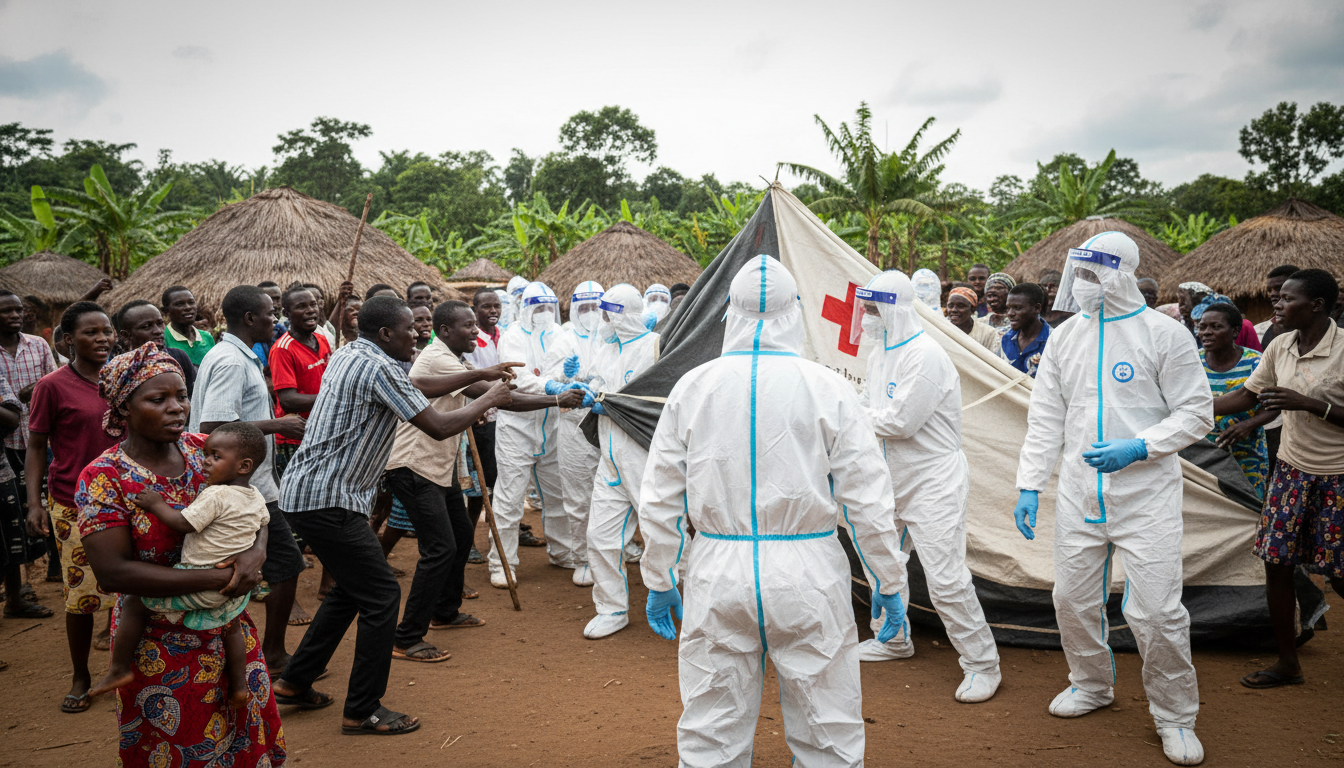
Ebola in Congo: Mistrust and Grief Undermine Response in Mongbwalu
Ebola in Congo outbreak in Mongbwalu is being complicated by deepening mistrust, rising fatalities and threats against health teams, hindering efforts to contain transmission and care for the ill.
In the remote mining town at the centre of the Democratic Republic of Congo outbreak, families are grieving while many residents question the existence or severity of the disease, slowing cooperation with responders. Local hospitals report suspected cases and deaths even as supplies and emergency kits arrive from international organisations. Rising doubt and isolated attacks on health workers have added a security dimension that is limiting testing, treatment and safe burials.
Mistrust and denial take hold in Mongbwalu
Many residents in Mongbwalu express disbelief that Ebola is present in their community, with families reluctant to accept official diagnoses or public-health guidance. That disbelief has been fuelled by a combination of unfamiliar symptoms, deaths despite treatment, and a lack of rapid, widely available confirmatory testing. Health officials say the resulting reluctance to report illness and to accept protective measures is accelerating spread and undermining contact tracing.
Hospitals report increasing suspected deaths without confirmed tests
Clinics and the main hospital in town are receiving more patients with suspected Ebola, but laboratory confirmation has lagged, leaving clinicians and families in doubt. Without timely test results, clinicians must treat and isolate based on symptoms, which strains limited isolation capacity and makes outcomes uncertain. The uncertainty contributes to community scepticism when people die despite receiving care, reinforcing the perception that medical teams cannot stop the disease.
Burial practices amplify transmission risks
Traditional burial customs, which can include direct contact with the deceased, are colliding with infection-control protocols designed to prevent spread from bodies that remain highly infectious. Trained teams clad in protective equipment are attempting to manage and disinfect remains, but enforcement is difficult when families seek customary rites or mistrust responders. Public-health workers warn that unprotected contact with corpses is a major driver of onward transmission in this outbreak.
Health workers face intimidation and attacks
Front-line staff have reported threats and, in some instances, physical attacks that force responders to withdraw or reduce services, according to local accounts. The hostilities increase the operational risks for teams trying to conduct testing, treatment and safe burials, and they deter outsiders from supporting a full-scale response. As a result, health agencies are adjusting tactics to prioritise staff safety even as caseloads climb.
Security and access limited by armed groups
The region’s complex security environment — including armed militias and rebel groups — constrains the movement of patients, supplies and response teams, complicating logistics and surveillance. Humanitarian flights and convoys are being coordinated carefully to avoid confrontations, and some deliveries now require security escorts. These restrictions slow the distribution of critical hygiene kits, personal protective equipment and other medical supplies needed to care for suspected Ebola patients.
International assistance arrives amid operational strain
Emergency aid shipments have begun reaching the hospital treating suspected patients, bringing hygiene kits and medical equipment that clinicians say are urgently needed. International organisations are working with national authorities to bolster testing capacity, provide protective gear and support safe-burial teams, but the speed and scale of assistance are constrained by access and community trust. Officials acknowledge that supplies alone will not stop the outbreak without parallel efforts to rebuild confidence and to engage local leaders.
Families of the deceased have voiced frustration and confusion when hospital reports of Ebola are not corroborated quickly by tests, leaving bereaved relatives uncertain about accepting infection-control measures. That skepticism has led some to reclaim bodies for private funerals and to avoid treatment centres, creating additional chains of transmission that are hard to trace. Public-health experts emphasise the need for transparent communication and rapid diagnostics to help close that trust gap.
Outreach aimed at community leaders, faith groups and traditional healers is being scaled up to explain how the virus spreads and why safe burials and isolation are necessary, but progress is uneven. Successful containment will depend on persuading families that measures protect them and their neighbours, not on imposing directives from outside. Health teams are also exploring culturally sensitive adaptations that allow some rituals while eliminating high-risk contact.
The situation in Mongbwalu underscores the dual public-health and social challenge posed by the current Ebola in Congo outbreak: responders must deliver medicines, tests and safe-burial capacity while also confronting fear and misinformation that undermine those interventions. Until community trust is restored and security conditions improve, officials warn the response will face persistent obstacles that could extend transmission beyond this mining town.
