
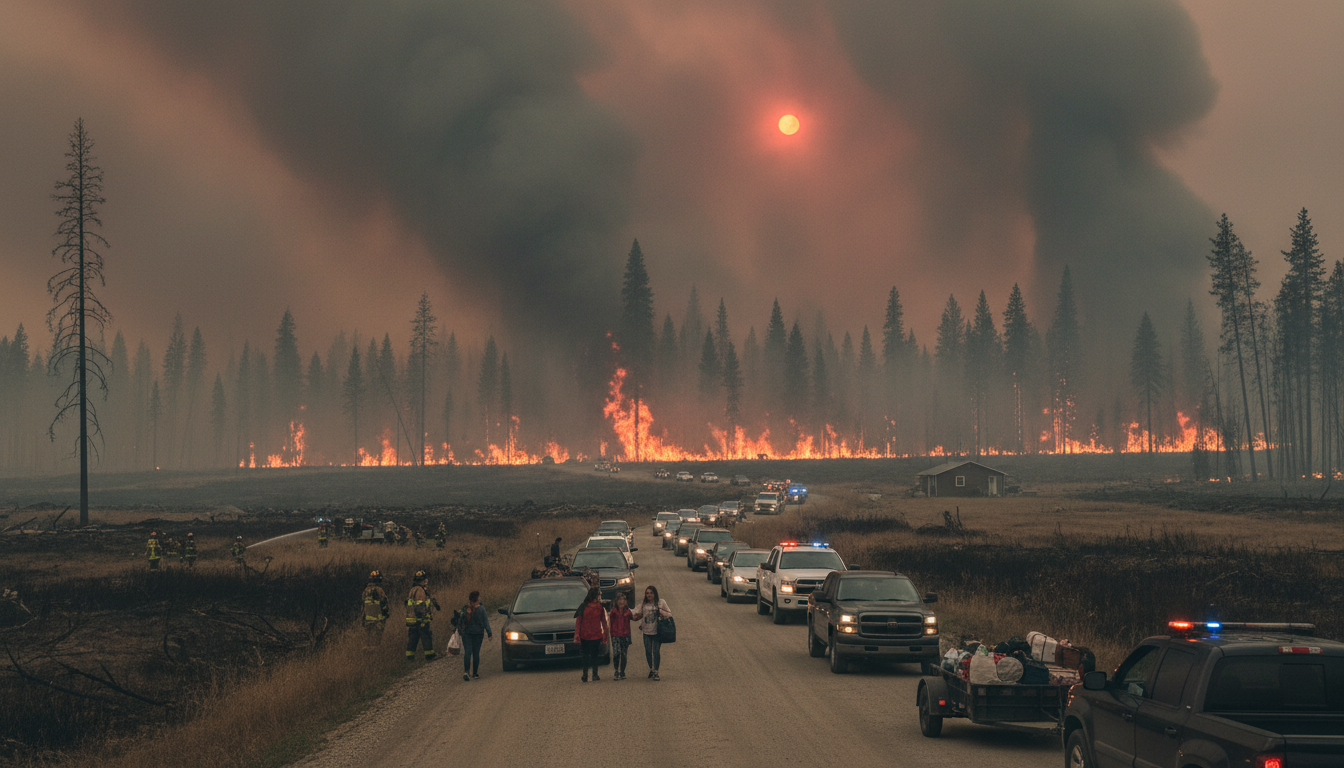
Sundre wildfire grows past 1,000 hectares; evacuation alert issued in Clearwater County
Sundre wildfire surpasses 1,000 hectares; evacuation alert issued for southern Clearwater County as crews battle fast-moving blaze amid extreme fire conditions.
A rapidly spreading wildfire north of Sundre has grown to more than 1,000 hectares, prompting authorities to issue an evacuation alert for parts of southern Clearwater County. The Sundre wildfire is centred roughly five kilometres north of James-Wilson Provincial Recreation Area and is threatening properties west of Range Road 80 and north of the James River. Emergency services ordered campers and backcountry travellers to leave a 10-kilometre zone around Highway 734 near the Highway 584 junction as crews work to contain the blaze. Provincial and local agencies described the fire as out of control and warned that dry fuels and high winds created conditions for a fast-moving, high-intensity incident.
Evacuation alert and travel restrictions
Clearwater County issued an evacuation alert covering the southern portion of the county, advising all residents, campers and visitors in the defined area to prepare to leave immediately if conditions worsen. Blockades were established at key access points including the corners of Highways 734 and 591, Coal Camp Road and Highway 734, and on Highway 584 east of Highway 734 to prevent entry while crews respond. Sundre RCMP urged the public not to enter the affected area and to revise travel plans, especially over the long weekend when recreational activity typically increases. The alert remains in effect as crews prioritize life and property safety while monitoring fire behaviour.
Fire behaviour and contributing conditions
Officials said the Sundre wildfire expanded rapidly due to strong winds and very dry vegetation, with forest fuels described as extremely dry across the region. Alberta’s fire warning placed Calgary and surrounding areas under an extreme fire warning, signalling a heightened risk of fast-spreading, high-intensity fires that are difficult to control. Fire managers reported that shifting winds initially accelerated the fire’s growth, then eased slightly as temperatures dropped and humidity rose, offering some relief to crews. Investigations into the fire’s origin are ongoing, though fire officials emphasized that current weather and fuel conditions are the principal drivers of the recent spread.
Response: firefighters, aircraft and equipment
Firefighting efforts have involved ground crews, heavy equipment and helicopters equipped for night operations, with additional crews and machines brought in to bolster containment work. Alberta Forestry and Parks indicated air tankers would be requested when conditions allow, and aircraft may scoop water from nearby lakes such as Cow Lake, Swan Lake or Burnstick Lake to support suppression efforts. Night-vision-equipped helicopters were deployed to work after dark, and crews focused on establishing containment lines while protecting infrastructure and homes at greatest risk. Authorities continue to coordinate provincial and municipal resources to manage the incident and maintain public safety.
Closures, bans and municipal responses
Alberta Parks closed the James-Wilson Provincial Recreation Area until further notice as a precautionary measure given the fire’s proximity and smoke. Clearwater County has instituted a fire restriction in its Non-Forest Protection Area, while neighbouring Mountain View County upgraded a restriction to a full fire ban and the Town of Sundre enacted its own ban. Local officials said bans were enacted not only because of current conditions but also in recognition of strained firefighting resources that could be stretched if multiple fires occur. Both counties are maintaining communication with forestry officials and stand ready to provide mutual aid if requested.
Community impact and local observations
Camp operators and residents near the fire described disruptions to weekend plans and growing concern as smoke became visible from nearby vantage points. Ken Edwards, manager of Camp Teepee Pole east of the blaze, said scheduled bookings were cancelled as a precaution and staff monitored smoke conditions closely. Clearwater County Reeve Jordon Northcott noted that while the potential for wildfire is a recurring risk in dry years, local fire departments train and prepare for rapid-response situations. Mountain View County Reeve Angela Aalbers said her municipality was watching developments closely and emphasized regional cooperation to protect communities.
Regional fire activity and broader outlook
The Rocky Mountain House Forest Area, where the Sundre wildfire is burning, has recorded multiple wildfires since the start of the year, highlighting the season’s elevated risk. Provincial officials reported 36 wildfires in that forest area since January 1, underscoring the need for heightened vigilance as warm, dry conditions persist. Forecasted cooler temperatures, lighter winds and higher humidity over the coming days should aid suppression efforts, but officials cautioned that recovery will depend on weather trends and resource availability. Residents in surrounding communities were advised to monitor official channels for updates and to follow evacuation and road closure notices.
As response operations continue, emergency crews are focused on protecting life, property and critical infrastructure while assessing containment prospects for the Sundre wildfire. Authorities encourage the public to heed evacuation alerts, avoid travel into affected areas, and report any new smoke sightings promptly to help firefighting teams allocate resources effectively.
