
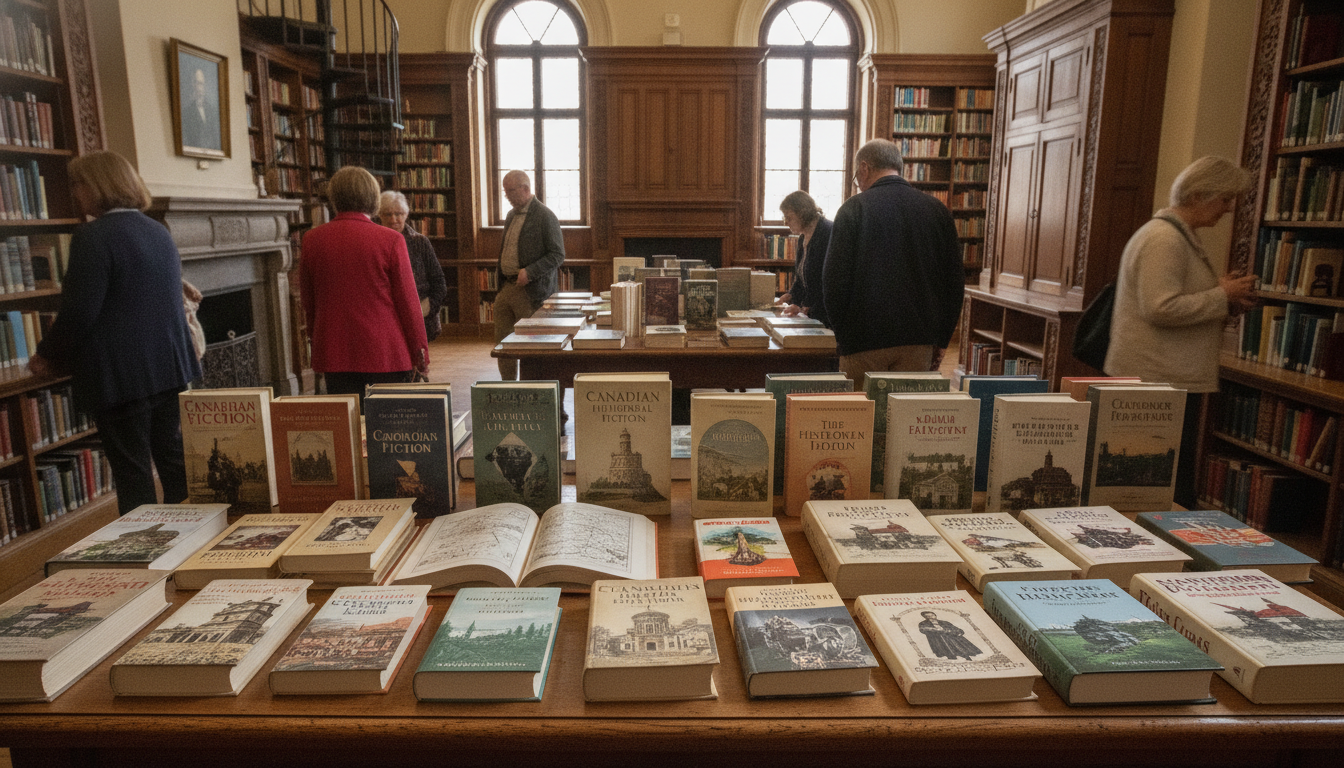
Canadian historical fiction novels to read now: CBC Books spotlights new and notable titles
A curated summer reading list of Canadian historical fiction novels, from 17th‑century Quebec to Expo ’67 Montreal, with brief synopses and author notes.
CBC Books highlights recent Canadian historical fiction novels
CBC Books has assembled a fresh selection of Canadian historical fiction novels that span centuries and continents, offering readers varied entry points into the past.
The roundup brings together new and notable works that revisit moments from 17th‑century New France to mid‑20th‑century prairie life and the social upheavals of the 1960s and 1970s.
The list is notable for its range of voices, including Indigenous, immigrant and queer perspectives, and for its mixture of intimate domestic narratives and larger public histories.
Readers will find both standalone stories and dual‑timeline mysteries that interrogate memory, identity and how personal lives intersect with broader historical forces.
Tara Gereaux explores concealment and community in Wild People Quiet
Tara Gereaux’s Wild People Quiet, set in 1940s Saskatchewan, centers on Florence, a Métis woman who carefully constructs a life of anonymity in a predominantly white town.
She alters her appearance and speech to avoid detection, but the arrival of seasonal Métis farm workers forces her to reckon with a past she has long kept hidden.
Gereaux, who is a citizen of the Métis Nation‑Saskatchewan and writes from Regina, frames Florence’s choices against the pressures of small‑town conformity and the uneasy possibilities of belonging.
The novel examines the emotional costs of passing and the ways community can both threaten and save those trying to survive in hostile social environments.
Heather Marshall and Genevieve Graham use dual timelines to unearth secrets
Heather Marshall’s Liberty Street unfolds in 1961 Toronto and pivots between an investigative journalist’s undercover work in a women’s prison and a later detective’s search that connects to cold remains.
Marshall, who writes from near Toronto, uses this structure to link institutional failures to long‑buried personal stories.
Genevieve Graham’s The Chambermaid’s Key likewise employs a past‑and‑present architecture, moving between 1929 and modern‑day Toronto as it follows a maid at a grand hotel and a contemporary building inspector.
Graham’s novel probes labour hierarchies, class disparity and the ways physical spaces can retain traces of violence and secrecy across decades.
Both novels use archival impulses and institutional scrutiny as engines of plot, inviting readers to consider how official records and personal memory diverge.
Their dual timelines make history tangible by showing how decisions made in one era reverberate into the next.
Blair Palmer Yoxall and Jennifer Chevalier revisit frontier justice and early colonial Quebec
In Treat Them as Buffalo, Blair Palmer Yoxall sets the action in 1855, focusing on a boy and a circle of women contending with a cousin’s disappearance and a justice system that refuses to act.
The book foregrounds grassroots resistance and the labor of women who refuse to be sidelined when institutions fail them.
Jennifer Chevalier’s The Winter Witch sends two sisters from Normandy to 17th‑century Quebec after scandal upends their prospects at home.
Chevalier explores religious belief, the search for safety in a new land and the complex figure of Jeanne Roy, a woman rumored to have powers in early Montreal.
Both works examine survival strategies in eras of acute precarity and show how gendered power and superstition shaped everyday life.
They also contribute to a broader trend in Canadian historical fiction of centering marginalized perspectives previously relegated to the margins of official narratives.
Christine Estima and Ben Ladouceur probe intimate lives through letters and nightlife
Christine Estima’s Letters to Kafka imagines Milena Jesenská’s life in post‑World War I Vienna and the correspondence and brief meetings that form a fraught, literary bond.
Estima frames translation as both livelihood and portal, and she investigates how desire and intellectual partnership intersect in an unsettled Europe.
Ben Ladouceur’s I Remember Lights turns to Montreal during Expo ’67, following a young gay man whose brief romance is later shaped by a 1977 police raid on a gay bar.
Ladouceur, primarily known as a poet, draws on memory and the city’s celebratory and traumatic moments to depict how public spectacles and state violence inform private lives.
Both titles use close, emotionally resonant storytelling to illuminate the stakes of love and expression in different historical contexts.
They underline how gestures—letters, conversations, a night out—can become vessels for longing, risk and resilience.
Ray Nayler and Janie Chang center survival and secrecy in global historical backdrops
Ray Nayler’s Palaces of the Crow follows four young fugitives navigating forests and wartime threats as they flee both Nazi and Soviet forces.
The novel emphasizes survival, interdependence and small moments of human connection in the face of systemic violence.
Janie Chang’s The Fourth Princess takes place in 1911 Shanghai, inside a once‑forsaken mansion where an American mistress and her secretary uncover secrets amid shifting social orders.
Chang’s narrative combines atmosphere with the political turbulence of an international settlement on the cusp of national transformation.
Nayler and Chang expand the scope of contemporary Canadian historical fiction by situating stories in transnational landscapes, showing how Canada’s literary culture engages with global histories.
Their books suggest that the nation’s writers are increasingly willing to place Canadian authorship in conversation with wider geopolitical upheavals.
Kate Hilton, Ray Nayler and authors tackling museums, archives and institutional history
Kate Hilton’s City of the Muse juxtaposes a 1903 archaeological dig in Egypt with a present‑day Toronto archivist’s frustrated career, knitting together questions of provenance, museum politics and buried crimes.
The novel interrogates who tells the story of objects and what happens when institutional authority meets ethical ambiguity.
Several of the titles on this list, including Hilton’s and Graham’s, tap into an archival impulse that drives plot through discovered documents, objects or renovation reports.
Those narrative devices allow authors to dramatize the process by which the past is curated and to spotlight the ethical stakes of museums, television archeology and archival stewardship.
These works encourage readers to think about history not as a fixed ledger but as contested material—records and relics subject to interpretation, manipulation and reclamation.
They also reflect a broader literary interest in how professional roles—archivist, inspector, journalist—mediate access to truth.
Diversity of perspective and the contemporary return to historical inquiry
The CBC Books roundup highlights authors from a variety of Indigenous, immigrant and regional backgrounds, and many novels foreground characters historically excluded from the record.
This diversification extends the reach of Canadian historical fiction novels by foregrounding stories of labour, migration, gendered violence and cultural crossing.
Writers on the list balance research and imaginative reconstruction, often using literary devices such as letters, dual timelines and first‑person interiority to bridge documentary gaps.
The result is fiction that both entertains and complicates how readers understand the social contexts that produced recorded events.
By centering previously marginalized voices and by deploying narrative strategies that emphasize subjectivity and material culture, these books participate in an ongoing reappraisal of what constitutes the national past.
They ask readers to weigh empathy alongside evidence when encountering histories that were long silenced or simplified.
Summer reading suggestions and where to start
For readers who prefer grounded domestic drama, Tara Gereaux’s Wild People Quiet and Genevieve Graham’s The Chambermaid’s Key offer intimate perspectives on hidden lives and the slow reveal of long‑held secrets.
If you gravitate toward international settings and wartime survival, Ray Nayler’s Palaces of the Crow and Janie Chang’s The Fourth Princess provide atmospheric, high‑stakes narratives.
Those intrigued by archival mysteries and institutional critique will find Kate Hilton’s City of the Muse and Heather Marshall’s Liberty Street satisfying, as both novels hinge on discoveries that reconfigure personal and public histories.
For readers seeking lyrical treatment of queer histories and intimate correspondence, Christine Estima’s Letters to Kafka and Ben Ladouceur’s I Remember Lights offer emotionally precise engagements with desire and memory.
Mixing titles from different sections of this list makes for a reading program that alternates restraint and spectacle, domestic detail and geopolitical sweep.
That variety reflects a current in Canadian fiction that values both local specificity and transnational curiosity.
These novels also make readable complements when paired: try a prairie‑set identity story with an archival Toronto mystery, or a Europe‑centred love story with a wartime survival tale.
Pairings like these can help readers track how similar themes—belonging, secrecy, resilience—play out in distinct historical and geographic registers.
The CBC Books selection serves as a reminder that historical fiction remains a vital way to interrogate the present by inhabiting the past.
Each novel on the list contributes a different set of questions about how we remember, whom we remember and what we do with the stories we inherit.
Whether guided by archival curiosity, devotion to character or interest in geopolitical sweep, readers will find books that illuminate the forces that shaped private and public lives.
Those looking for a summer backlog can turn to this curated set for a mix of lyrical prose, suspenseful plotting and ethical inquiry.
For readers and book clubs alike, these titles open opportunities for conversations about the ethics of storytelling, representation and the responsibilities of historical imagination.
They also offer models for how fiction can complicate tidy narratives of nationhood and identity.
If you are assembling a summer reading list, consider selecting one title from each thematic cluster represented here to sample the breadth of contemporary Canadian historical fiction novels.
Doing so will showcase voices from the Prairies, Toronto, Montreal and transnational settings, and will offer a varied portrait of historical engagement in current Canadian letters.
The list compiled by CBC Books underscores the range and ambition of novelists working in historical fiction today, and it highlights how Canadian writers continue to push the form into new terrains.
Readers will find stories that are intimate and expansive, and that use the past to illuminate the questions that still matter in the present.
