
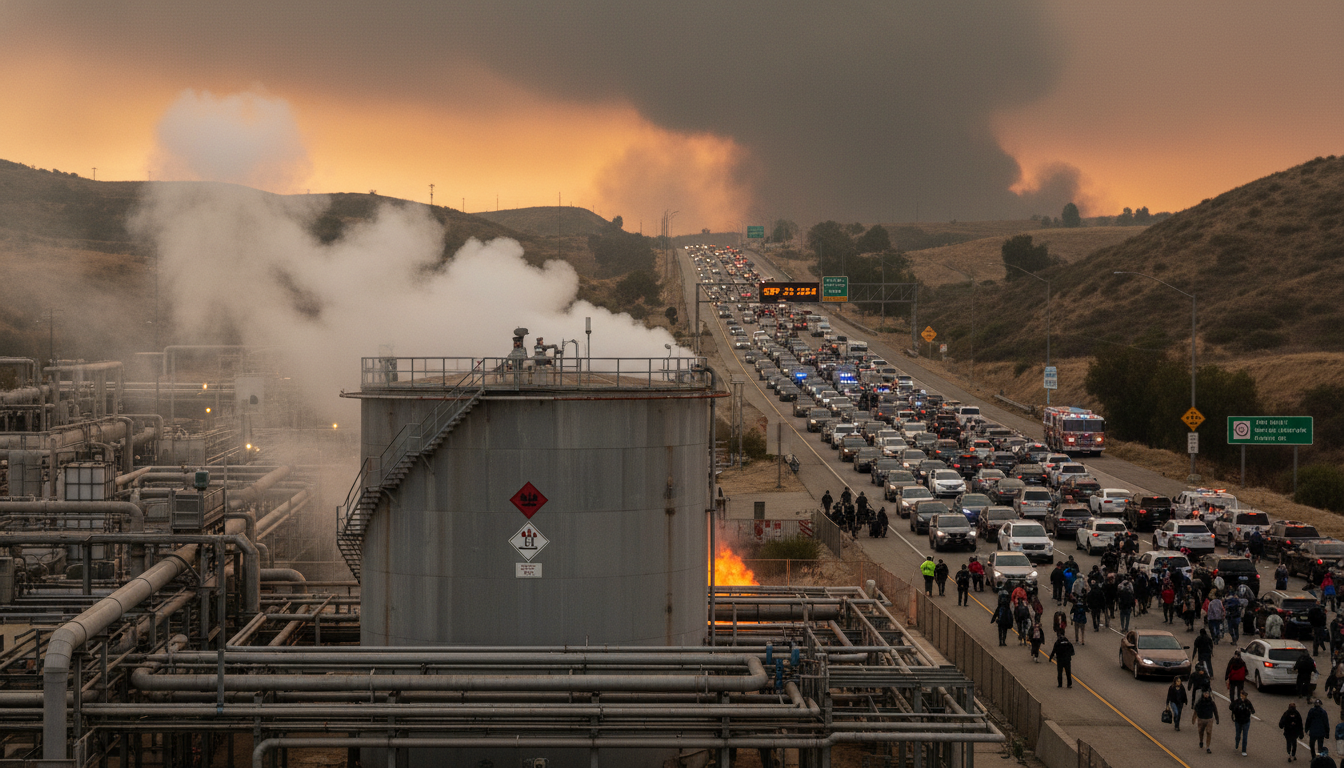
Methacrylate Tank Heats Near Garden Grove, Prompting Evacuation of About 40,000 Residents
California crews scramble to cool a 26,000-litre methyl methacrylate tank after temperatures rose, triggering evacuations and water barriers to protect coastal waterways.
A large storage tank holding roughly 26,000 litres of methyl methacrylate began heating steadily near Garden Grove in Orange County, California, prompting authorities to order the evacuation of about 40,000 residents in suburban Los Angeles. Emergency crews reported the liquid’s temperature climbed from about 25°C to 32°C, and firefighters described the increase as a grave risk that could lead to a rupture or explosion. Officials moved quickly to cool the tank and establish protective measures for nearby communities and waterways while investigators work to determine the source of the leak.
Evacuation Order and Affected Communities
The evacuation notice issued for the wider suburban area sought to remove tens of thousands of residents from potential exposure and blast risk. Local authorities identified neighborhoods in and around Garden Grove as most at risk and advised residents to follow emergency routes and shelter orders from county officials. Emergency shelters and information centers were opened to assist displaced families and to coordinate reunification and medical screening for anyone with exposure concerns.
Temperature Rise Spurs Explosion Concerns
Fire command reported that the product temperature rose from about 25°C to 32°C over the course of a day, and described an average increase of roughly one degree Fahrenheit per hour. That rate of heating led officials to treat the situation as time-sensitive because methyl methacrylate is a flammable liquid whose vapor and pressure behavior can escalate rapidly under heat. Firefighters and hazard specialists said preventing a thermal runaway or structural failure of the tank is their top priority to avoid a catastrophic release of flammable vapors.
Firefighters Employ Continuous Cooling Measures
Crews responded with sustained cooling operations, using fire hoses to keep the tank and adjacent storage units at lower temperatures. Aerial footage broadcast by local media showed multiple cylindrical tanks being sprayed continuously by water streams, with fire personnel rotating shifts to maintain the response. Commanders emphasized that cooling is intended to control internal pressure and to limit vapor formation while containment and monitoring systems remain in place.
Health Risks from Methyl Methacrylate Exposure
Public health officials warned that methyl methacrylate can irritate the skin, eyes and respiratory tract and that acute or prolonged exposure may trigger respiratory and neurological symptoms. The U.S. Environmental Protection Agency identifies the substance as an irritant with potential to cause more serious effects depending on concentration and duration of exposure. Authorities urged evacuated residents and first responders to avoid the plume, use protective equipment if required, and seek medical attention for coughing, eye burning, dizziness or other concerning signs.
Environmental Protections and Waterway Safeguards
Because the site lies only a few kilometres from coastal waters, responders moved quickly to deploy physical barriers and absorbent booms to prevent chemical runoff from reaching streams or the ocean. Teams are preparing containment berms and diversion channels to channel any spilled product away from storm drains and open water. Officials also described ongoing sampling of soil and runoff at strategic points to detect contamination and to guide cleanup should product escape containment.
Risk Area Mapping and Ongoing Monitoring
Emergency maps released by the county fire department show a primary impact zone of roughly 330 metres around the tank where an explosion would likely cause major damage. That same mapping indicates a secondary band beyond that radius where lighter damage or nuisance effects could be experienced depending on wind and blast direction. Command staff said the only people immediately at risk within those areas are emergency personnel working on site, thanks to the preemptive evacuations, and stressed that monitoring equipment is being used to track pressures, temperatures and air quality in real time.
Investigators have not yet publicly identified the cause of the leak that led to the heating, and authorities said forensic inspections and a structural assessment of the tank are underway. County and state environmental regulators are coordinating with fire services to document the incident, supervise containment, and prepare for longer-term remediation if needed.
Community leaders and emergency managers continue to brief the public as conditions evolve, urging residents to remain informed through official channels and to respect evacuation boundaries until officials declare the area safe. No injuries have been reported so far, but officials cautioned that the situation could change if the tank’s temperature cannot be stabilized.
Emergency teams said they will maintain cooling and monitoring operations until the tank can be secured and temperatures decline to safe levels.
