
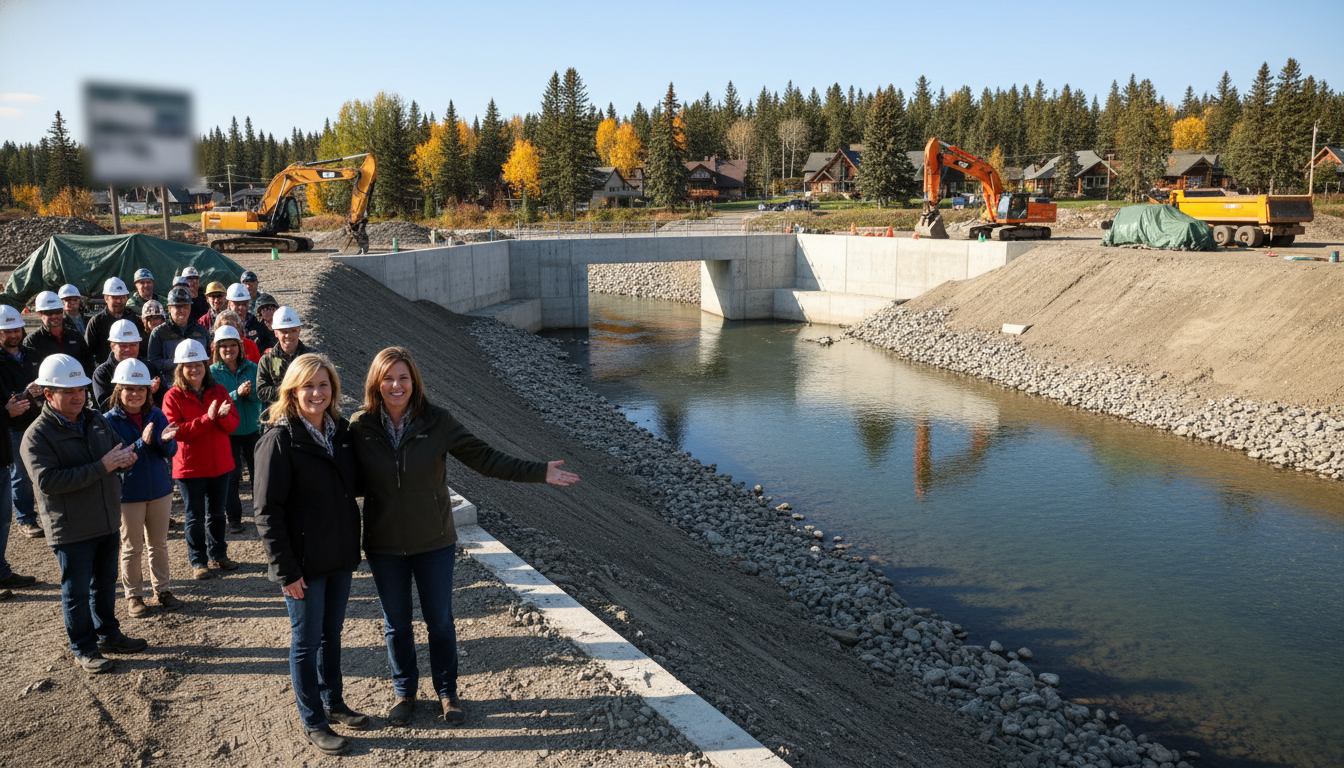
Bragg Creek flood mitigation keeps hamlet safe after early June rains
After three days of heavy rain in early June 2026, Bragg Creek flood mitigation measures helped the hamlet avoid damage, easing fears rooted in the June 2013 flood.
Storms and swollen creek prompt community watch
Residents in Bragg Creek spent early June watching river levels closely after three days of steady rainfall produced high flows in the Elbow River system. Longtime locals reported checking the creek frequently, citing the dark, churning water and memories of the catastrophic June 2013 flood. Municipal and provincial monitoring systems showed higher-than-normal flows but officials did not issue evacuation orders for the hamlet during this weather episode. The community’s vigilance, coupled with improved river infrastructure, kept homes and businesses clear of the worst outcomes seen 13 years ago.
$42 million in works reshaped the flood line
Following the 2013 disaster, provincial and federal investments upgraded Bragg Creek’s flood defenses with bank stabilization, retaining walls and more than four kilometres of berms. The province provided $36.4 million and the federal government added $5.8 million, together delivering roughly $42.2 million in local mitigation projects. Those structures were designed to redirect floodwaters away from residential and commercial areas and to reinforce vulnerable stretches of the creek. Officials say the combination of engineered barriers and naturalized bank work has materially reduced the hamlet’s exposure to high flows.
Resident memories of 2013 remain vivid
Many people in the hamlet still recount the images from June 2013, when more than 300 properties were damaged and more than 1,100 residents were evacuated. Some homeowners, whose basements and ground floors were inundated, have since taken practical steps to reduce future losses, investing in sump pumps, raised utilities and self-mitigation plans. Kathleen Burk, a realtor and long-term resident, said that while questions about flood risk used to dominate homebuyers’ concerns, those inquiries have eased as mitigation and preparedness have improved. For those who lived through the flood, the memory is both a warning and a motivator to stay prepared.
Not all infrastructure offers the same protection
The hamlet’s upgraded berms and bank work are standalone protections, but large regional projects affect risk differently depending on their location. The Springbank Off-stream Reservoir — an $850-million dry dam built downstream of Bragg Creek — will divert Elbow River flows during extreme events but does not shield the hamlet because of its siting. Some residents, including Dick Koetsier whose home was swept away in 2013, say they would have preferred upstream solutions that might have protected Bragg Creek directly. Others acknowledge the trade-offs in regional planning and emphasize that the local works remain crucial for immediate resilience.
Preparedness and community response sharpened since 2013
The flood prompted changes in how the hamlet organizes emergency response and how households prepare for high water. Local residents report clearer evacuation routes, better communication channels and more consistent maintenance of berms and drainage channels. Homeowners who experienced loss in 2013 have shared practical advice with neighbors on property-level mitigation and emergency kits. That informal knowledge transfer, together with municipal planning, has reduced panic during recent heavy rains and helped ensure the community can act quickly if conditions worsen.
Engineered protection reduces but does not eliminate risk
Engineers and municipal officials caution that no single project can remove flood risk entirely, particularly as climate patterns evolve and extreme precipitation events become less predictable. The berms and bank stabilizations lower the probability of local flooding, but very large or prolonged storms could still overwhelm local defences. Residents and authorities plan continued monitoring, maintenance funding and periodic reassessments of the river corridor to ensure protections keep pace with changing conditions. Investment in emergency planning and property-level measures remains part of the community strategy.
The early June weather tested Bragg Creek’s improved defences and the community’s readiness, and this time the hamlet avoided the extensive damage of 2013. Residents say the mitigation work has restored a measure of confidence while reinforcing the reality that living beside a river carries ongoing risk.
