
Bow Glacier Falls trail reopens after deadly 2025 rockslide
Bow Glacier Falls trail in Banff reopens after year-long closure following the June 19, 2025 rockslide; Parks Canada posts new signage and risk zones now
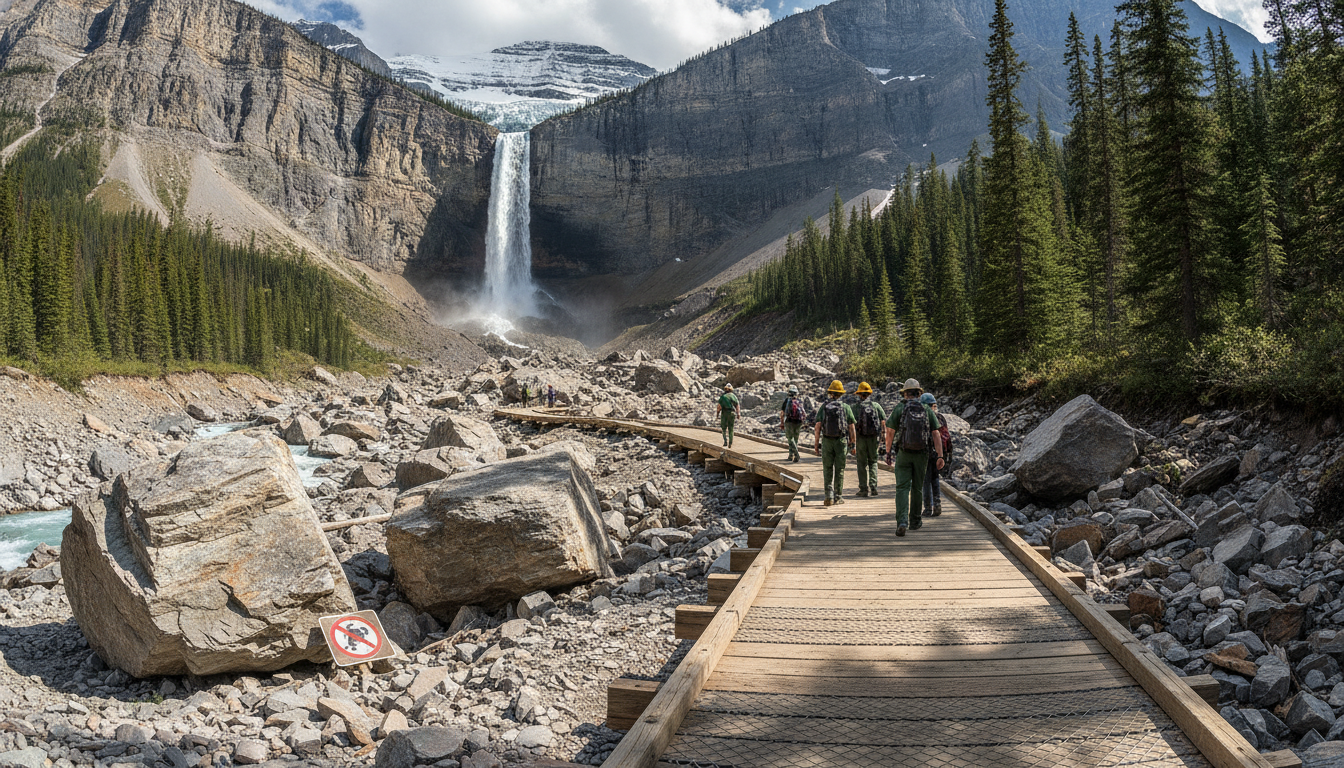
The Bow Glacier Falls trail in Banff National Park has reopened in July 2026 after more than a year of closure following a fatal rockslide on June 19, 2025. Parks Canada said the decision follows a detailed geotechnical assessment and the installation of updated warning signs that mark the official end of the maintained trail. Visitors are being reminded that mountain hazards remain and that the reopening does not remove all risk.
Trail Reopened After Year-Long Closure
Parks Canada announced the reopening in a Thursday statement, allowing access to the established route up to clearly marked limits. The agency said work focused on mapping rockfall hazard zones and improving on-site warnings so hikers understand where official maintenance and safety assessments end.
The agency identified lower-risk sections that may be used by visitors and higher-risk areas that remain off-limits or require extra caution. Signs now point out where the maintained trail ends and explicitly warn that continuing beyond those markers increases exposure to rockfall.
Geotechnical Assessment and Risk Zoning
The reopening followed a comprehensive geotechnical review of slopes above the falls and along the valley walls. Engineers assessed rock stability, potential fall paths and areas where natural processes make rockfall more likely to occur.
Those findings were used to draw risk zones and inform the placement of new signs, according to Parks Canada. The assessment allowed officials to reopen portions of the route judged to be lower risk while clearly delineating sections where rockfall potential remains significant.
June 19, 2025 Rockslide That Prompted Closure
On June 19, 2025, a rockslide on the approach to Bow Glacier Falls killed two hikers and injured others, prompting the park closure the following day. The victims were identified as 70-year-old Calgarian Jutta Hinrichs and 33-year-old Hamza Benhilal, who had been visiting from Vancouver.
Emergency responders airlifted two other injured hikers via STARS air ambulance, and rescuers evacuated 13 people from the scene. At the time, Parks Canada said the event was the result of natural mountain processes and described it as neither predictable nor preventable.
New Signage and Visitor Instructions
New panels installed along the route clearly mark the end of the official trail and describe the elevated risk beyond those points. The signage emphasizes that rockfall risk is highest near the falls and the adjacent rockwall, with potential debris runout reaching lower slopes.
Parks Canada advises hikers to respect the posted warnings, to avoid steep slopes past the marked trail, and to travel with companions where possible. Officials also recommend staying alert to changing conditions and moving quickly through sections identified as higher risk.
Parks Canada Guidance and Ongoing Monitoring
In its reopening announcement, Parks Canada reiterated that natural hazards are an inherent part of mountain environments and that residual risk will persist. The agency urged visitors to choose trips that match their experience and comfort level and to recognize that backcountry travel always carries risk.
Parks Canada said it will continue monitoring conditions and reviewing hazard information for the area. Staff warned that while the geotechnical work reduced uncertainty in some areas, periodic rockfall remains a possibility and could occur without advance warning.
Impact on Local Recreation and Visitor Planning
The reopening restores access to a popular out-and-back route that draws day hikers and visitors seeking views of the falls and surrounding peaks. Local tourism operators and trail users have been advised to factor the new hazard signage into trip planning and to follow the updated instructions.
Park officials cautioned that the reopening is not an invitation to explore beyond the marked limits, and they encouraged trip planning that accounts for variable weather, route conditions, and personal ability. Groups with less experience are advised to consider alternative, lower-risk hikes elsewhere in Banff National Park.
Visitors should consult current Parks Canada guidance before travelling to Bow Glacier Falls and be prepared to alter plans if conditions or signage indicate heightened risk. The reopening restores access to the established trail but leaves in place clear boundaries and warnings designed to reduce exposure to rockfall.
