
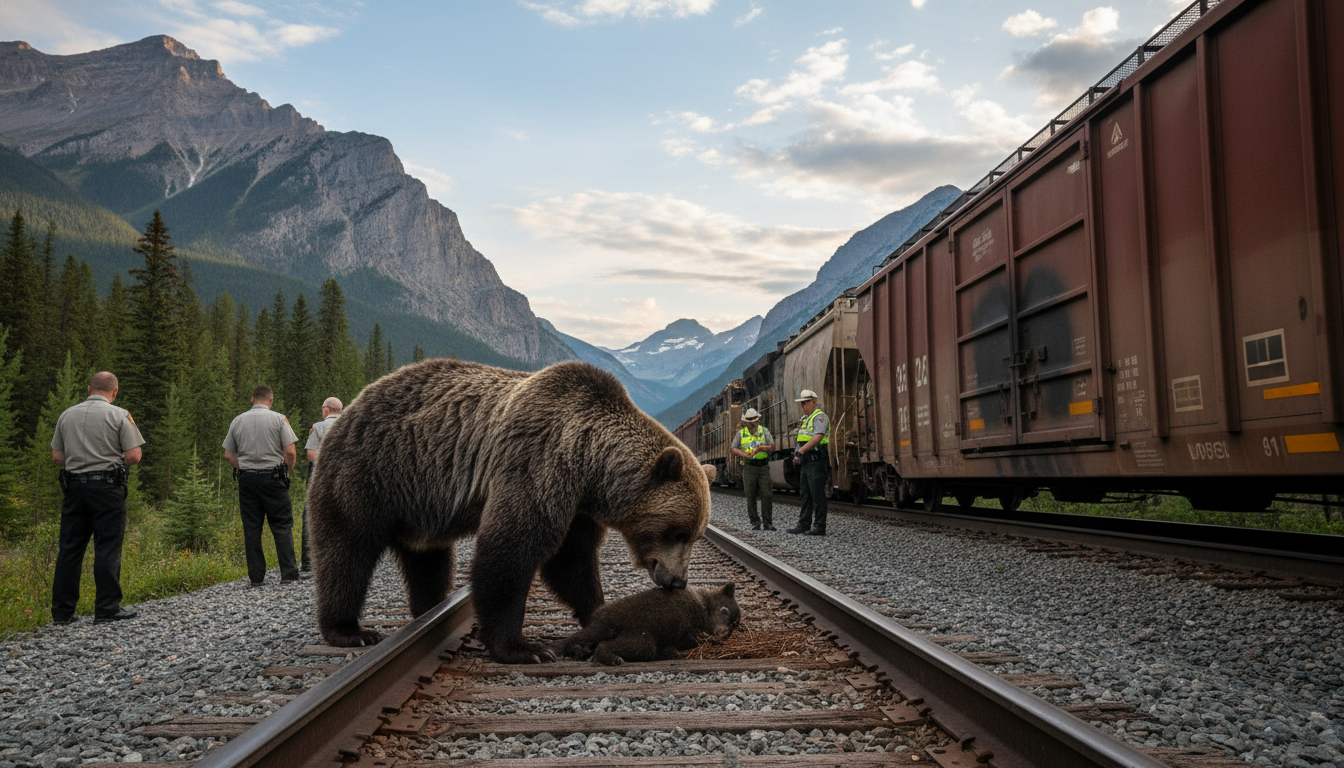
Banff grizzly cub killed by train sparks renewed calls for stronger rail safeguards
A young Banff grizzly cub killed by a train on May 17, 2026, has drawn fresh attention to collisions along the CPKC rail corridor and the broader challenge of protecting grizzly bears in Banff National Park. The incident, involving the well-known sow Bear 142 and one of her two cubs, was confirmed by Parks Canada and has prompted reactions from conservationists, researchers and the railway operator. The loss underlines persistent risks where wildlife and rail infrastructure intersect in the Bow Valley.
Bear 142, a familiar sow, lost a cub on the Banff rail line
Bear 142, an estimated 16-year-old female grizzly frequently seen near human activity in the Bow Valley, was photographed on the tracks in recent years and again captured in images after the incident. Parks Canada told reporters the cub, believed to be under a year old, was struck and killed by a train on May 17, 2026. The sow is the daughter of a widely known male grizzly and has a documented history in the valley, which makes this loss particularly visible to people who follow local wildlife.
Wildlife photographer Jason Leo Bantle, who has photographed Bear 142 with her cubs, described the event as heartbreaking and said the death resonates with other recent, high-profile grizzly losses in the region. Residents and frequent visitors to the Bow Valley say Bear 142’s presence near roads and rail has made her a familiar figure, and the violence of the incident has amplified concern among those who study and appreciate Banff’s wildlife. Parks Canada crews continue to monitor the area where the collision occurred and have coordinated with the railway on the immediate response.
Railway collisions have killed 19 grizzlies in Banff since 2005
Parks Canada records show that rail-related mortality has claimed 19 grizzly bears within Banff National Park since 2005, making the rail corridor one of the most persistent sources of human-caused bear deaths in the area. The Canadian Pacific Kansas City (CPKC) line that runs through the Bow Valley is a critical freight route, but it also crosses prime habitat and traditional travel corridors for bears. Trains and tracks present both a direct collision risk and indirect attractants that draw bears into harm’s way.
Observers note that several high-profile incidents have reinforced public alarm: in 2024 the white grizzly known as Nakoda died under circumstances that drew widespread attention, and Bear 142 herself lost a cub in 2020 after a conflict with a dominant male. Those episodes, together with the latest fatality, have highlighted how railway-related mortality compounds other threats to grizzlies in the region. Local photographers, conservation groups and some scientists have urged a re-evaluation of mitigation measures to reduce the frequency of strikes on the corridor.
Limited reproduction and small population increase the stakes for each loss
Grizzly bears reproduce slowly, and populations in the Bow Valley are small enough that every adult female plays an outsized role in future numbers. Current estimates put the Banff grizzly population at roughly 65 individuals, and provincial and federal listings reflect ongoing vulnerability: Alberta classifies the species as threatened, while the federal government lists them as a species of special concern. That combination of low numbers and slow reproductive rates means the death of even a single cub can have symbolic and demographic significance over time.
Female grizzlies typically begin breeding between five and eight years of age and then produce litters only every three to five years. Litter sizes are small and cub survival varies with food availability, predation and human-caused mortality. Conservation biologists warn that repeated losses of young or adult females from collisions could slow population recovery and complicate long-term planning for the species in the national park. For managers, the challenge is to balance transportation needs with measures that reduce mortality while maintaining habitat connectivity.
Parks Canada and CPKC have worked together on mitigation since 2010
Efforts to reduce wildlife–train collisions in Banff and neighbouring Yoho National Park date back more than a decade, with a joint study launched in 2010 bringing Parks Canada and the railway together to identify risks and test responses. Since then, agencies implemented travel-route alternatives for wildlife, conducted prescribed burns and forest thinning to shift vegetation away from tracks, and carried out multi-year vegetation management to reduce plant species that attract bears. Those interventions have aimed to make tracks less appealing as foraging sites and to create safer escape routes where animals encounter trains.
CPKC has told officials and the public that it works with Parks Canada on corridor inspections and on removing attractants each spring, including addressing grain spills and other food sources that might draw animals to the right-of-way. A spokesperson for the railway said the company engaged with Parks Canada following the latest cub fatality and reiterated ongoing joint efforts to manage the corridor. Despite these actions, researchers and local observers argue that the continuing pattern of collisions shows the work remains incomplete and that additional, targeted measures are still needed.
Researchers have tested warning systems and documented attractants on the tracks
Academic researchers have been evaluating technological and ecological approaches to reduce strikes, including alarm and warning systems designed to encourage animals to leave the rail when a train approaches. University of Alberta professor Colleen Cassady St. Clair, who has led studies on wildlife mortality on railway lines, said a tested warning system prompted animals to depart the tracks roughly six and a half seconds sooner than when it was inactive. While that is a measurable effect, she cautioned that shorter response times must translate to meaningful reductions in collisions when trains travel at speed through the valley.
Studies point to multiple factors that draw grizzlies to tracks, including spilled grain from railcars, an abundance of light-loving plants such as buffaloberries and dandelions that colonize cleared trackbeds, and the relative absence of human activity on the rail right-of-way. Vegetation management and regular clearing can reduce some attractants, but researchers say the landscape effect is complex and requires ongoing maintenance and monitoring. The warning systems, habitat alterations and operational measures such as speed adjustments must be assessed collectively to determine their combined efficacy.
Photographers, conservationists and scientists call for expanded safeguards
The death of a cub associated with a well-known sow has elicited calls for more stringent measures from wildlife photographers, conservation organisations and members of the scientific community. Jason Leo Bantle, who has chronicled Bow Valley wildlife, emphasized that mother bears are vital to maintaining grizzly numbers and urged authorities to redouble prevention efforts. Others pointed to the need for transparent reporting on collisions, systematic evaluation of mitigation projects and closer coordination between transport operators and park managers.
Some conservationists have suggested further steps such as expanded use of detection and deterrent technologies, targeted habitat restoration away from the rail corridor, and consideration of operational changes including reduced train speeds in high-risk sections. There are also proposals to strengthen monitoring programs so that the effect of each intervention can be measured and adjusted quickly. Those advocating for action stress that protecting bears in a national park requires a proactive and sustained approach that matches the intensity of transportation through a sensitive ecological area.
The tragic loss of a grizzly cub in Banff on May 17, 2026, highlights the ongoing collision risk posed by rail infrastructure to wildlife in the Bow Valley and renews debate over the mix of technological, ecological and operational responses needed to reduce mortality. Parks Canada and CPKC say they continue to collaborate on managing attractants and testing mitigation, while researchers and local observers press for accelerated deployment of effective systems and closer tracking of outcomes. As managers weigh next steps, the incident has underscored how the fate of individual animals can shape public concern and conservation priorities in the national park.
