
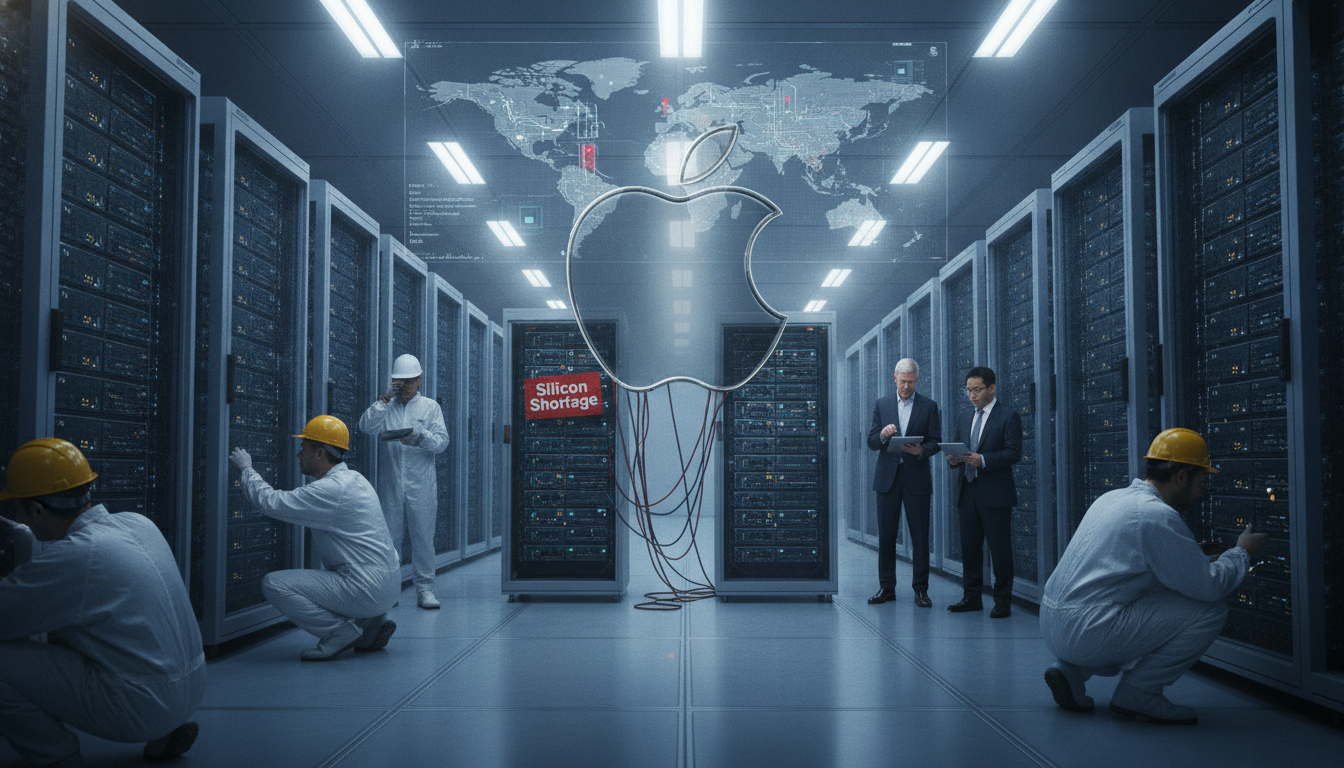
Apple chip shortages worsen as AI data center demand strains global capacity
Rapid AI data center growth has squeezed global chip capacity, forcing Apple to scramble for extra production after underestimating iPhone and Mac demand.
Apple chip shortages surfaced sharply last year when the company misread consumer demand for several iPhone models and a subset of Mac computers. The company’s typically resilient supply chain encountered difficulty securing additional production slots for complex chip systems. That strain reflects a wider market pressure as data center operators expand capacity for AI workloads.
AI Data Centers Drive Global Chip Demand
The expansion of AI training and inference infrastructure has driven unprecedented demand for specialized semiconductors. Large cloud providers and hyperscalers are ordering vast numbers of accelerators and GPUs, pushing foundry and packaging capacity to near limits. This shift has reallocated manufacturing priorities toward datacenter silicon at the expense of some consumer product allocations.
The imbalance is compounded by lead times. Building and ramping advanced fabs, and the downstream packaging and testing facilities they require, takes years and large capital investments. In the meantime, existing capacity is allocated to the highest-bidding customers and long-term contracts, squeezing flexible production for last-minute increases.
How Apple Felt the Squeeze
Apple’s production shortfall followed an underestimation of demand for new iPhone models and particular Mac configurations. Despite its normally robust forecasting and supplier relationships, the company struggled to identify available capacity for the additional chipsets and subsystems needed to meet stronger-than-expected sales. That gap translated into shipment delays and tighter inventory windows for some models.
Manufacturing partners faced hard choices about prioritizing production runs, and Apple’s requests for additional capacity competed directly with large-scale datacenter orders. The result was fewer immediate options to scale up output for consumer devices without disrupting other customers’ plans.
Supply-Chain Bottlenecks and Foundry Constraints
Capacity constraints are not limited to wafer fabrication; they span the full manufacturing chain including chip design tape-outs, advanced packaging, and final system integration. Foundries operating at high utilization allocate slots based on multi-year agreements and strategic partnerships, limiting the ability to accommodate short-term surges. Packaging and test facilities, often the bottleneck after wafer output, have similarly tight schedules.
The specialization required for advanced system-on-chip designs increases lead times and reduces lane flexibility. When datacenter accelerators demand the most advanced nodes and complex packaging, consumer SoCs that rely on similar process technologies can face delays. These technical interdependencies create cascading bottlenecks across the industry.
Apple’s Strategic Responses
Apple is unlikely to accept repeated production disruptions and has several levers to reduce future exposure to similar shortages. The company can increase advance commitments to foundries, expand multi-supplier relationships, and boost inventory buffers for key components. It can also accelerate investments in packaging capacities and negotiate priority lanes with manufacturing partners.
Additionally, Apple’s vertical integration in chip design gives it leverage to optimize product road maps and component commonality, which can ease manufacturing pressures. Analysts also point to the possibility of reallocating product launches or adjusting build-to-order strategies to smooth demand spikes and better match production throughput.
Market Impact and Outlook
For consumers, the immediate consequence has been intermittent availability and potential delays for high-demand models, which can influence buying decisions and secondary-market pricing. Competing smartphone and laptop makers may find short windows to gain market share if they can secure capacity more effectively. For enterprise and cloud customers, priority allocation to datacenter silicon may continue to dominate near-term capacity planning.
Industry investments in new fabrication plants and advanced packaging facilities are under way, but these projects typically require multiple years before producing relief. Until then, the balance between datacenter and consumer semiconductor demand will remain a central factor shaping product availability and pricing.
Apple chip shortages have exposed how rapidly shifting demand in AI infrastructure can ripple through the consumer electronics supply chain. The company’s next moves—ranging from longer-term supplier contracts to tactical inventory adjustments—will determine how quickly it can restore the flexibility that has long been a hallmark of its operations.
