
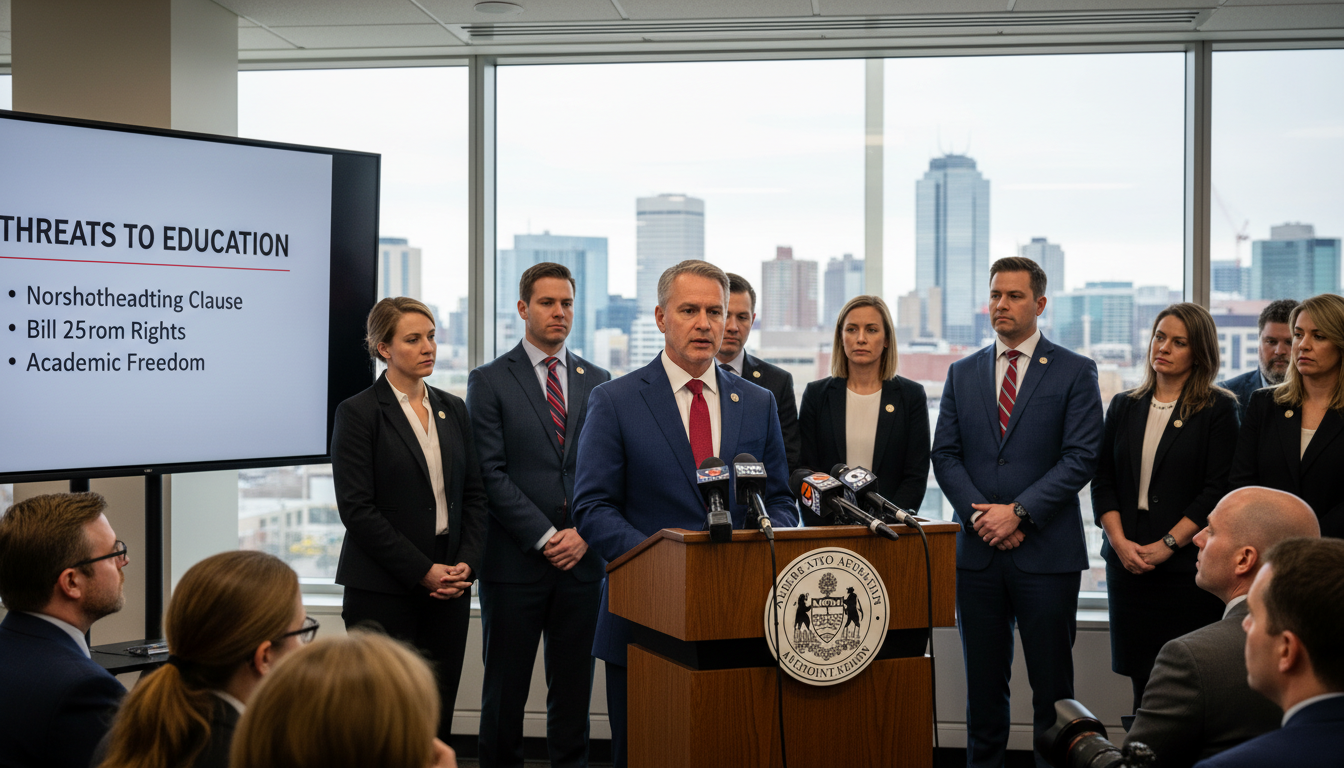
Alberta teachers press government on notwithstanding clause, Bill 25, funding and AI at ATA assembly
Alberta teachers took centre stage at the Alberta Teachers’ Association assembly in Calgary, where president Jason Schilling warned that the notwithstanding clause, Bill 25, funding shortfalls and the rise of classroom AI are reshaping the province’s schools. The gathering brought together about 400 educators to debate policy, pedagogy and the province’s education priorities.
Schilling opens with personal view of teaching
Jason Schilling framed teaching as a moral and professional commitment, describing the classroom as a place where educators attend to students carrying unseen burdens. He said teachers continue their work not for ideal conditions but from a belief in honesty, justice and the capacity to make a difference.
Schilling used his remarks to link lived classroom experience to the larger policy battles unfolding in Alberta, saying those debates have direct consequences for how teachers do their jobs and for student well‑being.
Notwithstanding clause remains a flashpoint
More than six months after the province used the notwithstanding clause to end strike action, the measure remains a dominant issue for delegates. Schilling said members have not forgotten the abrupt legislation that forced teachers back to work and curtailed collective bargaining rights.
He told the assembly that the move has left a lasting distrust among educators toward the government and that many teachers feel their charter protections were effectively suspended, shaping how they view subsequent policy changes.
Bill 25 raises questions about classroom neutrality
Bill 25, which is slated to take effect on Sept. 1, drew scrutiny for provisions that give the education minister expanded influence over superintendent contracts and instruct teachers to present topics in an “impartial” way. Education officials have argued the language aims to keep classrooms free of politics, but critics say the term impartial is vague and could chill instruction.
The Alberta Teachers’ Association cautioned delegates that the bill’s stated purpose of removing “politics and ideology” may reach into curriculum choices and classroom discussions of complex historical and social issues. Teachers fear ambiguous rules could limit how sensitive subjects, including genocide and rights‑based topics, are taught.
Funding pledges meet scepticism from classroom leaders
Delegates discussed recent government investments, including a 7.2 per cent increase in the education budget to about $10.8 billion and targeted grants intended to reduce class sizes. The province has also announced funding for “complexity teams” and the planned hiring of thousands of staff over coming years.
Schilling and other teachers questioned whether short‑term announcements will translate into sustained hiring and systemic change. They urged the government to pair new dollars with long‑term strategies for teacher recruitment, expanded pre‑service training capacity and stable funding formulas that restore supports eroded by previous policy changes.
Teachers warn of private sector expansion and infrastructure shifts
Speakers at the assembly raised concerns about ongoing public dollars flowing into independent and charter school infrastructure. Delegates referenced past policy changes that allowed certain schools to access taxpayer funding for buildings, raising alarms about potential privatization of school assets.
Delegates argued that investments in private or semi‑private facilities can undermine public school capacity and exacerbate inequities. They called for clearer rules to ensure public funding strengthens the public system rather than subsidizing private interests.
AI tools that mimic relationships draw union opposition
The ATA added formal opposition to the introduction of anthropomorphic artificial intelligence into K‑12 settings, with delegates citing privacy risks and the potential for machines to simulate friendship or counselling roles. Schilling framed the issue as both a data‑protection concern and a response to student loneliness.
Frontline teachers described AI that delivers emotionally tailored responses as fundamentally different from past classroom technologies. One local leader said educators are open to tools that support learning but resist deploying systems that could form pseudo‑intimate relationships with children without strict oversight and vetting.
Final paragraph
Delegates left the assembly with a clear list of priorities for provincial negotiations and public messaging: push for durable funding, clarify how Bill 25 will operate in practice, safeguard student privacy against intrusive technologies and press the government to rebuild trust after the use of the notwithstanding clause.
