
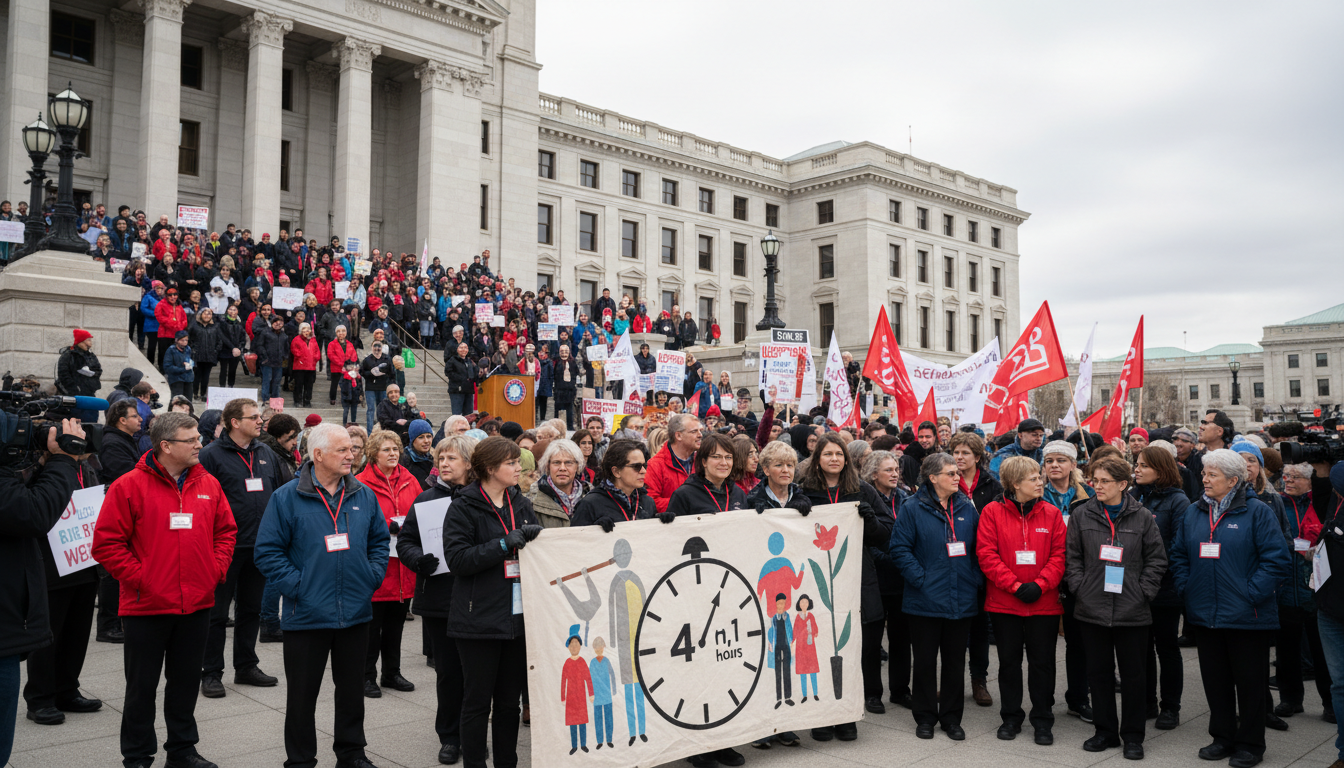
AUPE urges Alberta government to act as union warns Alberta continuing care is ‘collapsing’
AUPE urges Alberta government to pass legislation to stabilize Alberta continuing care, demanding mandatory staffing, 4.1 direct care hours, and transparency.
The union representing thousands of continuing care workers in Alberta says the sector is in crisis and is calling on the provincial government to introduce legislation to reverse years of privatization-driven problems in Alberta continuing care. AUPE president Sandra Azocar told reporters that workers are raising urgent alarms about chronic short-staffing, deteriorating working conditions and the inability to provide acceptable care for seniors. The union said bargaining talks are under way for roughly 17,000 members and that preparations for possible job action are underway if conditions do not improve.
Union says Alberta continuing care is collapsing
AUPE framed the sector’s problems as systemic, arguing that private operators have expanded rapidly while oversight and standards have not kept pace. Union leaders contend that many facilities are operating with bare-minimum staffing models that leave residents without reliable access to hands-on care.
The union’s public comments come after a recent bargaining conference in Calgary where continuing care members were told to prepare for potential strike action. AUPE emphasized that the dispute is not only about pay but about the structure of service delivery and the safety of residents.
Union calls for mandatory minimum staffing and 4.1 care hours
A central demand from AUPE is legislation that would require minimum staffing levels across continuing care facilities, including a floor of 4.1 direct care hours per resident per day. The union argues that a measurable standard would reduce variability in care and prevent operators from understaffing to cut costs.
AUPE says the 4.1-hour figure is based on what it views as the minimum required to meet basic needs and reduce pressure on workers responding to complex cases. The union also wants clear rules to stop policies that have shifted patients with complex medical needs into continuing care primarily to free up hospital beds.
Essential-services rules could prevent sector-wide strike
Union leaders warned that an essential-services agreement currently in place may limit the ability of workers to strike, particularly where short-staffing has already left facilities operating with only core personnel. AUPE says some employers and the province could argue that so many positions are essential that large numbers of employees would be legally barred from withdrawing labour.
That reality has prompted AUPE to call for reforms to the essential-services framework, arguing it should not be used to effectively lock workers into unsafe or unsustainable conditions. The union maintains that legal protections should balance continuity of care with workers’ right to collective action.
Union demands transparency over private continuing care spending
A second major thrust of AUPE’s campaign is transparency for public dollars spent in facilities that operate outside the public health system. The union alleges that a growing share of continuing care beds are controlled by private non-profit or for-profit providers with limited provincial oversight.
AUPE is asking the government to require full disclosure of how taxpayer money is used by these operators, arguing that opaque contracts and accounting permit high fees and out-of-reach costs for families. The union says increased transparency would allow taxpayers and regulators to assess whether funds are actually improving resident care or primarily boosting private profits.
Province allocates funds but defends transfer and budgeting decisions
The Alberta government has highlighted recent budget commitments aimed at the sector, including a pledge of $400 million to create about 1,100 continuing care spaces and broader health spending that provincial documents put at a record $34.4 billion. A ministry spokesperson said the budget also earmarks $5.9 billion for assisted living and continuing care, with $555 million directed to workforce supports.
The ministry’s spokesperson, Amber Edgerton, rejected claims that patients are being inappropriately transferred from hospitals to continuing care. She said transfers occur when residents no longer require acute care and when vacancies exist, adding that the government wants hospital beds available for those in greatest need. The government also stressed that bargaining remains ongoing and had no further comment beyond those measures.
The union and the province present sharply different diagnoses of the same budget figures, with AUPE warning that a large portion of the new spending will channel into private operators without stronger rules. That disagreement sets the stage for continued negotiation and possible public debate over how best to protect seniors and shore up the continuing care workforce.
If the dispute over staffing standards, transparency and essential-services protections is not resolved, residents, families and facilities could face prolonged uncertainty in the months ahead. The coming weeks of bargaining and any legislative response from the provincial government will shape how Alberta’s continuing care system adapts to an aging population and mounting calls for greater accountability.
