
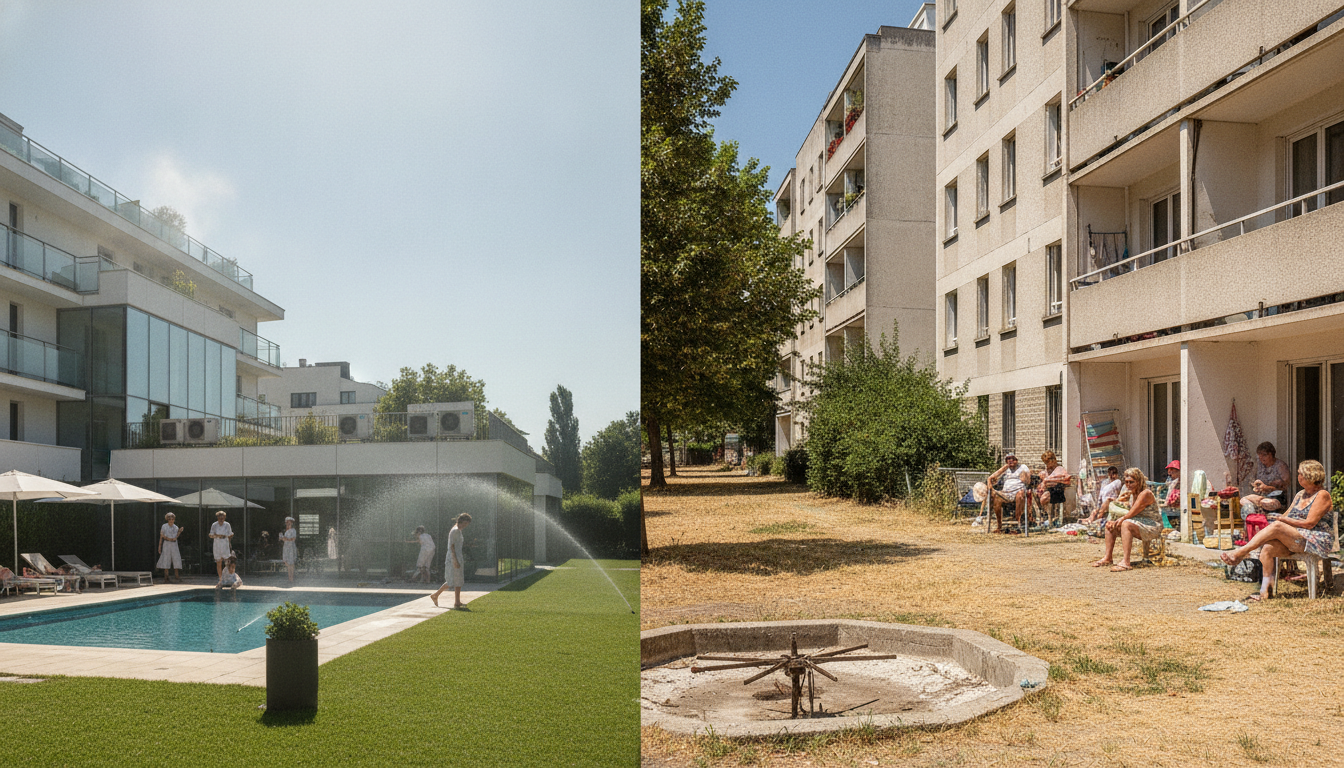
France heatwave exposes stark cooling inequalities in Paris suburbs
France heatwave scorches communities: Saint-Denis residents cool in canals while Chamonix finds respite; 2,025 excess deaths in week of June 22, 2026.
The France heatwave that swept the country in late June has laid bare a sharp divide in who can escape the heat, with residents of Paris’s northern suburbs resorting to makeshift cooling while alpine towns report milder nights. Locals in Saint-Denis described jumping into canals and improvising sprayed water and fans to endure apartments without air conditioning. Officials recorded 2,025 excess deaths during the week of June 22, 2026, a jump of roughly 30 percent nationwide and 62 percent in the Paris region, underscoring the human cost of rising temperatures.
Canal plunges and improvised cooling in Saint-Denis
Ibrahim Doukanthi, who lives near the Stade de France, said he has been entering the Canal Saint-Denis to cool off despite it not being designated for swimming. He described the water as visibly green and unpredictable but said the risk was outweighed by the need to escape sweltering flats. Neighbours and market-goers recounted similar improvisations, using spray bottles and fans in apartment blocks that lack climate control.
Limits on public cooling and cultural barriers
Access to public pools and cooling centres has been inconsistent, residents said, with some municipal facilities imposing dress rules that prevent certain people from using them. Inflatable pools and portable units are often restricted in social housing, leaving families to seek alternatives. For some, the combination of housing rules and cultural regulations effectively removes safe, legal options to cool down.
Official toll and regional disparities
National health authorities reported 2,025 additional deaths in the last heatwave week, with the Paris region particularly hard hit, according to public health figures. That spike represents a sharp week-on-week rise, and hospitals and emergency services faced heightened demand. Local activists and aid groups contend that official emergency measures — temporary shelters and water stations — remain insufficient to shield the most vulnerable.
Experts point to housing and policy gaps
Scholars and policy analysts said the heatwave primarily revealed pre-existing social vulnerabilities rather than producing new ones. Bruno Villalba, a political ecology specialist, argued that inadequate housing insulation and limited access to cooling are central drivers of risk. Researchers note that wealthier households are far more likely to report proper insulation and access to cooling, enabling them to avoid both immediate harm and longer-term health impacts.
Multiple vulnerabilities for the unhoused and overcrowded
Advocates working with people who live outdoors warned that those without shelter face the harshest conditions, with surfaces and asphalt accentuating perceived temperatures. NGOs said that measures taken during extreme weather — temporary shelters, extra water — are typically reactive and short-term. Activists called for sustained policies to reduce homelessness and strengthen long-term protections against climate extremes.
Mountain towns feel warmth but find relief in altitude
By contrast, towns in the Alps such as Chamonix reported daytime highs above 30 degrees Celsius, yet residents experienced cooler nights and nearby natural cooling options. Local officials described forested trails and glacial rivers that remain accessible and provide relief from daytime heat. Still, long-term changes are visible: retreating glaciers and increased rockfall risk are altering both the landscape and local safety.
Calls for structural, not just reactive, policies
Researchers and civil-society representatives urged a shift from short-term advisories to systemic measures that address housing quality and unequal access to cooling. They highlighted disparities in insulation and the affordability of air-conditioning units as policy targets. Experts recommended investments in green spaces, urban trees and building renovations to reduce overheating in deprived neighbourhoods.
Residents like Louiza Ammari described being blocked from simple coping mechanisms — from inflatable pools in courtyards to access to some municipal facilities — and said the combination of rules and poor housing leaves families exposed. Others argued that public messaging — drink water, avoid the sun — is inadequate without material solutions for people who cannot simply leave their neighbourhoods. The France heatwave has prompted renewed debate over how to translate short-term civil-protection steps into a long-term strategy that reduces vulnerability.
Policy makers face pressure to balance immediate emergency support with more ambitious retrofits of housing and urban planning that prioritize cooling in the areas most affected. Without such changes, experts warn, heat-related harm is likely to recur and widen existing social inequalities.
The uneven experience between low-lying suburbs and mountain towns during this summer’s extreme heat has crystallized a central challenge: adapting infrastructure and social policy so that cooling is a right, not a privilege, for all communities.
