
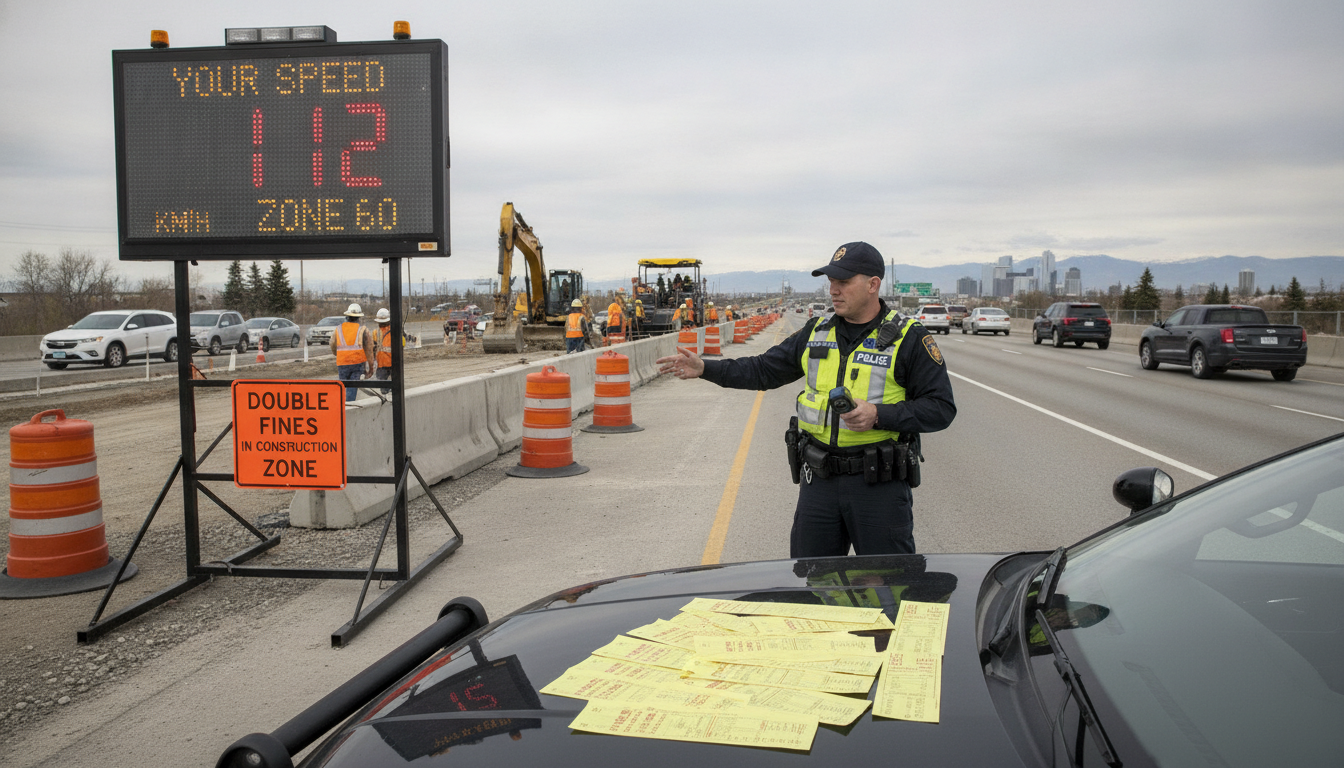
Calgary construction zone speeding: police issue hundreds of tickets and warn drivers to slow down
Calgary police warn of increased construction zone speeding after hundreds of tickets on Deerfoot Trail; drivers face double fines and insurance impacts.
Calgary police are urging motorists to slow down as enforcement teams report a sharp rise in construction zone speeding in Calgary, with hundreds of tickets already issued this year. The warning follows targeted patrols and roadside enforcement focused on work zones along major routes, where speed reductions are in place to protect road crews. Officials say the behaviour poses clear risks to workers and other road users and can carry elevated fines and insurance consequences when enforcement is active. The message from authorities is straightforward: reduce speed and obey temporary limits in construction zones.
Calgary police cite surge in construction zone speeding
Between Jan. 1 and April 30 this year, Calgary police recorded 404 tickets issued to drivers for speeding in active construction zones, a figure the service says is a cause for concern. By comparison, officers issued 2,487 such tickets during the previous calendar year, indicating sustained enforcement and continued compliance problems. Police stress these totals reflect proactive patrols by officers rather than automated camera enforcement, underscoring that front-line officers are intervening on site. The spike in tickets has prompted a renewed public safety appeal to motorists using arterial routes through active work areas.
A senior officer told reporters that many drivers are exceeding posted reduced limits by significant margins when crews are present, increasing the risk of collisions and worker injuries. Police say the approach is to pair visible enforcement with public education about why temporary limits exist and when they apply. Officers also note that some drivers display aggressive behaviours—lane weaving and tailgating—that compound the danger in already complex work zones. The force has publicly urged commuters to allow extra travel time and to plan alternate routes where possible.
Ticket totals and enforcement methods
The tickets issued during the first four months of the year were the result of conventional traffic stops and speed measurements by police rather than automated systems such as photo radar. Calgary police emphasized that Drive Safe or similar automated enforcement tools were not used to generate the cited tickets. Staff said manual enforcement enables officers to respond to unsafe behaviours beyond speed alone, including erratic lane changes and driver interactions with workers. That hands-on approach has produced immediate removals of dangerous drivers from active construction corridors.
Police point out that stepped-up presence near construction zones is a deliberate strategy, combining patrols at shift-change times and stationary observation near high-risk exits and merges. Enforcement is coordinated with municipal construction schedules so officers can concentrate resources where and when the risk is greatest. The decision to rely on officer-led enforcement also allows for on-the-spot warnings and education, in addition to formal charges. Authorities say the public can expect continuing visible enforcement as long as construction activity requires temporary speed reductions.
Deerfoot Trail identified as a high-risk stretch
One area receiving particular attention is the Deerfoot Trail south construction zone, where posted limits have been reduced to 80 km/h in work areas and drop sharply at certain ramps. Police singled out the Anderson Road and Bow Bottom Trail exit as a repeat hotspot, where the speed limit cuts from 80 km/h to 50 km/h while crews are active. In one recent enforcement stop, officers measured a driver travelling 91 km/h in the 50 km/h zone while construction workers were present, an example authorities say illustrates the gravity of the problem. The combination of high travel speeds and changing traffic patterns creates short reaction windows for both drivers and on-site workers.
Municipal traffic planners and contractor safety officers have also flagged changing lane configurations and temporary merges on Deerfoot Trail as complicating factors that demand lower speeds. Reduced limits are designed to give drivers more time to adjust to lane shifts and to provide a safer buffer around crews. Officials stress that signage and channeling devices are installed to guide motorists, but their effectiveness depends on drivers adhering to the temporary restrictions. The city has reiterated that compliance with posted speeds is the single most effective tool for preventing crashes in these work zones.
Motorists describe dangerous driving and close calls
Multiple motorists interviewed in the area described frequent incidents of tailgating, lane weaving and sudden speed changes in the construction corridors. One commuter said drivers routinely ignore the posted reductions and make aggressive lane changes to gain a few metres, creating fear and frustration for those who adhere to the limits. Another resident reported witnessing near-misses as vehicles cut across lanes around slower-moving traffic near the work sites. Drivers who slow to meet the temporary limit often say they feel pressured by vehicles approaching rapidly from behind.
Eyewitness accounts also describe a broader pattern of risk-taking that goes beyond speed alone, with some drivers using gaps between cones to pass others or failing to yield when lanes rejoin. These behaviours increase the chance of side-impact collisions and put both workers and motorists at risk. Several people expressed concern that habitual speeding in construction areas has normalized risky driving around active worksites. The consensus among interviewed motorists is that clearer enforcement and public awareness are needed to change habits and improve safety.
Penalties, double fines and insurance consequences
Police and municipal officials reiterated that fines are higher when construction zones are active, and drivers caught exceeding the posted limit while workers are present face enhanced penalties. When a construction zone is designated as being "in operation," the fine for a speeding offence is typically doubled, a measure intended to act as a deterrent to dangerous driving near crews. Officers warned that the financial consequence can be substantial, particularly for drivers who receive multiple convictions during the same period. Beyond ticket costs, the Insurance Bureau of Canada notes that traffic convictions can influence insurance premiums based on severity and frequency.
Insurance regulators and industry representatives in Alberta say insurers may consider the nature of convictions when setting premiums, which can translate to higher costs for drivers with a record of serious speeding offences. The exact impact on an individual policy depends on insurer practices, the number of demerit points, and the timing of violations. Drivers are reminded that the immediate fine is only one component of the overall cost of unsafe driving in construction areas. Officials suggest that avoiding a double fine by slowing down is a relatively small sacrifice compared with potential medical, legal and insurance consequences of a crash.
What city and contractors say about safety measures
City officials and contractors responsible for work on major routes say they maintain signage, barriers and sequence plans to protect workers and guide motorists through active sites. Contractors reported deploying additional advance warning signs and tapering cones near complex merges to make lane reductions and speed changes more visible. Project managers also coordinate with police on times of intensified enforcement and with traffic control personnel during high-volume periods. Both the city and contractors emphasized that temporary limits are set based on engineering assessments of risk and the presence of workers in proximity to active traffic lanes.
Officials acknowledged that signage can be missed when motorists are distracted or speeding, and they said they are exploring options to improve compliance, including better sign placement and additional digital messaging on variable message boards. Some projects have trialed reduced speed zones reinforced by roadside messaging that explains the reason for the limit and the presence of personnel. The city reiterated that construction timing is communicated in advance and that drivers should consult municipal updates for planned work that may affect their routes. Municipal leaders reiterated a commitment to worker safety and to reducing the incidence of high-risk driving behaviours.
Public advice and enforcement priorities going forward
Police are asking drivers to leave earlier, plan alternate routes and expect slower speeds in active work areas, especially during peak construction seasons. The message is to treat reduced limits as mandatory safety measures rather than suggestions, since temporary signs are placed to account for changed roadway geometry and the proximity of workers. Enforcement priorities will continue to target zones with persistent non-compliance and where worker exposure is highest. Officers indicated they will maintain visibility during key shifts and collaborate with project leads to ensure enforcement aligns with site activity.
Public safety campaigns planned for the coming months will focus on explaining why work-zone limits exist and illustrating the real consequences of failing to comply. Police and city officials said they will share data on enforcement activity to identify recurring problem locations and times of day. The goal, they said, is not to penalize drivers unnecessarily but to modify behaviour before an incident occurs. Municipal authorities also encouraged employers and unions representing construction crews to remind staff about safe work practices and to report near-misses so traffic control can be adjusted.
The recent enforcement figures and eyewitness reports paint a clear picture of recurring risk along Calgary’s active work zones, with Deerfoot Trail singled out for particular attention. Police and municipal authorities say they will continue to pair targeted enforcement with public outreach to change driver behaviour and protect workers. Motorists are being asked to recognize that the temporary limits are there for safety and to expect double fines and insurance impacts if they are caught exceeding those limits while worksites are active.
As construction season progresses and roadwork intensifies across the city, Calgary police will keep officers on plain patrol and use targeted stops where necessary to curb dangerous driving. The combined approach of visible enforcement, engineering controls and public messaging aims to reduce speed-related incidents in active work zones. Drivers who adjust speed and driving style to match changing road conditions will reduce risk for themselves and for the crews maintaining Calgary’s transportation network.
