
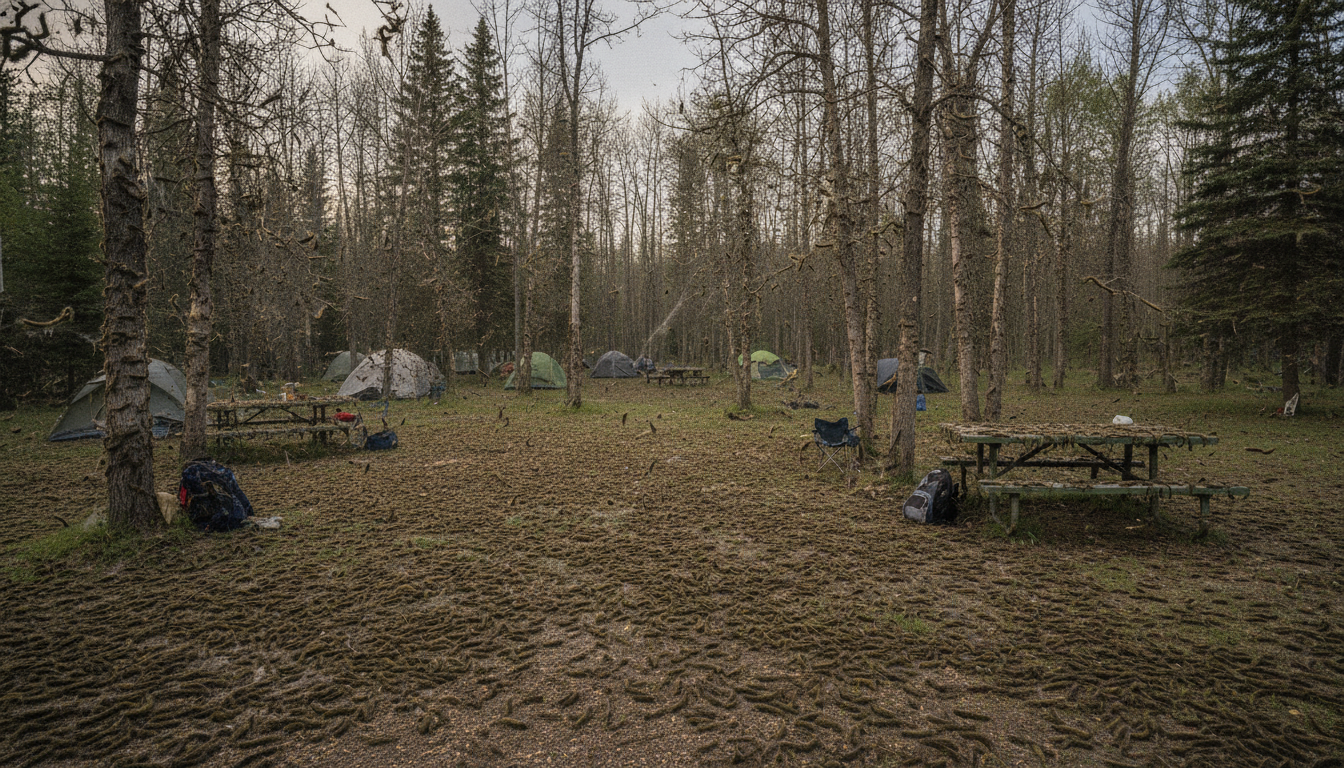
Forest tent caterpillars swarm Pigeon Lake Provincial Park campground
Forest tent caterpillars swarm Pigeon Lake Provincial Park, causing a temporary nuisance as Alberta Parks says the population follows a 10-12 year cycle.
Campers at Pigeon Lake Provincial Park, roughly an hour southwest of Edmonton, are reporting heavy numbers of forest tent caterpillars in the campground this week.
The insects have been seen crawling across picnic tables, gathering in fire pits and covering tree branches, prompting visitors to alter their routines.
Alberta Parks described the event as a seasonal population boom rather than an infestation and said the caterpillars will pupate within weeks before emerging as moths.
Campsites at Pigeon Lake See Surge in Forest Tent Caterpillars
Many campsites are dotted with the small, fuzzy caterpillars, creating an unusual sight for people expecting a typical summer visit.
Campers described finding the insects on tent platforms, table surfaces and around cooking areas, which has altered where and how families eat and relax.
Some occupants said they are choosing to eat inside trailers and campers rather than risk food or utensils coming into contact with the feeding insects.
The campground host has fielded multiple complaints and questions from visitors who are concerned about cleanliness and comfort.
Staff have been advising campers on basic precautions and reminding them the outbreak is a temporary phenomenon tied to the caterpillars’ life cycle.
Park officials said at the moment there is no plan to close the campground or to conduct large-scale interventions.
Campers Report Nuisance but No Widespread Health Threats
Those staying at the lake emphasized that while the caterpillars are unsettling in large numbers, they are not generally dangerous to humans.
Visitors reported discomfort and an “eerie” atmosphere when large clusters appeared on picnic tables and seating areas, prompting some to avoid outdoor meals.
A few campers noted mild skin irritation after contact, but park staff indicated serious allergic reactions are uncommon with this species.
Meghan Bodker, one camper on site, said the number of insects made outdoor dining less appealing, while another visitor, Robin King, said the family changed routines to minimize encounters.
Park officials reiterated that for most people the caterpillars are an unpleasant nuisance rather than a public health hazard.
Health agencies and park staff recommend avoiding direct handling and keeping food covered as practical, simple measures.
Alberta Parks Identifies Natural Boom Every 10 to 12 Years
Alberta Parks provided context for the event, saying forest tent caterpillars undergo cyclical population increases about every decade.
These boom cycles have been recorded in the region for many years and are driven by a combination of climatic conditions and natural predator-prey dynamics.
Officials expect the current surge to subside after the caterpillars complete their short larval stage and pupate.
Staff emphasized that the species is native to the province and plays a role in local ecosystems, serving as prey for birds and small mammals.
Rather than treating the outbreak as an emergency, park management is monitoring the situation and offering guidance to visitors.
The message from officials has been consistent: short-lived abundance is a normal ecological pattern, not an indication of widespread tree mortality or park failure.
Life Cycle Timeline Explains Short Duration of Outbreak
Forest tent caterpillars pass through several larval stages over a period of weeks before pupating and emerging as adult moths.
During the larval phase they feed heavily on foliage, which is when they’re most visible to people using park lands and campgrounds.
Alberta Parks noted that once larvae transform into pupae and subsequently moths, surface activity in campsites typically drops sharply.
The timing of the surge generally depends on spring temperatures and the availability of leaf growth, which determine when eggs hatch and larvae start feeding.
Because the larval period is relatively brief — typically several weeks — the window for intense sightings is limited.
Park managers expect the population to move through its lifecycle without intervention, reducing the number of visible caterpillars within a short timeframe.
Effects on Trees, Wildlife and Park Operations
Large numbers of feeding caterpillars can strip leaves from branches, sometimes leaving trees partially defoliated through a season.
Most healthy mature trees tolerate a single episode of defoliation and produce a new set of leaves the following year, according to forestry experts.
Repeated or severe defoliation across consecutive seasons is the primary situation that can cause tree stress, but officials say current observations do not point to that level of damage.
The caterpillars themselves form a vital part of the food web, supplying protein-rich prey for migrant and resident birds, as well as small mammals and predatory insects.
Park wildlife staff said the abundance may attract species that feed on larvae and small insects, which can briefly increase local bird activity and sightings.
Operationally, the park has recorded complaints and is fielding visitor questions, but it has not instituted closures or large-scale control measures.
Practical Advice for Campers and Park Visitors
Campers are being advised to cover food, store cooking utensils in sealed containers and close tent and trailer doors when not using the space.
Wiping surfaces before meals and suspending outdoor eating in heavily affected sites can reduce unwanted contact with larvae and ease discomfort.
Visitors who must remove caterpillars from surfaces are encouraged to wear gloves or use a tool to avoid direct skin contact.
Park staff discourages widespread pesticide use in the campground area due to ecological concerns and the species’ transitory nature.
If large silk mats, egg bands or concentrated nests are found on small trees or shrubs near campsites, report them to park staff rather than attempting to tackle the problem independently.
Campground hosts and park rangers can provide the latest guidance and help relocate campers to less-affected sites when possible.
The park’s approach emphasizes minimizing disturbance while ensuring visitor comfort and safety, officials said.
Staff are monitoring visitor feedback and will step up signage or onsite guidance if conditions change or if complaints increase.
For now, basic preventive measures and an understanding of the insect’s lifecycle are the primary tools available to visitors.
What to Expect in the Coming Weeks
Given the species’ predictable lifecycle and the provincial guidance, most visible activity at campsites should decrease as larvae pupate and adult moths appear.
Park authorities expect the number of caterpillars on campground surfaces to drop substantially once the larval feeding period ends.
Any damage to foliage observed this season will be assessed, but natural recovery is likely for healthy trees.
Alberta Parks is encouraging campers to plan around the temporary conditions and to contact the park directly with any urgent concerns.
Staff said they will continue to record observations to help track the timing and scale of the event for future reference.
The park’s monitoring will also inform whether additional public information is needed as the season progresses.
Natural resource specialists note that similar cyclical outbreaks have long been a feature of boreal and mixed-wood forests, and they often pass without lasting ecological harm.
Those specialists emphasize that outbreaks also provide ecological benefits by supporting higher trophic levels during periods of abundance.
For recreational users, the primary effect is an interruption of expected campsite conditions rather than a lasting threat to the landscape.
Visitors who are particularly sensitive to insect contact or who have small children may want to consider postponing nonessential trips until the surge subsides.
Alternatives include selecting campsites farther from heavily affected stands of deciduous trees or choosing provincial day-use areas where the concentration of caterpillars is lower.
Park staff can advise on current hotspots and suggest alternatives for families seeking fewer encounters.
Forest tent caterpillar events offer a reminder of the ways natural processes intersect with recreation, creating temporary inconveniences that are nevertheless part of local ecology.
Parks and conservation agencies aim to balance visitor experience with ecological stewardship when responding to such events.
In this case the emphasis remains on public information and simple protective measures rather than aggressive control.
Alberta Parks and on-site staff will continue to monitor the situation and provide updates to campers as needed.
Visitors seeking the most current advice should contact the park office or the campground host for site-specific information.
In the meantime, most indicators suggest the surge will be short-lived and that normal campsite conditions are likely to return once the caterpillars complete their developmental cycle.
For now, the best course for campers is awareness, basic precautions and patience while the natural cycle plays out.
