
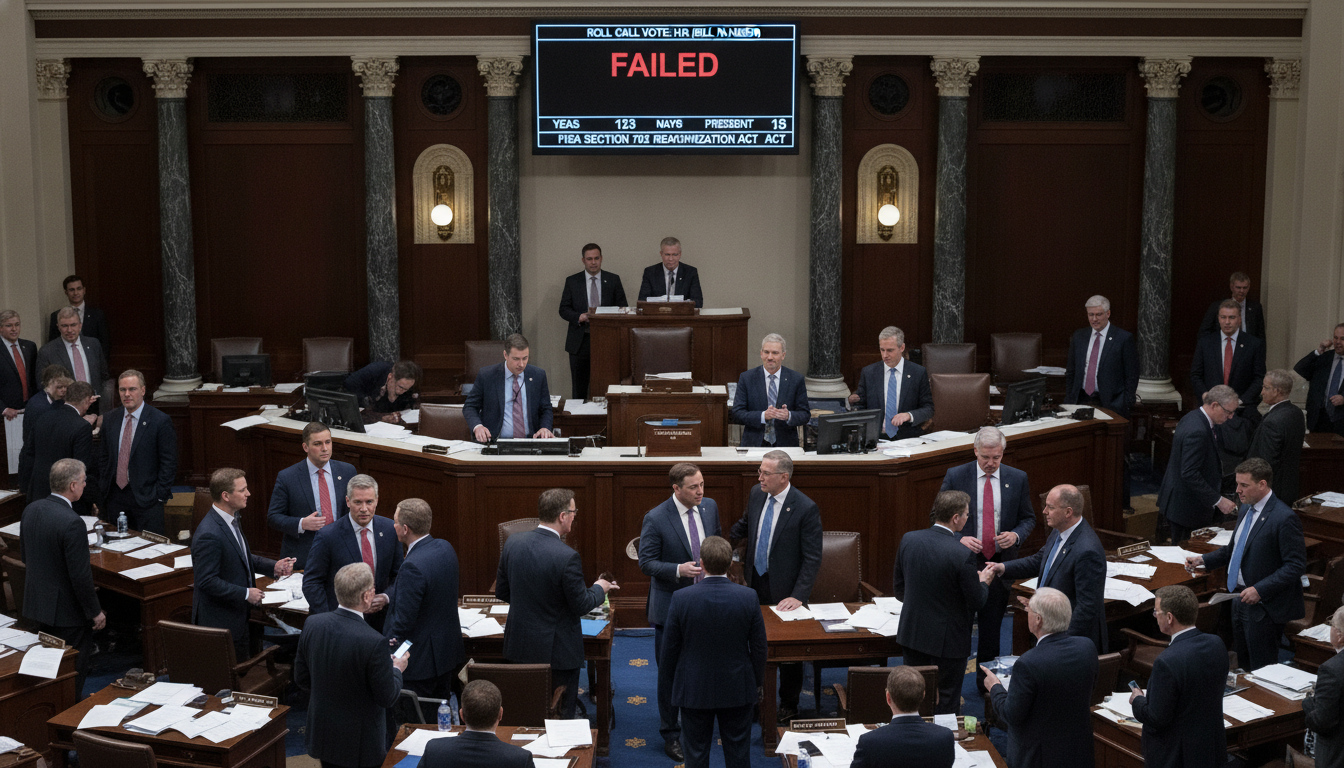
House fails to renew FISA Section 702 before June 12, 2026 expiry amid protests over intelligence appointment
House fails to renew FISA Section 702 before June 12, 2026 expiry, leaving U.S. warrantless surveillance in limbo amid objections to a Trump ally’s appointment.
The House of Representatives on Thursday failed to secure the supermajority needed to reauthorize the Foreign Intelligence Surveillance Act provision known as Section 702, allowing the warrantless surveillance authority to lapse when it expires on June 12, 2026. FISA, the law that permits broad collection of foreign intelligence that can include Americans’ communications, was at the center of a bitter dispute tied to a controversial White House appointment. Lawmakers opposing the reauthorization said the administration’s staffing choice raised fresh concerns about how surveillance powers could be used.
House vote falls short
The House recorded a 218-198 tally on the reauthorization measure, short of the two-thirds margin the bill required to pass under expedited rules. Nineteen Republicans joined Democrats in voting against the measure, citing civil liberties concerns and objections to recent executive branch actions. The failure leaves Congress without an immediate path to renew the statute before the statutory deadline.
Defections tied to intelligence appointment
Opposition coalesced after the White House named a politically connected ally to serve as acting director of national intelligence, prompting Republicans and Democrats to question the nominee’s qualifications. Lawmakers said the appointment heightened fears that an administration could misuse surveillance tools for political ends, creating an unusual coalition that scuttled the reauthorization vote. The White House later withdrew that nomination and announced a different candidate, but the timing came too late to change the vote result.
Scope and controversy of Section 702
Section 702 authorizes the collection of foreign intelligence from non-U.S. targets, but in practice it has captured large volumes of communications that can include Americans’ messages. Security officials argue the authority is vital for tracking foreign hackers, espionage and terrorism planning, while civil liberties groups and some legislators say it enables warrantless intrusions into private communications. The provision has prompted repeated reform campaigns, citing past abuses and calls for judicial oversight or warrant requirements before accessing Americans’ content.
Short-term operational effects
Even with the statutory language set to expire, several surveillance practices may continue under existing court certifications and other legal authorities, reducing the likelihood of an abrupt halt to operations. The Foreign Intelligence Surveillance Court approved agency certifications earlier this year that extend certain programmatic approvals into 2027, allowing some collection to proceed on an administrative basis. Nevertheless, companies that supply data or maintain call records may be reluctant to cooperate absent clear congressional authorization, and agencies could rely more heavily on other legal tools such as Executive Order 12333.
Political and legal consequences
The lapse injects uncertainty into both national security planning and civil liberties oversight, complicating relationships among intelligence agencies, private telecom providers, and the courts that normally review warrants and certifications. Senators and House members from both parties warned that a drawn-out fight over reform and reauthorization could erode trust in surveillance institutions. Senior lawmakers privy to classified briefings argued privately that the risk posed by the contested appointment outweighed the immediate operational concerns of letting the law lapse, a judgment that reshaped the floor dynamics.
Calendar and next steps in Congress
Leaders have signaled plans for another vote scheduled for June 23, 2026, but with many members leaving Washington for recess, lawmakers say a last-minute compromise is unlikely to be reached this week. Negotiators remain split on whether to attach judicial warrant requirements and new transparency and minimization procedures, or to pass a clean extension favored by some national security officials. Any successful path forward will require bridging divisions within the GOP caucus and addressing Democratic demands for stronger privacy safeguards.
The lapse of Section 702 reauthorization sets the stage for an intense summer debate over the balance between intelligence collection and privacy protections. Lawmakers now face the choice of crafting narrower reforms that address warrant and oversight concerns, or restoring broader authorities while accepting heightened scrutiny and political fallout. The coming weeks will determine whether Congress finds a middle ground or allows the statute to remain expired as negotiations continue.
