
AI brain tumour detection ‘laser pen’ classifies tissue in 10 seconds, Canadian researchers say
Canadian team unveils an AI brain tumour detection ‘laser pen’ that classifies tissue in 10 seconds, speeding surgical decisions and sparing healthy brain.
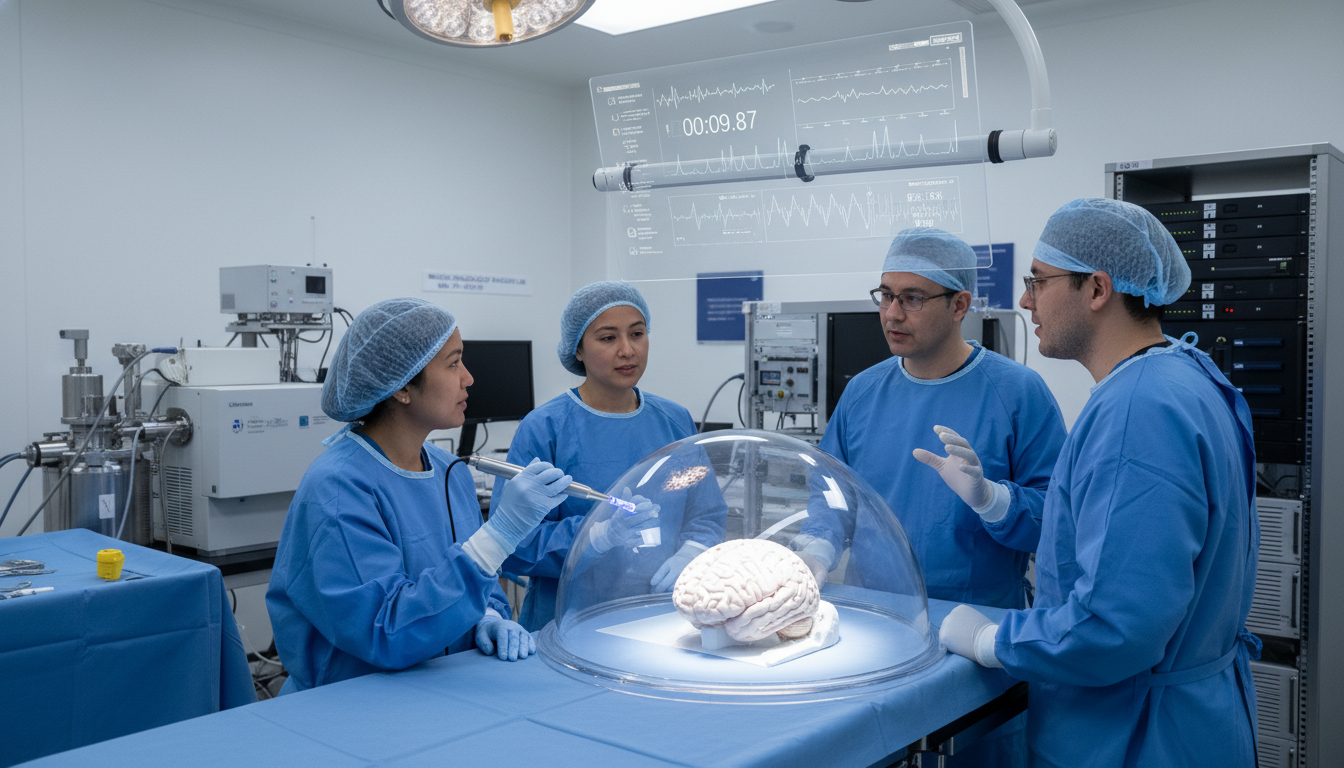
A Canadian research team has developed an AI brain tumour detection tool that can identify cancerous and healthy brain tissue in roughly 10 seconds during surgery. The device, described by researchers at Princess Margaret Cancer Centre and the University of Waterloo, combines a precision laser “pen,” mass spectrometry and machine learning to give neurosurgeons near‑instant guidance. Developers say the technology aims to reduce the time patients spend under the knife and to limit removal of healthy brain tissue while improving the accuracy of tumour resections.
How the surgical “pen” samples tissue
The instrument resembles a pen and uses a pulsed infrared laser—known as PIRL‑MS—to vaporize an extremely small amount of tissue without generating heat that could damage surrounding brain. The brief vaporization produces a molecular plume that is immediately captured and conveyed to analytical equipment. Because only a minute sample is taken, surgeons can probe multiple sites along a resection margin without significantly altering the operative field or increasing risk to the patient.
A linked mass spectrometer reads the chemical composition of the sampled molecules to create a molecular signature for the tissue. That signature is compared in real time to a reference database by an artificial intelligence model that classifies the sample as tumour or healthy tissue. The entire cycle from laser pulse to classification report is designed to occur in about ten seconds, delivering feedback fast enough to influence intraoperative decisions.
Current delays the tool seeks to solve
Neurosurgeons today often depend on frozen‑section pathology or postoperative histology to verify margins, processes that can take tens of minutes to hours or require pausing the operation. Those delays force surgeons to choose between longer anaesthesia times for patients and the risk of removing too much or too little tissue. Rapid, reliable intraoperative classification could shorten procedures and reduce uncertainty in the operating room.
Faster feedback has clinical implications beyond time savings. More precise margin assessment may lower the chance that malignant tissue is left behind, while sparing functional brain regions could preserve speech, motor skills and cognition. Investigators emphasize that quicker molecular reads are intended to supplement, not replace, surgical judgment and conventional pathology.
Machine learning reveals hidden molecular clues
Researchers involved in the project report that allowing the AI to explore molecular patterns without overly prescriptive rules produced unexpected insights. By training models on spectrometry profiles, doctoral candidate Dara Vlaminck and colleagues found the algorithm highlighted metabolites and chemical differences that standard analyses had overlooked. Those discoveries have prompted follow‑up laboratory work to identify the specific small molecules driving the classifications.
The team says the AI functions as a pattern detector for extremely subtle chemical signals that are invisible under a microscope. Clinicians on the project stress that final interpretation and surgical choices remain human responsibilities, with the machine framed as a decision‑support tool designed to reduce ambiguity at critical moments in surgery.
Regulatory, trial and data challenges ahead
The device remains at the research stage and must pass extensive clinical trials and regulatory scrutiny before routine hospital use. Investigators note that trials will be lengthy and costly, involving validation of accuracy across tumour types, surgical settings and patient populations. In parallel, evolving regulatory frameworks for medical AI will shape approval timelines and post‑market oversight.
A major technical hurdle is the representativeness of the model’s reference database. Early samples largely derive from patients in the Ontario region, and developers caution that biochemical signatures can vary across populations and environments. Expanding the dataset to include diverse demographic and geographic groups is a stated priority to ensure the tool performs reliably across Canada and beyond.
Worldwide projects and cooperative comparisons
The Canadian effort is one of several international initiatives exploring rapid intraoperative molecular classification. Related technologies, including the iPen in Texas and the iKnife in the United Kingdom, use different energy sources and analytic approaches but pursue the same clinical goal: faster, more precise tumour margin detection. Rather than viewing one another as rivals, teams say they compare methods and share findings to accelerate safe translation into practice.
Collaborative comparisons of performance metrics, such as sensitivity, specificity and impact on surgical outcomes, will help determine which approaches best fit different hospital environments. Researchers envision multi‑centre studies that test devices in academic centres and community hospitals to assess real‑world utility.
Potential timeline and impact for Canadian patients
Lead investigator Scott Hopkins has estimated that, in an ideal scenario, a device like this could reach broader clinical use within five to ten years, contingent on successful trials and regulatory approvals. If validated, the technology could expand access to precision neurosurgical tools beyond major urban centres by providing standardized, rapid tissue classification at the point of care. That prospect is particularly relevant for patients in rural and remote regions who currently travel to specialty centres for complex brain surgery.
The research team frames the technology as a step toward democratizing access to high‑precision surgical care, with the goal of reducing regional disparities. Wider deployment would require investments in equipment, training for operating room staff, and continued efforts to diversify the molecular reference database to ensure equitable performance across populations.
