
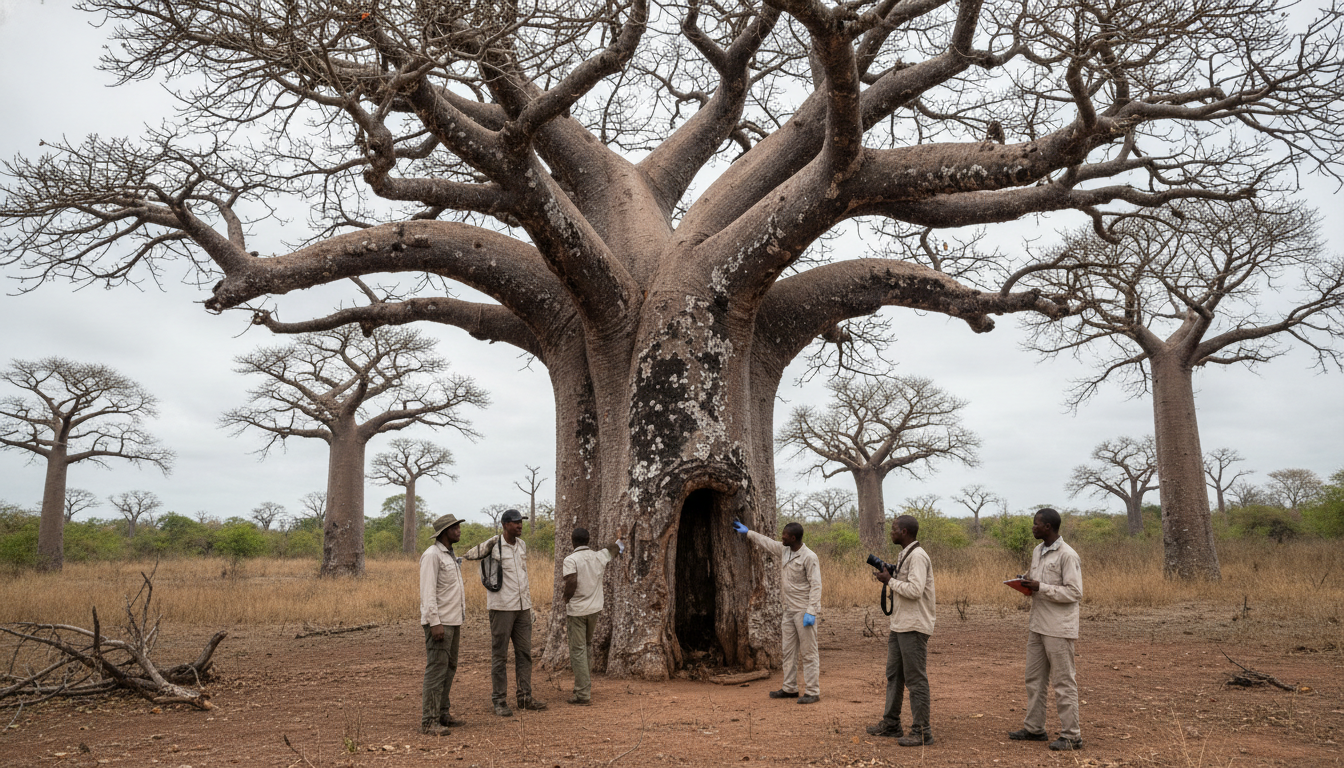
Tsitakakantsa baobab in Madagascar Shows Signs of Fatal Decline
Tsitakakantsa baobab in southwest Madagascar is dying after foul seepage and trunk decay, alarming local communities and scientists amid climate pressures.
The ancient Tsitakakantsa baobab in Madagascar’s Andombiry Forest is now visibly failing, researchers and local stewards say, after observers detected a foul-smelling liquid and large trunk fissures. The Tsitakakantsa baobab, long regarded as a spiritual and ecological landmark, is emitting dark seepage from its base and showing widespread internal rot that experts say could presage collapse. Local leaders and scientists visiting the site over recent months report accelerating damage, raising concern for both the tree’s survival and the surrounding community that relies on it.
First signs recorded by researchers
Cyrille Cornu, a long-term baobab researcher, reported the first alarming symptom last October when he encountered a musty, decomposition-like odor near the trunk of Tsitakakantsa. He and other visitors found a dark, foul-smelling liquid seeping from the tree’s base, a condition not previously observed during his 15 years of study. Subsequent visits documented expanding cracks in the trunk and interior mold, indicating that internal structural failure may be underway.
Local community reaction and spiritual loss
For residents of nearby Andombiry, the decline of Tsitakakantsa carries deep cultural and spiritual weight. Village chief Mampiavy described widespread sadness and said the tree had long brought blessings and served as a focal point for ceremonies and communal identity. Officials and villagers are already searching the forest for another large baobab to consecrate, underscoring the central role the giant tree plays in local social and religious life.
Scientific diagnosis and likely causes
Scientists assessing the tree point to fungal infection and prolonged water stress as probable drivers of its deterioration. Baobabs store large volumes of water in their spongy wood, which makes them vulnerable to root rot and fungal pathogens when exposed to extended periods of heavy rain or standing water. Ecologists, including Sarah Venter, note that intensifying storms and wetter conditions associated with climate change have increased the risk of such infections across Madagascar’s baobab populations.
Observed physical decline and collapse timeline
Field researchers report that significant portions of the trunk have already fallen and that the tree’s base is fragile, with internal decay evident to the naked eye. Cracks observed in February and the presence of mold suggest internal cavities and structural weakening that can accelerate collapse. Experts caution that while disintegration could occur within months, the exact timeline is uncertain and depends on variables such as weather, additional infection, and mechanical stress.
Ecological role and economic importance
Baobabs like Tsitakakantsa are keystone organisms in Madagascar’s dry forests, providing food, shade, water storage and habitat for a range of species. The trees also support livelihoods through baobab fruit harvests and ecotourism, with giants such as Tsitakakantsa drawing visitors who bolster local income. The loss of a major tree therefore reverberates beyond cultural grief, affecting local economies and ecological networks in the surrounding landscape.
Conservation challenges and funding shortfalls
Despite the ecological importance of baobabs, island-wide restoration and protection efforts face chronic funding and logistical obstacles, researchers say. Onja Razanamaro of the Tsimbazaza Zoo & Botanical Gardens has warned that natural regeneration is limited and that past attempts to coordinate large-scale restoration have stalled. Deforestation, traditional land-clearing fires and limited conservation budgets compound the difficulty of protecting old-growth baobabs and establishing replacement cohorts.
Possibility of recovery remains small but real
Although the current signs are dire, baobabs have shown surprising resilience in some documented cases, with trees recovering after severe damage. Scientists emphasize that recovery would require favorable conditions—reduced waterlogging, containment of fungal spread and protection from additional physical stress. Even so, the sheer age and current internal decay of Tsitakakantsa make a full rebound unlikely in the near term, with most experts preparing for eventual loss.
The unfolding decline of the Tsitakakantsa baobab illustrates a broader and urgent conservation challenge in Madagascar: how to protect venerable, slow-growing trees that are culturally treasured but increasingly vulnerable to changing climate and human pressure. As local communities arrange for spiritual succession and researchers monitor the tree’s condition, the case of Tsitakakantsa may serve as a catalyst for renewed investment in baobab monitoring, fungal research and targeted conservation funding across the island.
