
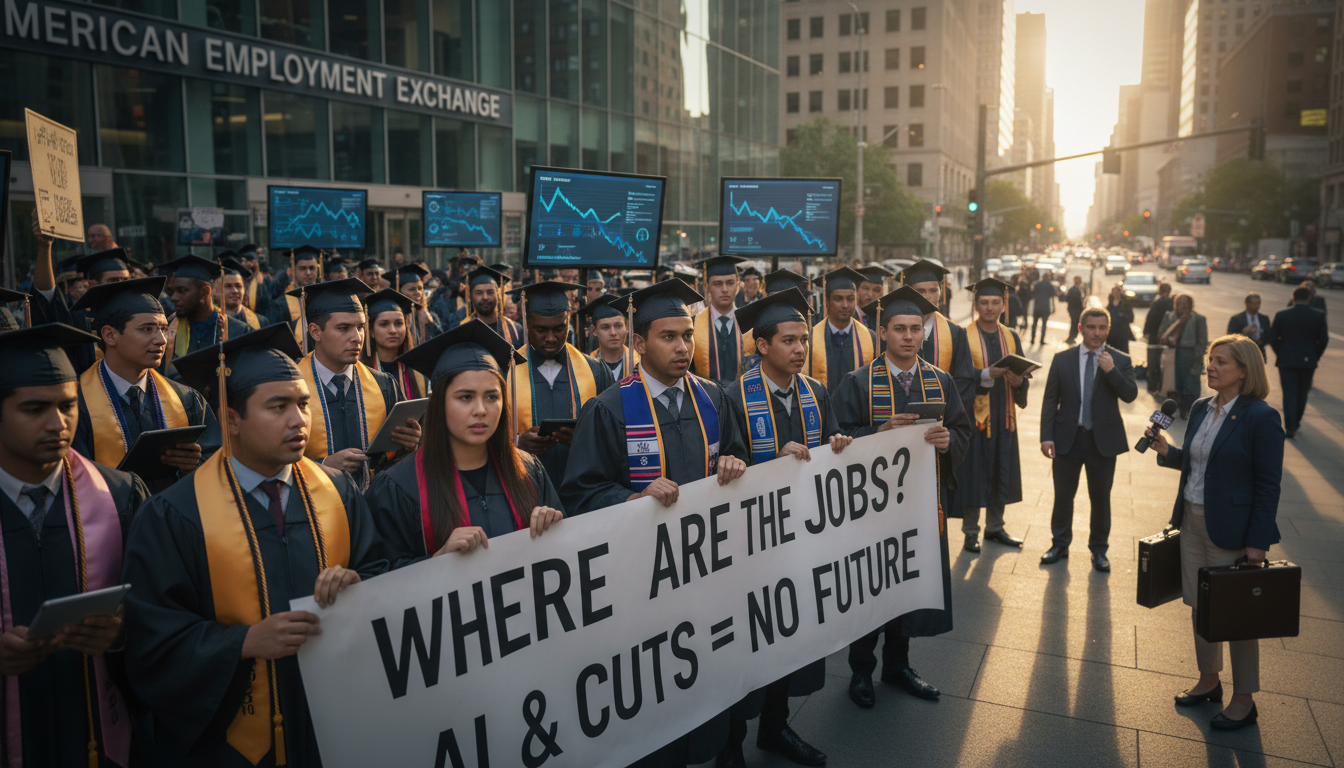
Tough Start for Class of 2026 as Graduate Job Market Tightens Under AI, Funding Cuts and Low Turnover
New graduates face a tightening graduate job market this spring as caps-and-gowns celebrations give way to a harsher employment reality, driven by funding cuts, artificial intelligence and reduced labour churn. Students across fields from public health to media report increasing competition for fewer openings as experienced workers stay put and hiring slows. The shift is reshaping entry-level opportunities and forcing universities, employers and graduates to adapt quickly.
Graduation Day Meets a "No-Hire" Reality
Graduation ceremonies this May, from Washington Square Park to campuses nationwide, have been tempered by a subdued hiring outlook for entry-level roles. For many new degree-holders, the symbolic transition from student life to the workforce is colliding with an economy that has slowed its pace of job creation.
Graduates describe applying to dozens of positions with response rates in the low double digits, while some sectors that once absorbed new entrants—research labs, public agencies and white-collar entry tracks—are showing fewer openings. The result is a cohort competing not just with peers but with mid-career professionals displaced by recent upheavals.
Funding Cuts Squeeze Public-Interest Hiring
Cuts to government and research funding have had an outsized effect on fields that traditionally hire recent graduates, notably public health and research-heavy disciplines. Universities and public institutions have announced hiring freezes and program reductions, shrinking the pool of available positions for newly minted masters and doctorate holders.
The consequence is intensified competition for a narrower set of roles: internships converted into paid jobs, research assistantships consolidated, and public-sector positions that once offered clear entry paths now in flux. Graduates pursuing public service and nonprofit careers report being redirected into a crowded market often dominated by applicants with greater experience.
AI’s Immediate Impact on Entry-Level Roles
Employers are increasingly using automation and AI tools in recruiting and operations, a trend that is reshaping which early-career jobs exist and who fills them. Recruiters and analysts say entry-level roles in customer service, basic tech tasks and routine analytical work are most vulnerable, while demand has risen for workers with proven, specialized experience.
The growing use of AI in hiring—from resume-screening algorithms to automated interviews—has also changed the application landscape, reducing human contact early in the hiring process and raising concerns about opaque filters that can screen out qualified candidates. New graduates report longer application lists and fewer human callbacks, a dynamic that can discourage jobseekers and lengthen their search.
Turnover Decline Raises Competition Across Cohorts
Labour market churn has declined, with fewer workers quitting and more people staying in existing jobs, narrowing openings for outsiders. That trend is exposing a structural problem for new entrants: when incumbents hold positions longer, fewer vacancies occur for entry-level hiring.
At the same time, layoffs in some sectors have pushed more experienced workers back into the market, creating direct competition between recent graduates and candidates with years of on-the-job expertise. Employers who prioritize experience are thus more likely to fill scarce roles with veterans rather than take a chance on junior hires.
Universities Shift Focus to Skills and Networking
Faced with a tighter labour market, university career centres and faculty are adjusting messages to students, emphasizing transferable skills, networking and practical experience over credentials alone. Institutions are encouraging in-person networking, internships that offer real responsibilities, and soft-skill development to help graduates stand out in AI-filtered hiring systems.
College leaders stress that degrees remain valuable but that a degree alone is less likely to land a job without demonstrable applied skills and professional connections. Career offices report greater demand for workshops on interview techniques, digital portfolios and employer engagement strategies to bridge the gap between classroom learning and employer expectations.
Students Navigate a More Competitive Landscape
Graduates describe a job hunt that feels markedly different from prior cohorts: more applications, more automated hurdles and a sense of competing across generations. Some recent degree-holders say they are accepting roles outside their field, pursuing temporary contracts or delaying entry into research careers until funding conditions improve.
Others are doubling down on reskilling, seeking certificates and on-the-job experience that signal immediate value to employers. The combined effect is a more pragmatic approach to career starts, with many graduates prioritizing opportunities that provide growth and stability over titles or prestige.
Despite the immediate strain, workforce experts caution that labour markets are cyclical and that historical episodes of difficult entry have eventually given way to stronger hiring for new graduates. Policymakers, employers and educators will play a central role in determining how quickly and equitably that recovery reaches the newest members of the workforce.
Graduates facing the current squeeze are advised to broaden search parameters, document practical achievements, maintain professional networks and be prepared to pivot into adjacent roles that build experience and open future opportunities.
