
Lethbridge rejects provincial ambulance proposal, keeps integrated fire/EMS as council holds firm
Lethbridge rejects provincial ambulance proposal and keeps its integrated fire/EMS model amid a funding dispute, public pressure and a May 31, 2026 deadline for the city to decide.
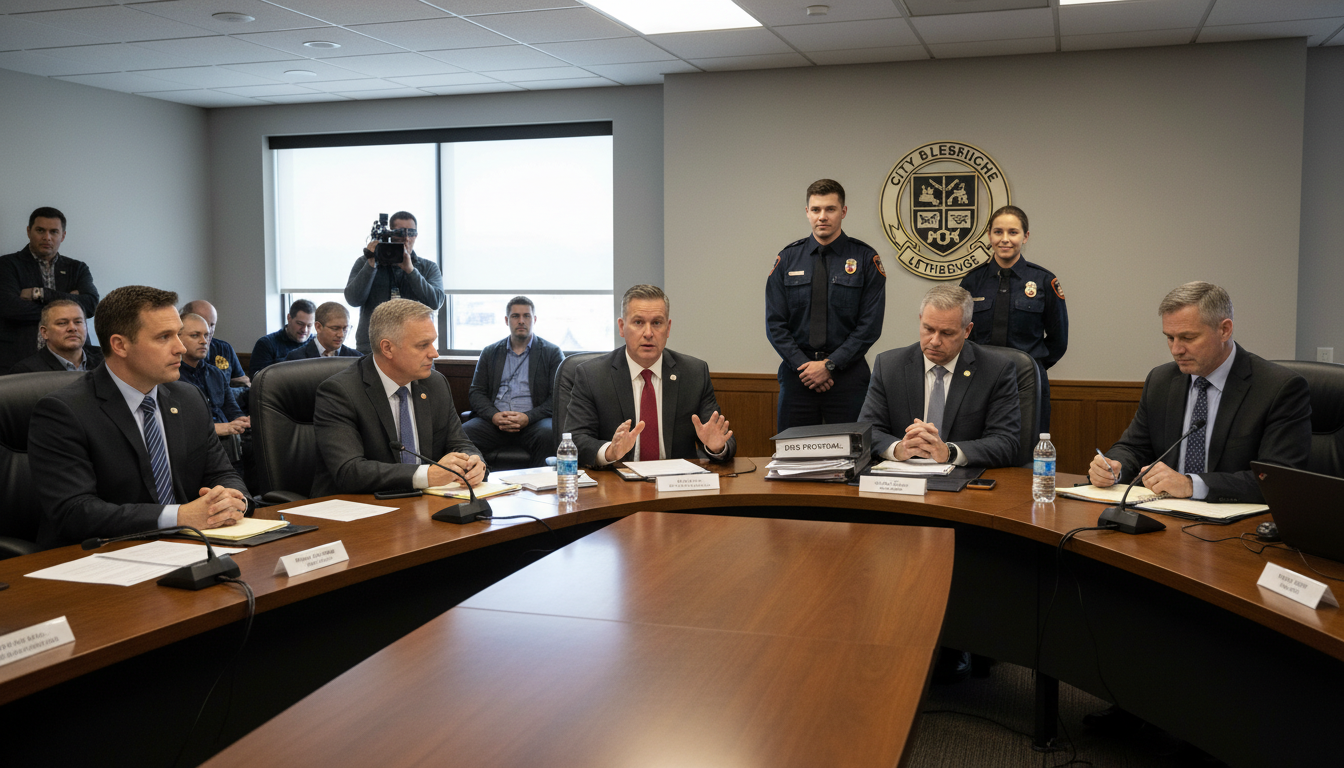
Lethbridge rejects provincial ambulance proposal and will maintain its locally run integrated fire and emergency medical services after city council voted on Tuesday to leave in place a prior unanimous decision rejecting the province’s Ground Ambulance Service Agreement.
The motion to overturn the March 24 decision was defeated 7-2, leaving the city’s official position unchanged and setting a tense countdown toward a provincial deadline.
Mayor Blaine Hyggen and a majority of councillors framed the vote as a defense of a 114-year-old local model and said they intend to seek ways to preserve it without raising taxes.
Council upholds March 24 stance with 7-2 vote
The rescission motion introduced by Councillor and acting mayor Jenn Schmidt-Rempel failed, with seven councillors opposed and two in favour.
By voting against rescinding the earlier action, council reaffirmed the municipality’s rejection of the provincial offer to alter how ground ambulance services are funded and delivered.
Council members said their decision reflects a commitment to a longstanding integrated model rather than an embrace of the specific terms the province presented.
The debate at the council table was narrowly procedural but broadly consequential for the delivery of emergency medical services in Lethbridge.
Councillors who opposed the rescission emphasized that the city should not accept a provincial funding arrangement that would, as presented, require new revenue sources.
Those who supported rescinding warned that leaving the stance unchanged could weaken the city’s bargaining position with the province.
Mayor and council underscore desire to keep integrated fire/EMS
Mayor Blaine Hyggen described the integrated fire and EMS model as a community institution, saying the city intends to retain local control of both services.
Hyggen and several councillors said the integrated approach, in place for more than a century, offers operational benefits they are not willing to abandon without a viable alternative.
At the same time, they made clear the city will not accept solutions that force an immediate tax increase on households.
Council members said they are exploring other revenue options and efficiency measures to preserve the model without shifting the full cost onto taxpayers.
The mayor stated repeatedly that preserving the integrated service is the goal, but he acknowledged the obligation to find funding sources that are sustainable.
Officials cautioned that the city’s position should not be mistaken for certainty about the outcome; negotiations with the province remain possible.
Council chamber tensions and threatening messages escalate debate
The issue has provoked strong public emotion and heated exchanges inside and outside council chambers, with councillors reporting abusive messages from residents.
Deputy mayor Rajko Dodic said he received pressure and messages that crossed a line, including a suggestion that not voting to maintain the integrated model could be akin to criminal culpability.
Dodic later described a moment of regret after he criticized what he characterized as fear-based advocacy by some groups during council recognition statements.
Citizens attending the meeting expressed both support and anger, and some remarks from the public gallery drew audible jeers when councillors pushed back.
Mayor Hyggen and other councillors noted that online commentary has spilled over into personal attacks that have affected family members, and they urged more respectful civic discourse.
Councillors stressed their responsibility to weigh service quality, cost and long-term risk rather than respond to inflammatory rhetoric.
IAFF Local 237 and community groups press to retain integrated system
Local firefighters and paramedics, represented by IAFF Local 237, said they have heard repeatedly from residents who want the integrated system to remain in place.
Union president Brent Nunweiler told council the community understands the value of the combined fire/EMS model and has made that position clear through calls, letters and emails.
Nunweiler also noted that the province’s sudden change in funding terms, announced March 13, 2026, created immediate pressure on local budgets and on council decision-making.
Union and community advocates estimate the cost to maintain the integrated service under the province’s proposal would amount to roughly $10 more per household each month.
That figure has been cited repeatedly in public meetings as a measure of the likely impact on municipal revenues if the city were to accept the provincial terms.
Union leaders argued that many residents view the investment as worthwhile for the continuity and quality of emergency response.
Councillors who back the integrated model say they are listening to those constituent messages while still scrutinizing whether the price and terms are acceptable.
Councillor Jenn Schmidt-Rempel, who voted against keeping the March 24 stance, warned that the city may be “gambling” on the province entering further negotiations.
Supporters of the standing decision said the city must retain leverage to secure a deal that does not undermine municipal fiscal stability.
Province sets May 31, 2026 deadline and outlines RFEOIQ process
EHS-Alberta informed the city that Lethbridge has until May 31, 2026, to enter into a sole-source agreement under the provincial offer.
If the city declines to sign, the province said ground ambulance services would be included in a Request for Expression of Interest and Qualification (RFEOIQ) process, opening the service to bidding.
EHS-Alberta stated its intention to ensure continuity of ground ambulance services throughout any procurement process and invited the city to participate in the RFEOIQ if it chooses.
City officials noted the current local contract for integrated ground ambulance runs through the end of September 2026, a date that frames both operational planning and procurement timelines.
That expiry means any transition to a new provider would need to be managed carefully to avoid service gaps or disruptions.
Provincial officials, through their statement, promised service standards would be maintained, but municipal leaders remain wary of private or external bidders altering local response patterns.
The RFEOIQ pathway would allow other providers to submit qualifications and proposals to deliver ground ambulance services in Lethbridge.
Municipal staff told council the city could still submit a bid to continue operating the service locally if it so chooses.
Council members argued that remaining in control of the integrated system preserves continuity, training synergies and local accountability.
Paths forward: negotiation, bidding or hybrid arrangements
With less than three weeks until the May 31, 2026 deadline, council faces a narrow window to either negotiate a different provincial deal or prepare for a competitive procurement process.
One option is to continue pressing the province for amended terms that protect the integrated model without requiring tax increases, or to secure transitional funding that eases the immediate budget impact.
Another route is for the city to enter the RFEOIQ and seek to win the contract to keep services locally under revised financial terms.
Council members also raised the possibility of hybrid solutions, such as short-term agreements that preserve local operations while longer-term procurement plays out.
Municipal staff are being asked to quantify cost-saving options and to model the fiscal implications of different scenarios before the deadline.
Schmidt-Rempel warned that council’s current stance may have cost the city some negotiating leverage, a point that underscores the political as well as fiscal stakes.
Analysts and local stakeholders said the outcome in Lethbridge could influence other Alberta municipalities weighing whether to accept provincial terms or to retain local integrated services.
Communities such as Red Deer and Strathcona County chose to continue funding their integrated services, while others have taken different paths, signaling a patchwork of municipal responses across the province.
Those divergent choices illustrate the complex fiscal and operational judgments municipalities must make in the face of shifting provincial policy.
Public trust, municipal credibility and political fallout
Some councillors acknowledged that the series of votes and public statements may have strained trust between the electorate and the municipal government.
Schmidt-Rempel expressed concern that residents might view council as having weakened its negotiating position, potentially eroding confidence in elected officials.
Other councillors countered that their primary duty is to safeguard service levels for residents and to avoid immediate tax impacts when alternatives exist.
The town-hall atmosphere and strong community mobilization suggest elected officials will continue to face intense scrutiny in the coming weeks.
Council members said they will hold further public engagement and seek clearer financial options to present a defensible plan to residents.
Officials also urged residents to engage constructively and to focus on solutions that prioritize both quality of service and municipal sustainability.
Lethbridge’s next administrative steps include completing updated cost estimates, exploring potential revenue-neutral options, and communicating how any proposed changes would affect households.
Municipal staff are expected to report back to council with a range of scenarios that can be weighed before any final decision or bid is submitted.
The outcome will be closely watched by unions, residents and neighbouring municipalities monitoring how Alberta’s ambulance funding framework evolves.
The city’s integrated fire and EMS system has long been presented by supporters as delivering coordinated responses and local oversight, while officials negotiating with the province must balance that operational value against budgetary constraints.
As May 31, 2026 approaches, council must decide whether to pursue continued negotiations, enter the RFEOIQ, or prepare a municipal bid to preserve local delivery.
The path chosen will shape emergency medical response and municipal finances in Lethbridge for the months ahead.
The council’s decision to uphold its March 24 stance leaves a clear public record of intent, but significant technical and political choices remain to be made before the provincial deadline and the contract’s September expiry.
Residents, emergency service workers and municipal leaders will now watch closely as Lethbridge seeks a path that maintains high-quality emergency care without undue fiscal burden.
How the province responds and whether the city can secure an acceptable arrangement will determine whether the integrated model endures or gives way to a new procurement-driven provider.
