
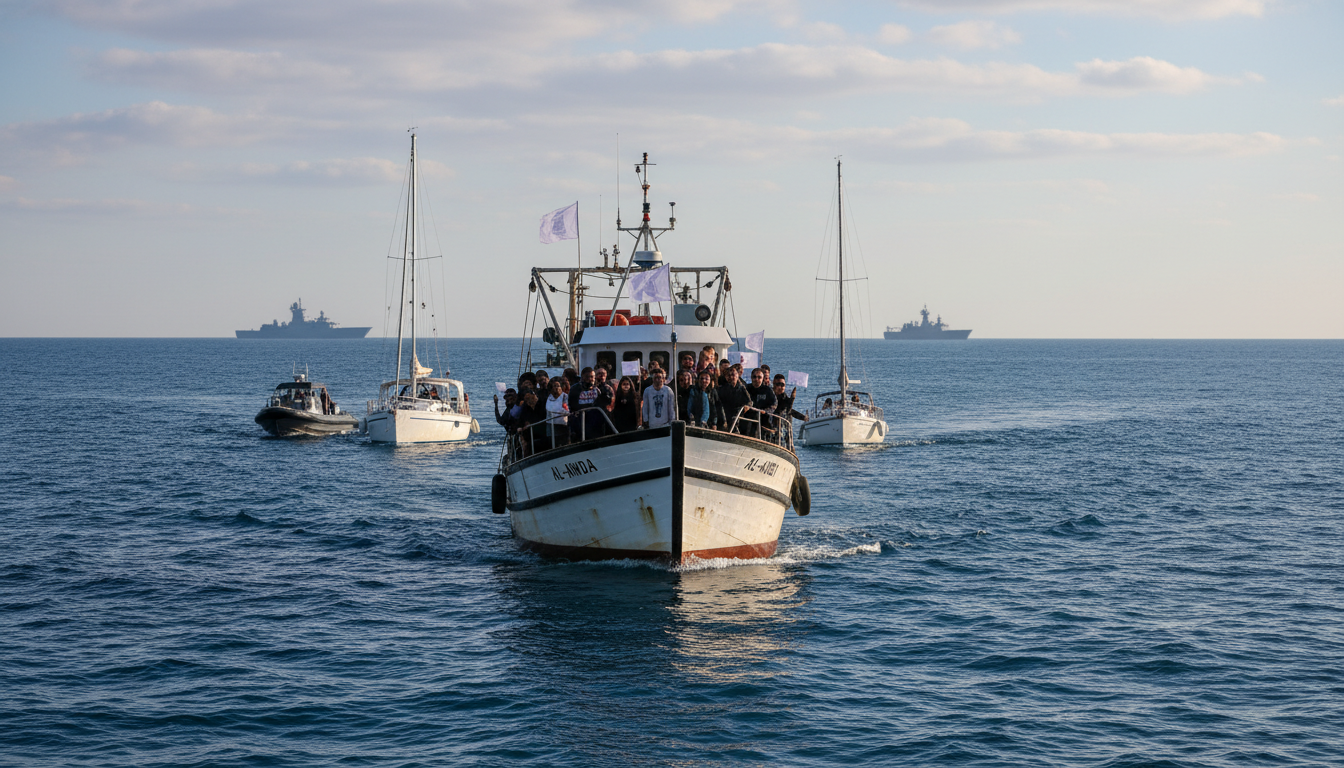
Global Sumud Flotilla Intercepted 600 Nautical Miles Offshore, Activists Say
Global Sumud Flotilla intercepted 600 nautical miles offshore; activists report injuries and abuse as fleet heads to Marmaris amid legal and diplomatic scrutiny.
The Global Sumud Flotilla says several of its vessels were violently intercepted in international waters roughly 600 nautical miles from Israel’s coast, leaving dozens injured and prompting renewed questions about maritime jurisdiction and state conduct at sea. Organizers say the fleet is regrouping in Marmaris, Turkey, and will press on with efforts to deliver humanitarian aid to Gaza. The incident has raised immediate legal and diplomatic concerns among the flotilla’s participants and observers tracking the mission.
Details of the Interception
Participants say the attacks occurred days before the full flotilla could assemble, with at least 22 vessels reportedly targeted while transiting international waters. Activists on board described being met by a foreign naval force that, they say, boarded and disabled several boats at sea.
Organizers estimate the operation took place about 600 nautical miles — roughly 1,100 kilometres — from the intercepting state’s territorial coast, a distance activists argue is far beyond commonly accepted maritime enforcement zones. The scope of the operation has fuelled debate about where and how naval powers may lawfully act against civilian vessels.
Injuries, Allegations of Sexual Assault and Detentions
Those involved in the mission say at least 30 people were wounded during the confrontations, with several activists requiring medical attention for injuries sustained during boarding operations. Four individuals have come forward with allegations of sexual assault, according to participants.
Two activists identified by the flotilla — Saif Abu Keshek and Thiago Ávila — were reportedly taken into custody and transported to Israel, where they faced terrorism-related charges, participants say. Both men later announced hunger strikes while in detention; activists claim they were beaten and mistreated while held, allegations that have intensified calls for independent investigation.
Questions Over Maritime Law and Responsibility
The interception has prompted activists and legal experts to ask whether coastal and regional authorities fulfilled their obligations under international maritime law, including search-and-rescue responsibilities. Critics argue that neighbouring coastguards and port authorities should have acted to prevent or mitigate the incident, particularly where distress signals were reported.
One specific point of contention is whether a naval vessel tied to the operation should have been allowed to depart from a Greek port after reports emerged alleging detainee mistreatment. Observers say those developments test the limits of jurisdiction and the duties of states when foreign military forces operate within or near their maritime zones.
Aegean Disputes Complicate Accountability
The flotilla’s decision to regroup in Marmaris places the vessels in the eastern Aegean, a region long marked by overlapping Greek and Turkish claims to airspace, territorial waters and search-and-rescue zones. That dispute has historically complicated coordinated responses to incidents at sea.
Legal scholars and diplomats note that the murky boundaries in the Aegean make it difficult to determine which state would be responsible for intervening when a foreign navy acts in contested waters. The ambiguity, they say, can be exploited to evade accountability and stretches established norms for maritime conduct.
Organizers Pledge to Continue and Cite Political Impact
Despite the violence, flotilla leaders say the mission will continue after regrouping in Marmaris, framing the voyage as an act of solidarity with Palestinians and a challenge to what they call extraterritorial enforcement. Organizers point to previous flotilla actions that, they argue, helped generate international pressure and debate over access to Gaza.
Activists contend that repeated interceptions, increasingly distant from Palestinian shores, amount to an expansion of extraterritorial control over the seas and mirror policies on land that they say have constrained Palestinian territory. They are urging allies, legal advocates and governments to scrutinize the incidents and call for independent inquiries.
The episode has also drawn attention from human rights groups and maritime law experts, who say the allegations of abuse and the scale of the interception merit prompt, impartial investigation.
The flotilla’s participants face a complex legal and diplomatic path forward as they regroup and maintain their stated objective of reaching Gaza, even as governments and international bodies weigh responses to the reported incident.
