
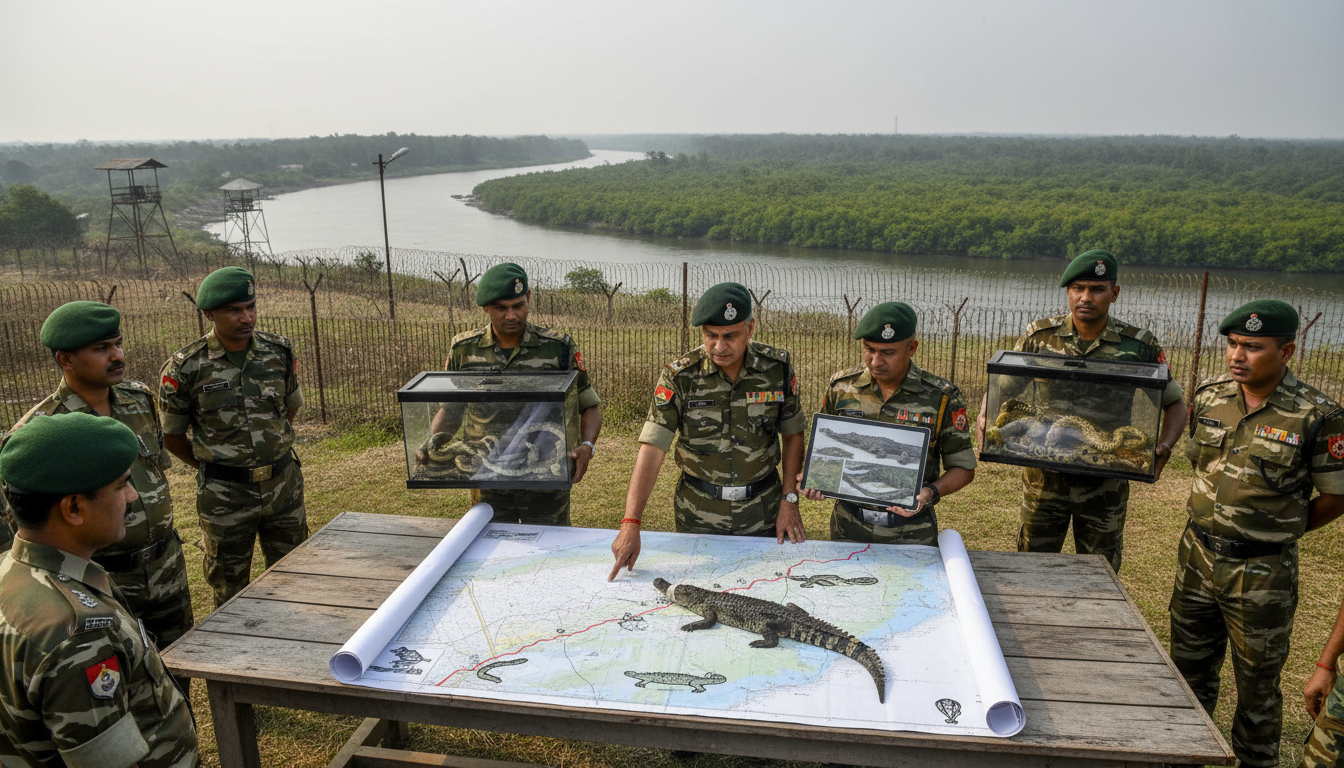
India’s border force considers deploying crocodiles and venomous snakes along Bangladesh frontier
India’s BSF considered deploying crocodiles and venomous snakes in river gaps along the Bangladesh border, sparking human-rights and conservation alarm.
Indian officials have floated a proposal to use crocodiles and venomous snakes as natural deterrents along unfenced riverine stretches of the India–Bangladesh border, according to an internal Border Security Force (BSF) communication. The idea, directed to frontier units to “explore feasibility,” has prompted immediate concern from human-rights groups, legal experts and wildlife conservationists. The proposal comes as New Delhi continues work to fence much of the 4,096-kilometre frontier but struggles with marshes, islands and fast-flowing rivers that make physical barriers impractical.
Border gaps prompt unconventional proposal
The India–Bangladesh boundary traverses diverse and often inhospitable terrain across West Bengal, Assam, Tripura, Meghalaya and Mizoram. New Delhi has completed fencing on large portions of the line, but stretches that are low-lying, flood-prone or crossed by navigable rivers remain resistant to conventional border infrastructure. Local populations live on both sides of many riverine segments, complicating any attempt to install permanent barriers without displacement or land-acquisition disputes.
Officials say the riverine gaps have long presented an enforcement challenge, with smugglers and undocumented crossers exploiting waterways where patrols and physical fences are ineffective. The BSF’s internal note, dated March 26, instructed eastern and northeastern units to examine whether reptiles could be used to deter crossings in those particular gaps. The communication reportedly also sought follow-up reports on actions taken after the instruction.
BSF directive and official rationale
Government documents and public statements on border work emphasize the priority of preventing illegal cross-border movement and curbing contraband networks. The Home Ministry has acknowledged that specific problem areas — including riverine stretches, habitations close to the frontier and pending land-acquisition cases — have slowed fencing efforts and complicated border management. The BSF cast the exploration as a technical response to the persistent problem of unsecured waterways where conventional fences cannot be built.
That rationale, however, has not satisfied critics who note that security responses must weigh legality, humanitarian obligations and ecological safety. Officials have not provided details on what species, sourcing, containment or monitoring would look like, nor on whether environmental impact assessments or community consultations would be conducted before any pilot measures.
Human rights and communal concerns
Human-rights advocates say the proposal risks dehumanizing people who migrate or who are displaced, and could amount to a form of state-sanctioned violence. Observers also warn the policy could be applied selectively, with minority communities — particularly Bengali-speaking Muslims in border states — bearing the brunt of enforcement. Activists point to previous cases where individuals were labelled “foreigners” after administrative proceedings in states such as Assam and were vulnerable to expulsion or detention without robust judicial safeguards.
Legal scholars stress that any measure that places civilians at heightened risk must be judged against constitutional protections and India’s obligations under international human-rights law. They argue that effective border management requires bilateral diplomacy with Dhaka, transparent legal processes for determining citizenship, and humane enforcement mechanisms — not measures that could cause indiscriminate harm.
Ecological and safety risks
Wildlife experts caution that moving predators outside their natural range would likely fail on biological grounds and could create severe ecological disruption. Crocodile species occur in parts of India such as the Sundarbans and some Assam wetlands, but those habitats differ markedly from the river stretches under discussion. Introducing animals into unfamiliar channels or fluctuating floodplains could lead to high mortality among the animals themselves and destabilize local food webs.
Flood cycles and seasonal shifts in river courses raise the prospect that venomous snakes or displaced crocodiles could spread into villages, harming fishermen, farmers and children. Conservation biologists emphasise that species translocation carries risks of disease transmission, genetic disturbance and unintended attacks on non-target species — and that predators do not distinguish between nationalities or legal status when they bite or kill.
No modern precedent and international echoes
There is no recent, credible international precedent for using wild predators as an instrument of border policy. Past reported suggestions in other countries — often dismissed as rhetorical extremes — have drawn sharp criticism from rights groups and ecologists. Comparisons have also been made to controversial detention centres located in remote wetlands, where terrain rather than designed security infrastructure has been held up by some as a deterrent; such facilities have attracted scrutiny for humanitarian and environmental harms.
Human-rights organizations and wildlife NGOs have called for immediate transparency: they are urging authorities to publish any internal directives, to halt moves that would endanger people or animals, and to pursue alternatives backed by environmental assessments and legal oversight. Observers say bilateral engagement with Bangladesh and investment in non-lethal surveillance and community-based border management would be more lawful and sustainable approaches.
The BSF’s instruction to study the idea does not mean the government will implement it, and officials have given no timetable for any decision. Rights groups, conservationists and legal experts say the episode exposes deeper policy tensions over migration, security and minority protections, and they are pressing for public disclosure, independent review and a clear commitment to measures that uphold safety, the rule of law and ecological integrity.
