
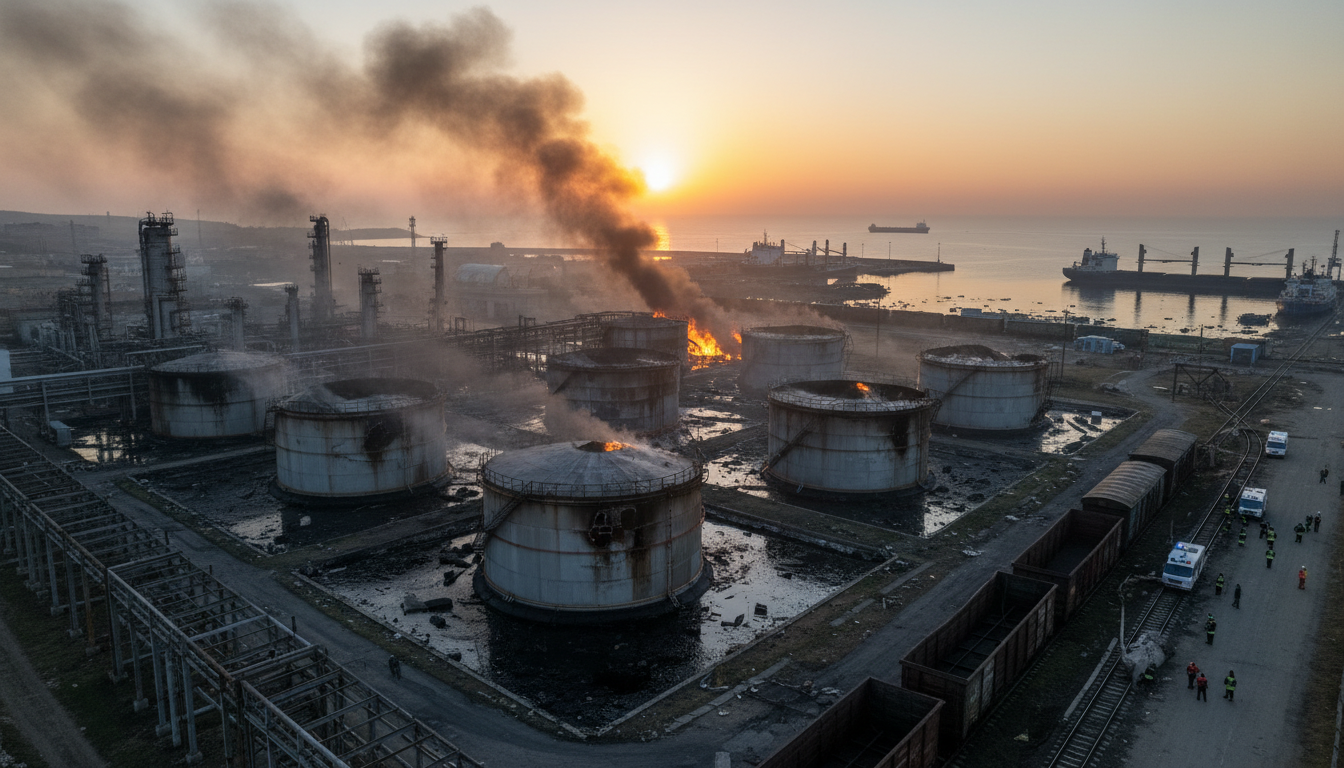
Ukraine strikes Russian oil exports, cutting transits and hitting revenue amid refinery attacks
Ukraine’s intensified long-range campaign against Russian oil infrastructure has sharply reduced Russian transhipments and revenues, with Kyiv saying the strikes deprived Moscow of billions during March and April. The Ukraine strikes on Russian oil exports campaign, begun in earnest on March 21, targeted ports, loading berths and refineries to prevent crude and refined product shipments even as the US briefly waived sanctions to ease global prices.
Long-range strikes curb Russian oil revenue
Ukraine’s leadership says long-range strikes have substantially dented Moscow’s oil income, with President Volodymyr Zelenskyy asserting March revenue losses alone reached at least $2.3 billion. Kyiv’s foreign intelligence service cited industry data showing March transhipments fell by hundreds of thousands of barrels per day, a decline that Ukraine says continued into April.
The campaign was timed to counter a temporary US waiver on sanctions and to stop Russia from loading tankers as oil surged above $100 a barrel following disruption in the Gulf. Ukrainian officials have framed the strikes as both an economic and military measure aimed at denying Russia the ability to monetize its crude.
Drops in exports force production adjustments
Industry observers and Russian business outlets reported sharp falls in exports that, in some assessments, reached their weakest levels since mid-2024. Sources consulted by international news agencies estimated April crude output was trimmed by roughly 300,000 to 400,000 barrels per day as logistical pathways and loading operations were disrupted.
Swedish military intelligence officials warned that Russia would need sustained high oil prices to plug a wartime budget gap, underscoring how the strikes complicate Moscow’s fiscal position. Meanwhile, Moscow’s export routes have faced renewed bottlenecks despite attempts by some buyers to resume flows under short-term waivers.
Attacks on refineries and ports escalate
Since mid-April, Ukraine has reported strikes on multiple refinery complexes and port facilities deep inside Russian-held territory, including hits on the Black Sea port of Tuapse and refineries in Samara, Gorky and Sizran. Videos and open-source imagery widely circulated after the strikes showed large fires, plumes of smoke and reports of black rain in affected cities.
Ukrainian authorities said several facilities were forced to suspend loading or refining operations because shipping refined products became impractical or unsafe. Ukrainian statements also named the targeting of a drone components producer, in what Kyiv described as efforts to degrade Russia’s drone production and logistics networks.
Regional authorities mobilize to defend industrial hubs
Local Russian officials in Leningrad and other regions acknowledged the scale of the strikes and signalled new defensive measures. The governor of Leningrad region described St. Petersburg and nearby industrial zones as effectively front-line areas and announced plans to recruit reservists and form mobile fire-fighting and air-defence teams to protect critical infrastructure.
Those regional moves reflect growing concern among Russian authorities about the vulnerability of export and refining nodes far from the front lines, and indicate an operational shift toward protecting maritime and coastal facilities from aerial and maritime threats.
Ukraine advances drone and air-defence systems
Kyiv has coupled offensive strikes with new air-defence tactics and technologies, including improvised mobile fire groups mounting heavy weapons on light vehicles and novel interceptor systems. The Unmanned Systems Forces reported that a Sting interceptor drone, launched from an unmanned surface vehicle, successfully downed a jet‑powered Shahed-type loitering munition in trials.
Defence Minister Mykhailo Fedorov said private-sector air-defence units are being integrated with military command and control, with about 19 companies already linked into a broader architecture. Kyiv has also announced longer-term cooperation deals on defence technology with several Gulf states, signalling demand abroad for Ukrainian systems and expertise.
EU financial package and sanctions tightening
Europe moved to shore up Kyiv’s finances and close energy loopholes for Moscow after months of diplomatic wrangling, approving a €90‑billion loan package two-thirds of which is earmarked for defence assistance. EU foreign policy officials also unveiled a new round of sanctions designed to make it harder for Russia to sell oil and refined products on global markets.
The loan release followed a temporary political impasse in the bloc that delayed payments; Ukrainian officials said the fresh funding arrives as Kyiv faces urgent budgetary needs. Brussels’ measures aim to combine fiscal support for Ukraine with further pressure on Russian export channels targeted by Kyiv’s strikes.
Russia’s military and political posture has shown strains beyond energy. Open-source analysts dispute some Russian claims about territorial gains, and a state pollster reported a modest decline in presidential approval ratings in recent weeks. Those indicators suggest the strikes on oil infrastructure are one element in a broader pressure campaign affecting Moscow’s economy, military logistics and domestic politics.
Russia faces a precarious choice as the conflict continues: reopen and secure export routes to restore revenue, or accept an extended period of constrained oil income while attempting to mitigate fiscal shortfalls. The coming weeks will test whether Kyiv’s strategy of striking export choke points can be sustained and whether international financial measures and defence cooperation will reshape the balance of economic pressure on Moscow.
