
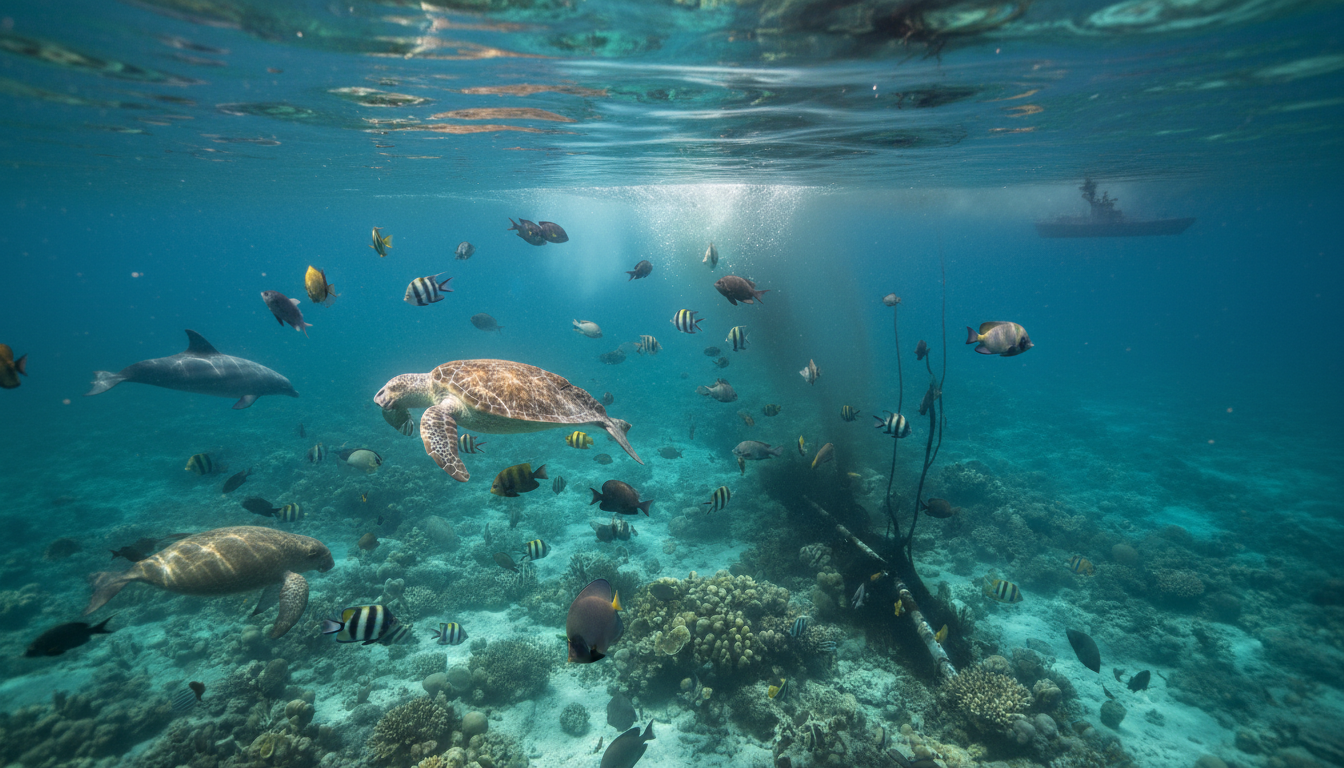
Persian Gulf marine life faces noise, spill and habitat risks after U.S.-Israeli strikes
Persian Gulf marine life faces rising underwater noise, sonar disruption and oil-spill danger after U.S.-Israeli strikes beginning February 28, 2026, scientists warn.
Opening summary
The conflict that began on February 28, 2026, with U.S.- and Israeli-led strikes has introduced new threats to the Persian Gulf marine life, researchers and conservationists say. Naval operations have increased low- and mid-frequency sound in the semi-enclosed sea, while thousands of commercial tankers waiting near the Strait of Hormuz raise the risk of a large oil spill. Scientists warn that the combination of acoustic disturbance and potential oil contamination could harm cetaceans, dugongs, coral communities and coastal fisheries across the region.
Naval sonars and underwater noise
Military sonar and increased ship traffic have sharply raised ambient noise levels in the Gulf, according to marine bioacoustics specialists working in the region. Low- and mid-frequency pulses used to detect mines and submarines can mask the calls and echolocation clicks that dolphins and other toothed whales rely on for navigation, feeding and social behaviour.
Researchers who study animal soundscapes say such noise can force animals to abandon feeding or breeding areas, and it can produce chronic stress when escape is impossible. Field teams are currently limited from conducting in‑sea surveys because of security constraints, making direct measurement of population impacts difficult at this stage.
Dugongs, dolphins and heat‑tolerant coral concentrations
The shallow waters along Abu Dhabi and Dubai coasts host internationally significant populations of marine mammals and heat‑resilient coral communities. The Gulf supports one of the world’s largest remaining dugong populations—estimated in the low thousands—and seasonal gatherings of humpback dolphins, porpoises and visiting humpback whales.
Biologists note the area’s corals are among the few worldwide that tolerate very high summer temperatures, making the region a critical natural laboratory for understanding climate resilience. Disruption of feeding grounds, nursery areas and seagrass meadows that dugongs depend on would therefore carry outsized conservation and scientific consequences.
Tanker congestion and the threat of a large spill
Tanker traffic has backed up near the Strait of Hormuz since the escalation of hostilities, leaving many vessels idle in the Gulf and elevating the risk of a major discharge. Analysts and scientists point to the concentration of oil cargo and recent attacks on shipping as factors that could transform localized damage into a large-scale pollution event.
A major spill would predominantly affect surface and nearshore habitats, including mangrove stands and key nesting beaches for endangered sea turtles. Such contamination would also imperil shorebirds, coastal fisheries and the livelihoods of communities that rely on marine resources.
Satellite analysis and documented environmental incidents
A London‑based conflict‑environment monitor has used satellite imagery and open-source reporting to catalogue nearly 300 environmental incidents linked to the campaign so far. One early case, recorded on March 5 during the operation known as Epic Fury, involved a struck Iranian vessel that produced a fuel slick close to a protected marine area.
Investigators caution their tally is almost certainly an undercount because internet restrictions and limited satellite access constrain verification. Officials and researchers say priority must be placed on identifying wreck sites, mapping fuel releases and assessing ongoing leaks to target cleanup and mitigation.
Implications for coastal communities and desalination plants
The coastal economies and public utilities of Gulf states are also vulnerable to the conflict’s environmental side effects. In the United Arab Emirates, for example, large‑scale desalination provides the majority of municipal freshwater, and contamination events could disrupt production or increase treatment costs.
Fishing communities would face immediate losses from reefs and seagrass damage, and the longer recovery of shallow Gulf waters—known for slow exchange with the open ocean—could extend ecological and economic impacts for years. Experts underline that people as well as wildlife depend on a healthy Gulf for food, water and coastal protection.
Scientists and conservation groups are urging governments and naval actors to adopt risk‑reduction measures, including careful routing of military exercises and greater transparency about spills and wrecks. They also call for increased international monitoring capacity so satellite and acoustic data can be shared quickly with environmental responders.
Long‑term recovery in the shallow, warm waters of the Persian Gulf is likely to be slow if habitat integrity is compromised, researchers say, and the lessons of previous conflicts—when deliberate and accidental oil releases produced multi‑year damage—remain relevant today. Continued monitoring, rapid incident reporting and coordinated mitigation will be essential to limit harm to marine species, coastal ecosystems and the human communities that rely on them.
