
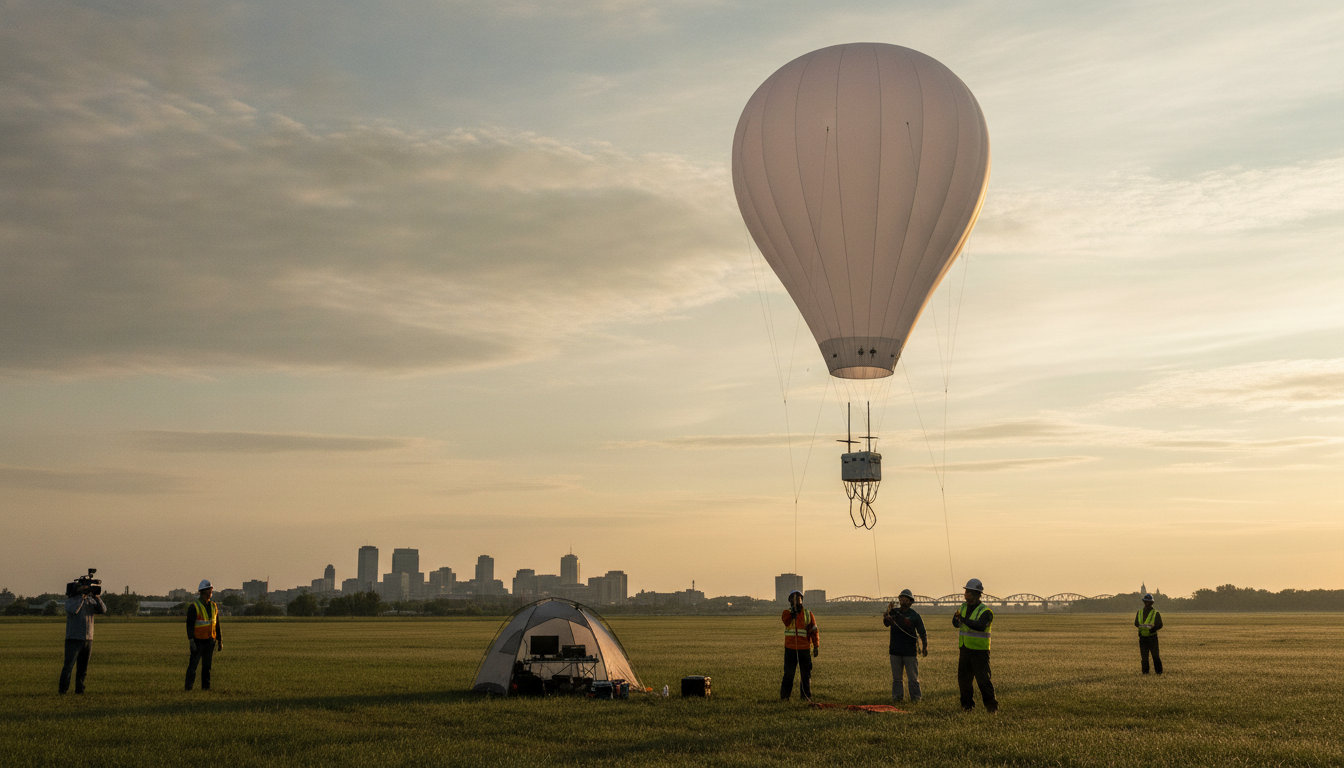
Saskatoon weather balloons launched daily to sharpen storm and tornado forecasts across the Prairies
Saskatoon launches daily weather balloons to collect upper‑air data that will improve storm and tornado forecasts across Saskatchewan and Manitoba this summer.
A temporary Environment and Climate Change Canada station in Saskatoon is launching weather balloons every day through mid‑September, officials said, in an effort to improve forecasting of severe storms and tornadoes in the Prairie provinces. The Saskatoon weather balloons carry radiosondes that transmit precise measurements of temperature, humidity, pressure and wind as they climb through the atmosphere. The daily program is intended to fill observational gaps that meteorologists say have hampered accurate short‑term warnings this season.
Temporary launch station established in Saskatoon
Environment and Climate Change Canada established a temporary upper‑air station in Saskatoon to support a concentrated radiosonde program running into mid‑September. Technologists at the site inflate natural‑latex balloons with helium and attach radiosondes equipped with GPS and barometric sensors before daily launches.
The agency said the station will provide a steady stream of timed observations that can be integrated into forecast models and operational decision making for the region. Officials have not ruled out establishing a permanent station in Saskatchewan if the program demonstrates sustained value.
Daily radiosonde launches and the instrumentation used
Each balloon is required to lift a payload of at least 300 grams, carrying a radiosonde that relays its position and atmospheric data in real time. The radiosondes report the balloon’s location to the second, along with temperature, relative humidity, pressure and wind speed and direction.
Ground antennas at the Saskatoon site collect the transmissions and pass the data to meteorologists for analysis and ingestion into numerical weather prediction systems. The high‑resolution vertical profiles captured by these launches reveal atmospheric features that satellites and surface networks cannot always resolve.
University project notes increased tornado activity in the Prairies
Researchers with the Northern Tornadoes Project at Western University in Ontario have documented a rise in tornado occurrences across the Prairies this year, reporting 44 tornadoes in Saskatchewan and Manitoba compared with 29 in 2025. The trend has prompted closer collaboration between research groups and federal forecasters to better understand evolving severe‑weather patterns.
Those counts underscore the urgency cited by forecasters for denser upper‑air observations, particularly during the high‑hazard months when rapid storm development and tornadogenesis can occur. The radiosonde data from Saskatoon are expected to complement ground surveys and radar analyses used by investigators and researchers.
Meteorologists say upper‑air data improves warnings and forecasts
Alysa Pederson, a meteorologist responsible for warning preparedness at Environment and Climate Change Canada, said the radiosonde measurements help identify upper‑level jets and smaller‑scale atmospheric structures that are difficult to detect from satellites. Those features often play a decisive role in whether a thunderstorm intensifies and organizes into a severe system.
Pederson added that the data can alter or confirm the timing and extent of severe‑thunderstorm warnings, giving forecasters greater confidence when issuing watches and alerts. The information may narrow warning windows and improve lead times, which are critical for public safety and emergency response.
Storm chasers and forecasters report gaps in precision without sondes
Local storm chasers and weather observers have pointed to this summer’s volatile conditions as evidence that additional upper‑air sampling is needed across the region. Ryan Crouse, an active storm chaser, described a season of notable instability and said the lack of frequent radiosonde launches limited the precision of some forecasts.
Advocates for expanded upper‑air networks argue that targeted, high‑frequency launches during peak storm periods can reveal atmospheric layers and wind shear profiles that influence tornadogenesis. That information is particularly valuable across the Prairies, where storm modes can shift rapidly over short distances.
Potential for a permanent upper‑air presence in Saskatchewan
While the Saskatoon installation is designated temporary, federal officials acknowledged the possibility of a permanent station in Saskatchewan if the program proves effective. Permanent stations require sustained logistical support, staffing and equipment, as well as demonstrable benefits to forecasting and public safety.
Decision makers will weigh the operational advantages of continuous upper‑air data against budgetary and resource considerations, and results from the Saskatoon deployment will inform any future planning. Researchers and local stakeholders said they will monitor the program’s outcomes closely.
Daily radiosonde launches from Saskatoon are expected to continue through mid‑September, feeding near‑real‑time observations into forecast models and helping forecasters refine warnings for severe storms and tornadoes across Saskatchewan and Manitoba.
